Physical Therapy Program, Department of Physical Medicine and Rehabilitation, University of Colorado Anschutz Medical Campus, USA.
Am J Phys Med Rehabil. 2012 Mar;91(3):220-6; quiz 227-30. doi: 10.1097/PHM.0b013e3182411e49.
This study aimed to examine functional mobility and strength loss in the ankle plantarflexors and dorsiflexors and knee extensors and flexors after total knee arthroplasty.
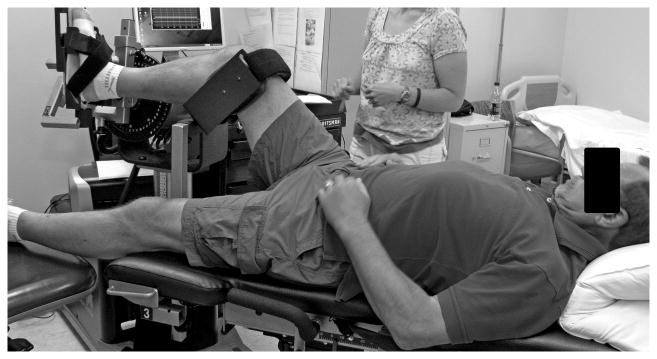
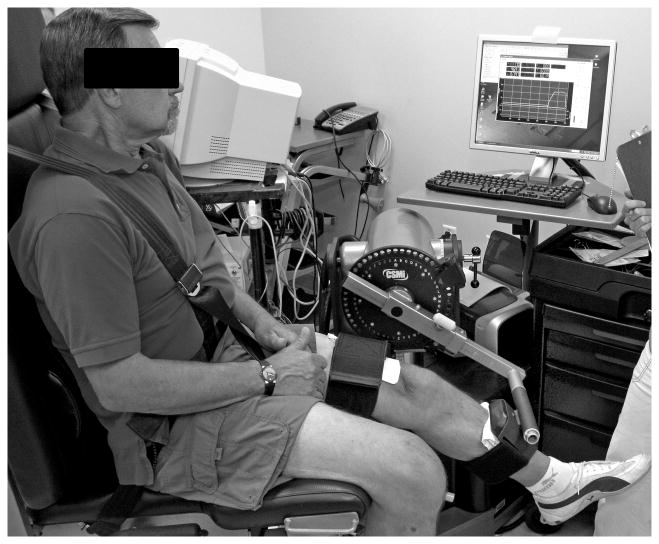
This was a prospective, longitudinal cohort study. Maximal voluntary isometric contractions and gait speed assessments were performed before and after total knee arthroplasty.
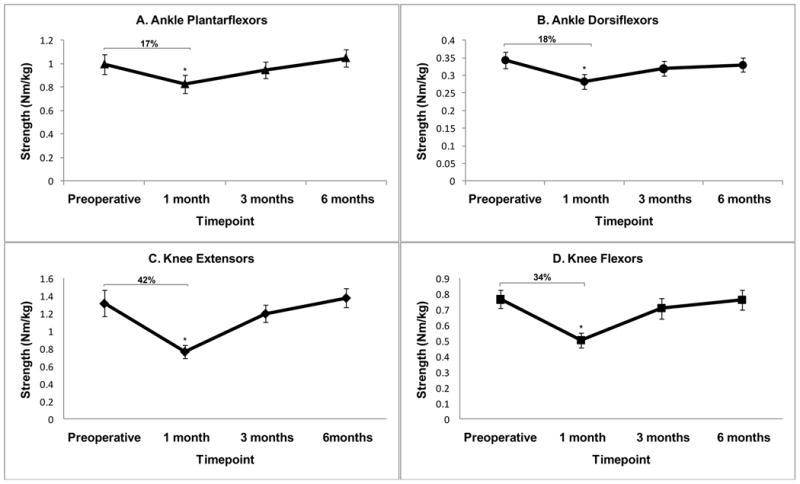
Twenty patients undergoing primary total knee arthroplasty were followed. Repeated-measures analysis of variance results indicated an effect of time on muscle strength, with all muscle groups being significantly weaker (knee extensors, P < 0.001; knee flexors, P < 0.001, ankle plantarflexors, P = 0.004; ankle dorsiflexors, P < 0.001) 1 mo postoperatively. Knee extensors were 42% weaker than preoperative levels, and knee flexors were 34% weaker, whereas the ankle plantarflexors were 17% weaker, and the dorsiflexors were 18% weaker. Three and 6 mos after surgery, strength in all muscle groups was similar to preoperative levels (P > 0.05 for all muscle groups). Patient function followed a similar trend, with patients walking slower 1 mo postoperatively (P < 0.001) and recovering to preoperative levels by 3 and 6 mos after surgery (P > 0.05).
Patients may benefit from early postoperative rehabilitation, including strengthening of the plantarflexors and dorsiflexors, although strengthening of the quadriceps and hamstrings muscles should continue to be a priority.
本研究旨在探讨全膝关节置换术后踝关节跖屈肌和背屈肌以及膝关节伸肌和屈肌的功能移动性和力量损失。
这是一项前瞻性、纵向队列研究。在全膝关节置换术前和术后进行最大自主等长收缩和步态速度评估。
对 20 名接受初次全膝关节置换术的患者进行了随访。重复测量方差分析结果表明,时间对肌肉力量有影响,所有肌肉群均明显减弱(膝关节伸肌,P<0.001;膝关节屈肌,P<0.001,踝关节跖屈肌,P=0.004;踝关节背屈肌,P<0.001),术后 1 个月。膝关节伸肌比术前水平弱 42%,膝关节屈肌弱 34%,而踝关节跖屈肌弱 17%,背屈肌弱 18%。术后 3 个月和 6 个月,所有肌肉群的力量均接近术前水平(所有肌肉群的 P 值均>0.05)。患者的功能也呈现出类似的趋势,术后 1 个月患者行走速度较慢(P<0.001),术后 3 个月和 6 个月恢复到术前水平(P>0.05)。
患者可能受益于术后早期康复,包括加强跖屈肌和背屈肌的锻炼,尽管继续加强股四头肌和腘绳肌的锻炼仍然是首要任务。