Choi Min Suk, Park Joon Suk, Kim Hong Kwan, Choi Yong Soo, Kim Jhingook, Shim Young Mog, Kim Kwhanmien
Department of Thoracic and Cardiovascular Surgery, Samsung Medical Center, Sungkyunkwan University School of Medicine, Korea.
Korean J Thorac Cardiovasc Surg. 2011 Apr;44(2):169-77. doi: 10.5090/kjtcs.2011.44.2.169. Epub 2011 Apr 14.
Video-assisted thoracic surgery (VATS) lobectomy has been performed with increasing frequency over the last decade. However, there is still controversy as to its indications, safety, and feasibility. Especially regarding lung cancer surgery, it is not certain whether it can reduce local recurrences and improve overall survival.
We retrospectively reviewed 1,067 cases of VATS lobectomy performed between 2003 and 2009, including the indications, postoperative morbidity, mortality, recurrence, and survival rate.
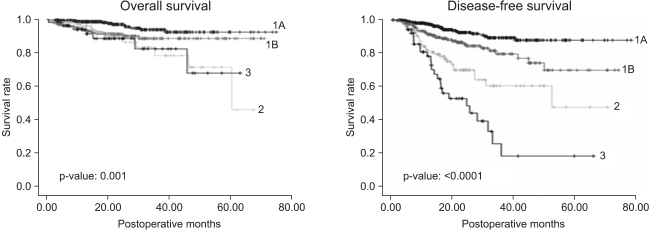
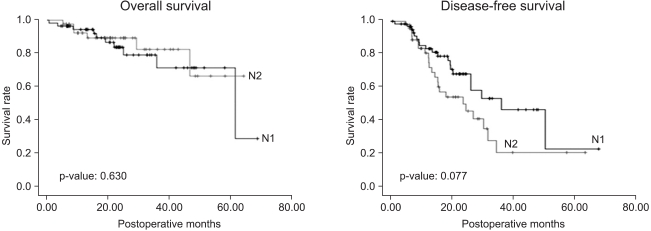
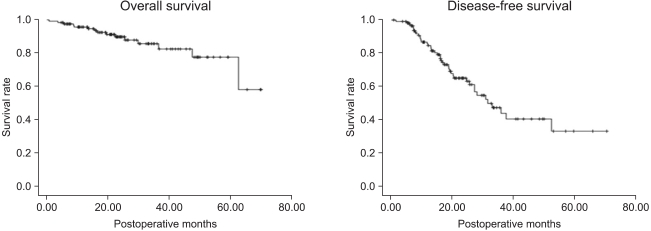
ONE THOUSAND AND SIXTY SEVEN PATIENTS UNDERWENT VATS LOBECTOMY FOR THE FOLLOWING INDICATIONS: non-small cell lung cancer (NSCLC) (n=832), carcinoid tumors (n=12), metastatic lung cancer (n=48), and benign or other diseases (n=175). There were 63 cases (5.9%) of conversion to open thoracotomy during VATS lobectomy. One hundred thirty one (15.7%) of the 832 NSCLC patients experienced pathologic upstaging postoperatively. The hospital mortality rate was 0.84% (9 patients), and all of them died of acute respiratory distress syndrome. One hundred forty-nine patients (14.0%) experienced postoperative complications. The median follow-up was 22.9 months for patients with NSCLC. During follow-up, 120 patients had a recurrence and 55 patients died. For patients with pathologic stage I, the overall survival rate and disease-free survival rate at 3 years was 92.2±1.5% and 86.2±1.9%, respectively. For patients with pathologic stage II disease, the overall survival rate and disease-free survival rate at 3 years was 79.2±6.5% and 61.9±6.6%, respectively.
Our results suggest that VATS lobectomy is a technically feasible and safe operation, which can be applied to various lung diseases. In patients with early-stage lung cancer, excellent survival can be also achieved.
在过去十年中,电视辅助胸腔镜手术(VATS)肺叶切除术的开展频率日益增加。然而,关于其适应症、安全性和可行性仍存在争议。特别是在肺癌手术方面,不确定它是否能减少局部复发并提高总体生存率。
我们回顾性分析了2003年至2009年间进行的1067例VATS肺叶切除术病例,包括适应症、术后发病率、死亡率、复发率和生存率。
1067例患者因以下适应症接受了VATS肺叶切除术:非小细胞肺癌(NSCLC)(n = 832)、类癌肿瘤(n = 12)、转移性肺癌(n = 48)以及良性或其他疾病(n = 175)。在VATS肺叶切除术中,有63例(5.9%)转为开胸手术。832例NSCLC患者中有131例(15.7%)术后病理分期上调。医院死亡率为0.84%(9例患者),且均死于急性呼吸窘迫综合征。149例患者(14.0%)出现术后并发症。NSCLC患者的中位随访时间为22.9个月。随访期间,120例患者复发,55例患者死亡。对于病理分期为I期的患者,3年总生存率和无病生存率分别为92.2±1.5%和86.2±1.9%。对于病理分期为II期的患者,3年总生存率和无病生存率分别为79.2±6.5%和61.9±6.6%。
我们的结果表明,VATS肺叶切除术是一种技术上可行且安全的手术,可应用于各种肺部疾病。对于早期肺癌患者,也可实现良好的生存率。