Lee Deok Heon, Park Chang-Kwon, Kum Dong-Yoon, Kim Jae-Bum, Hwang Ilseon
Department of Thoracic and Cardiovascular Surgery, College of Medicine, Keimyung University, Korea.
Korean J Thorac Cardiovasc Surg. 2011 Aug;44(4):279-84. doi: 10.5090/kjtcs.2011.44.4.279. Epub 2011 Aug 18.
The aim of this study is to investigate the clinical characteristics and management of intrathoracic bronchogenic cysts.
Twenty-four (n=24) patients with intrathoracic bronchogenic cysts were treated surgically between August 1990 and December 2009 at our institution. Patients were divided into two groups by bronchogenic cyst location: mediastinal or intrapulmonary. Symptoms at diagnosis, radiologic findings, locations, surgical methods, pathological findings, and surgical outcomes were investigated retrospectively from consecutive patient medical records.
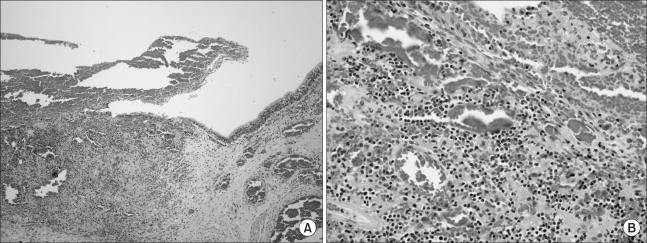
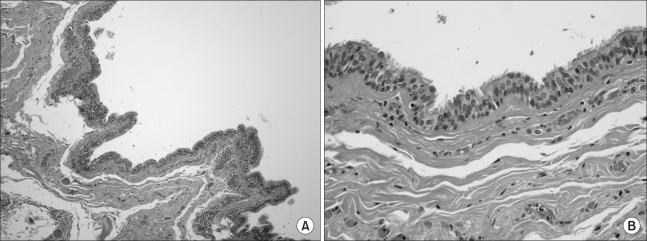
There were 12 females (50.0%). The mean age was 26.8 (range, 5 to 64) years. The mean follow-up period was 27.3 (range, 1 to 121) months. There were 15 (62.5%) mediastinal and 9 (37.5%) intrapulmonary bronchogenic cysts. Symptoms occurred in 8 patients with mediastinal bronchogenic cysts (53.3%) and 5 patients with intrapulmonary bronchogenic cysts (55.6%) (p=1.000). On computed tomography (CT), 7 patients (46.7%) showed homogenous solid masses in mediastinal bronchogenic cysts and five (55.6%) patients exhibited heterogeneous cystic masses with air-fluid levels in intrapulmonary bronchogenic cystic masses. Open thoracotomy was performed in 17 (70.8%) patients, and video-assisted thoracic surgery was performed in 7 (29.2%) patients. On pathological findings, there were 16 (66.7%) complicated cysts, and in 13 symptomatic patients, 11 (84.6%) patients had complicated cysts. There was no operative death in this study. During the follow-up period, no recurrence was detected.
Intrathoracic bronchogenic cysts have a wide variety of clinical characteristics and radiologic findings. Even though some patients do not experience symptoms and signs caused by bronchogenic cysts, serious symptoms and complications may develop with the passage of time.
本研究旨在探讨胸内支气管源性囊肿的临床特征及治疗方法。
1990年8月至2009年12月期间,我院对24例胸内支气管源性囊肿患者进行了手术治疗。根据支气管源性囊肿的位置将患者分为两组:纵隔型或肺内型。通过连续的患者病历回顾性调查诊断时的症状、影像学表现、位置、手术方法、病理结果及手术结局。
女性患者12例(50.0%)。平均年龄26.8岁(范围5至64岁)。平均随访时间27.3个月(范围1至121个月)。纵隔型支气管源性囊肿15例(62.5%),肺内型9例(37.5%)。纵隔型支气管源性囊肿患者中有8例(53.3%)出现症状,肺内型支气管源性囊肿患者中有5例(55.6%)出现症状(p = 1.000)。在计算机断层扫描(CT)上,7例(46.7%)纵隔型支气管源性囊肿表现为均匀实性肿块,5例(55.6%)肺内型支气管源性囊肿表现为含气液平面的不均匀囊性肿块。17例(70.8%)患者行开胸手术,7例(29.2%)患者行电视辅助胸腔镜手术。病理结果显示,有16例(66.7%)为复杂性囊肿,13例有症状的患者中,11例(84.6%)为复杂性囊肿。本研究无手术死亡病例。随访期间未发现复发。
胸内支气管源性囊肿具有多种临床特征和影像学表现。尽管有些患者未出现支气管源性囊肿引起的症状和体征,但随着时间推移可能会出现严重症状和并发症。