Department of Disease Control and Epidemiology, National Veterinary Institute, SE-751 89 Uppsala, Sweden.
Prev Vet Med. 2012 Jul 1;105(3):202-8. doi: 10.1016/j.prevetmed.2011.12.011. Epub 2012 Jan 23.
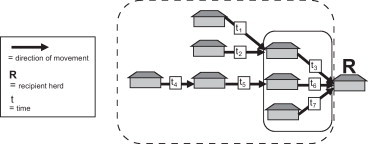
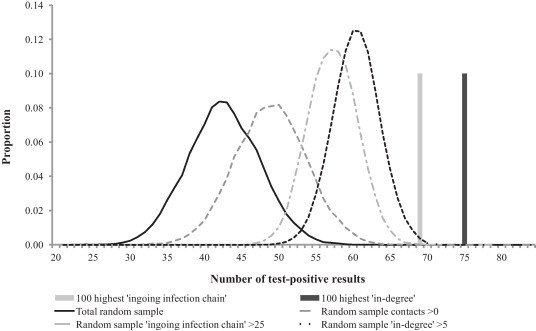
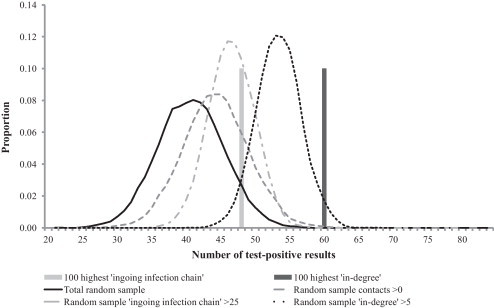
Financial resources may limit the number of samples that can be collected and analysed in disease surveillance programmes. When the aim of surveillance is disease detection and identification of case herds, a risk-based approach can increase the sensitivity of the surveillance system. In this paper, the association between two network analysis measures, i.e. 'in-degree' and 'ingoing infection chain', and signs of infection is investigated. It is shown that based on regression analysis of combined data from a recent cross-sectional study for endemic viral infections and network analysis of animal movements, a positive serological result for bovine coronavirus (BCV) and bovine respiratory syncytial virus (BRSV) is significantly associated with the purchase of animals. For BCV, this association was significant also when accounting for herd size and regional cattle density, but not for BRSV. Examples are given for different approaches to include cattle movement data in risk-based surveillance by selecting herds based on network analysis measures. Results show that compared to completely random sampling these approaches increase the number of detected positives, both for BCV and BRSV in our study population. It is concluded that network measures for the relevant time period based on updated databases of animal movements can provide a simple and straight forward tool for risk-based sampling.
财力可能会限制疾病监测计划中可采集和分析的样本数量。当监测的目的是发现疾病并确定病畜群时,基于风险的方法可以提高监测系统的灵敏度。本文研究了两种网络分析指标,即“入度”和“传入感染链”与感染迹象之间的关联。结果表明,基于对近期地方性病毒感染的横断面研究的综合数据分析和动物运动的网络分析,牛冠状病毒(BCV)和牛呼吸道合胞病毒(BRSV)的血清学阳性结果与动物的购买显著相关。对于 BCV,在考虑畜群规模和区域牛密度的情况下,这种关联仍然显著,但对于 BRSV 则不显著。本文还举例说明了通过基于网络分析指标选择畜群,将牛群运动数据纳入基于风险的监测的不同方法。结果表明,与完全随机抽样相比,这些方法增加了阳性检出率,在我们的研究人群中,BCV 和 BRSV 均如此。因此,基于动物运动更新数据库的相关时间段的网络措施可以为基于风险的抽样提供一种简单直接的工具。