Department of Biomedicine, University Hospital Basel, Petersgraben 4, Basel, Switzerland.
J Am Soc Echocardiogr. 2012 Apr;25(4):460-6. doi: 10.1016/j.echo.2011.12.016. Epub 2012 Jan 23.
In biologic systems, the arrest of circulating cells is mediated by adhesion molecules projecting their active binding domain above the cell surface to enhance bond formation and tether strength. Similarly, molecular spacers are used for ligands on particle-based molecular imaging agents. The aim of this study was to evaluate the influence of tether length for targeting ligands on ultrasound molecular imaging agents.
Microbubbles bearing biotin at the end of variable-length polyethylene glycol spacer arms (MB(2000) and MB(3400)) were prepared. To assess in vivo attachment efficiency to endothelial counterligands that vary in their distance from the endothelial cell surface, contrast-enhanced ultrasound (CEU) molecular imaging of tumor necrosis factor-α-induced P-selectin (long distance) or intercellular adhesion molecule-2 (short distance) was performed with each agent in murine hind limbs. To assess the influence of the glycocalyx on microbubble attachment, CEU molecular imaging of intercellular adhesion molecule-2 was performed after degradation of the glycocalyx.
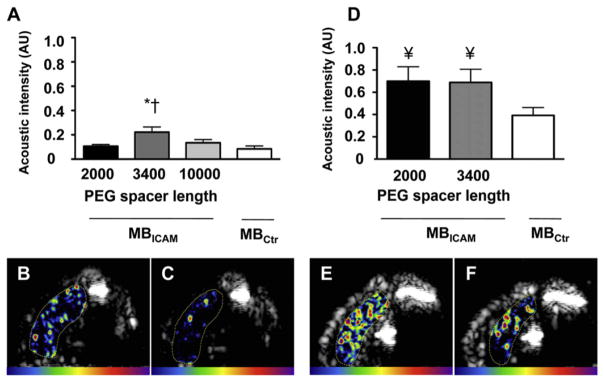
CEU molecular imaging targeted to P-selectin showed signal enhancement above control agent for MB(2000) and MB(3400), the degree of which was significantly higher for MB(3400) compared with MB(2000). CEU molecular imaging targeted to intercellular adhesion molecule-2 showed low overall signal for all agents and signal enhancement above control for MB(3400) only. Glycocalyx degradation increased signal for MB(3400) and MB(2000).
Microbubble targeting to endothelial ligands is influenced by (1) the tether length of the ligand, (2) the degree to which the endothelial target is projected from the cell surface, and (3) the status of the glycocalyx. These considerations are important for designing targeted imaging probes and understanding potential obstacles to molecular imaging.
在生物系统中,循环细胞的捕获是通过将其活性结合域突出到细胞表面上方的黏附分子来介导的,以增强键合形成和系链强度。同样,分子间隔物也用于基于颗粒的分子成像剂上的配体。本研究旨在评估靶向配体的系链长度对超声分子成像剂的影响。
制备末端带有生物素的带有不同长度聚乙二醇间隔臂的微泡(MB(2000)和 MB(3400))。为了评估与内皮细胞表面距离不同的内皮对照配体的附着效率,在肿瘤坏死因子-α诱导的 P-选择素(长距离)或细胞间黏附分子-2(短距离)的每种制剂的实验动物后肢中进行对比增强超声(CEU)分子成像。为了评估糖萼对微泡附着的影响,在糖萼降解后进行细胞间黏附分子-2 的 CEU 分子成像。
CEU 分子成像靶向 P-选择素显示出与对照剂相比,MB(2000)和 MB(3400)的信号增强,而 MB(3400)的信号增强明显高于 MB(2000)。CEU 分子成像靶向细胞间黏附分子-2 的所有制剂的整体信号均较低,仅 MB(3400)的信号增强超过对照剂。糖萼降解增加了 MB(3400)和 MB(2000)的信号。
内皮配体的微泡靶向受(1)配体的系链长度、(2)内皮靶标从细胞表面的突出程度和(3)糖萼的状态的影响。这些考虑因素对于设计靶向成像探针和理解分子成像的潜在障碍非常重要。