Renoir Thibault, Chevarin Caroline, Lanfumey Laurence, Hannan Anthony J
Postdoctoral Research Fellow at Neural Plasticity Group, Florey Neuroscience Institutes, Melbourne Brain Centre, University of Melbourne, Australia; Research Assistant, addiction and depression Group, Center for Psychiatry and Neuroscience, INSERM U894, University Pierre and Marie Curie, Paris, France; Head, addiction and depression Group, Center for Psychiatry and Neuroscience, INSERM U894, University Pierre and Marie Curie, Paris, France. and Head, Neural Plasticity Group, Florey Neuroscience Institutes, Melbourne Brain Centre, University of Melbourne.
PLoS Curr. 2011 Nov 8;3:RRN1281. doi: 10.1371/currents.RRN1281.
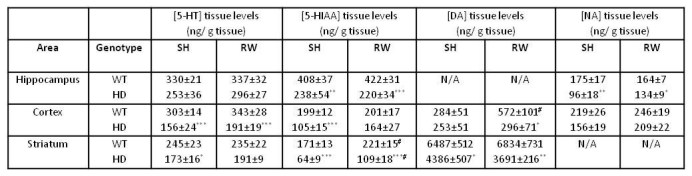
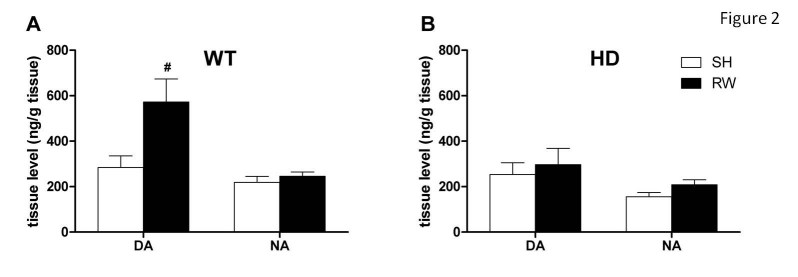
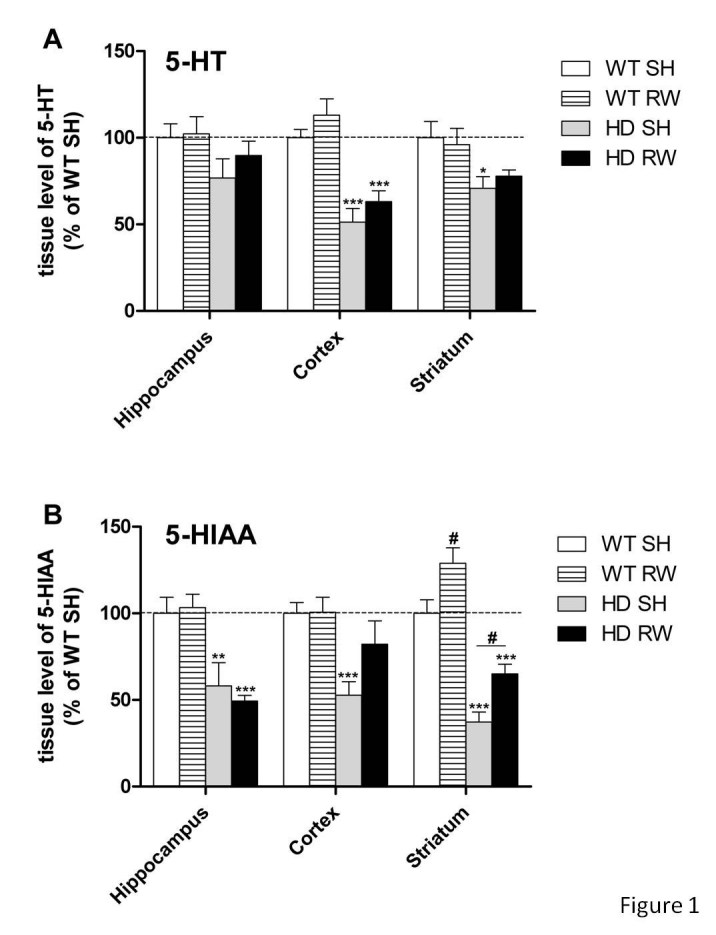
Using the R6/1 mouse model of Huntington disease (HD), we have recently shown that voluntary physical activity was able to correct the depressive-like behaviours exhibited by the HD animals at a pre-motor symptomatic stage of the disease. Using the high performance liquid chromatography system, we have now evaluated the effect of exercise on monoamine metabolism in HD mice. We found that serotonin and its metabolite as well as dopamine and noradrenaline were reduced across several brain regions in female R6/1 animals. Our data also suggest that some of these neurochemical deficits were modulated by physical activity, in a genotype-region dependent manner. These newly identified changes could account for some of the behavioural effects of exercise previously reported in HD mice.
利用亨廷顿舞蹈症(HD)的R6/1小鼠模型,我们最近发现,自愿进行体育活动能够纠正HD动物在疾病运动前期症状阶段所表现出的类似抑郁的行为。现在,我们使用高效液相色谱系统评估了运动对HD小鼠单胺代谢的影响。我们发现,雌性R6/1动物的几个脑区中血清素及其代谢产物以及多巴胺和去甲肾上腺素均减少。我们的数据还表明,其中一些神经化学缺陷受到体育活动的调节,且呈现出基因型-区域依赖性。这些新发现的变化可能解释了先前报道的运动对HD小鼠行为的一些影响。