Centre for Structural Biology, Division of Molecular Biosciences, Faculty of Natural Sciences, Imperial College London, London SW7 2AZ, United Kingdom.
J Biol Chem. 2012 Mar 9;287(11):8561-70. doi: 10.1074/jbc.M111.302778. Epub 2012 Jan 23.
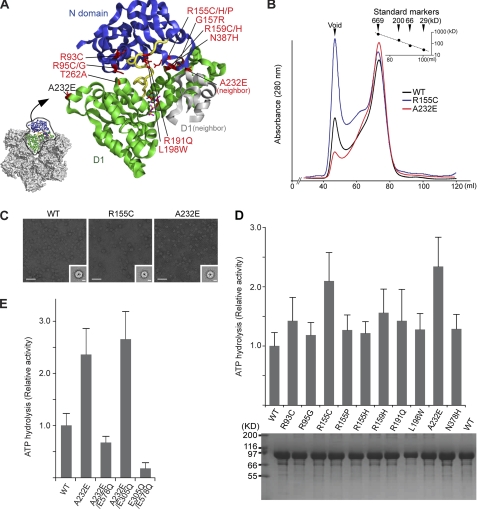
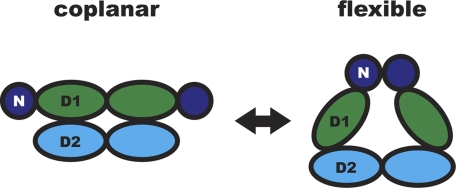
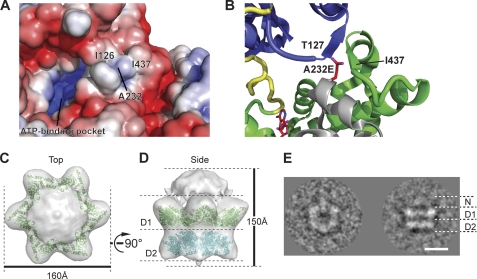
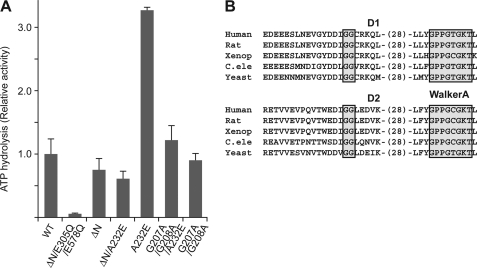
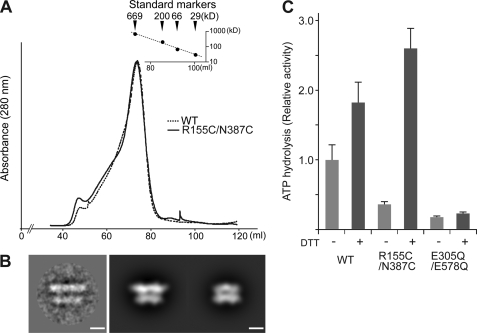
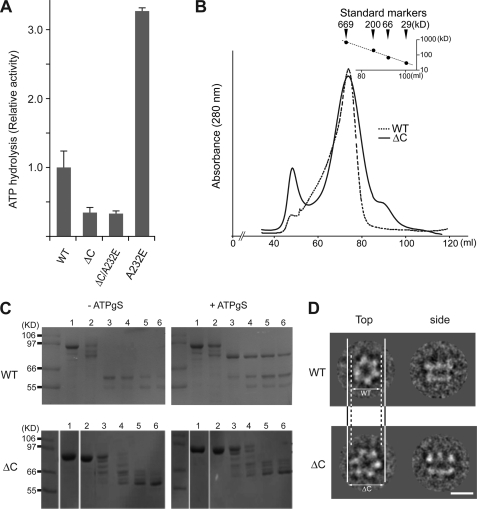
p97/valosin-containing protein (VCP) is a type II ATPase associated with various cellular activities that forms a homohexamer with each protomer containing an N-terminal domain (N-domain); two ATPase domains, D1 and D2; and a disordered C-terminal region. Little is known about the role of the N-domain or the C-terminal region in the p97 ATPase cycle. In the p97-associated human disease inclusion body myopathy associated with Paget disease of bone and frontotemporal dementia, the majority of missense mutations are located at the N-domain D1 interface. Structure-based predictions suggest that such mutations affect the interaction of the N-domain with D1. Here we have tested ten major inclusion body myopathy associated with Paget disease of bone and frontotemporal dementia-linked mutants for ATPase activity and found that all have increased activity over the wild type, with one mutant, p97(A232E), having three times higher activity. Further mutagenesis of p97(A232E) shows that the increase in ATPase activity is mediated through D2 and requires both the N-domain and a flexible ND1 linker. A disulfide mutation that locks the N-domain to D1 in a coplanar position reversibly abrogates ATPase activity. A cryo-EM reconstruction of p97(A232E) suggests that the N-domains are flexible. Removal of the C-terminal region also reduces ATPase activity. Taken together, our data suggest that the conformation of the N-domain in relation to the D1-D2 hexamer is directly linked to ATP hydrolysis and that the C-terminal region is required for hexamer stability. This leads us to propose a model where the N-domain adopts either of two conformations: a flexible conformation compatible with ATP hydrolysis or a coplanar conformation that is inactive.
p97/包含 valosin 的蛋白 (VCP) 是一种与各种细胞活动相关的 II 型 ATP 酶,它由每个同六聚体组成,每个单体含有一个 N 端结构域(N 域);两个 ATP 酶结构域,D1 和 D2;以及一个无序的 C 端区域。关于 N 域或 C 端区域在 p97 ATP 酶循环中的作用知之甚少。在与骨 Paget 病和额颞叶痴呆相关的 p97 相关人类疾病包涵体肌病中,大多数错义突变位于 N 域 D1 界面。基于结构的预测表明,这种突变会影响 N 域与 D1 的相互作用。在这里,我们测试了十个主要的与骨 Paget 病和额颞叶痴呆相关的包涵体肌病相关突变体的 ATP 酶活性,发现所有突变体的活性都比野生型高,其中一个突变体 p97(A232E)的活性高 3 倍。进一步对 p97(A232E)进行突变显示,ATP 酶活性的增加是通过 D2 介导的,需要 N 域和灵活的 ND1 接头。将 N 域锁定在 D1 共面位置的二硫键突变可可逆地消除 ATP 酶活性。p97(A232E)的 cryo-EM 重建表明 N 域是灵活的。去除 C 端区域也会降低 ATP 酶活性。总之,我们的数据表明,N 域相对于 D1-D2 六聚体的构象直接与 ATP 水解相关,并且 C 端区域是六聚体稳定性所必需的。这使我们提出了一个模型,其中 N 域采用两种构象之一:与 ATP 水解兼容的灵活构象或无活性的共面构象。