Department of Radiology, University of Lausanne, Switzerland.
Brain Topogr. 2012 Apr;25(2):125-8. doi: 10.1007/s10548-012-0219-0. Epub 2012 Jan 22.
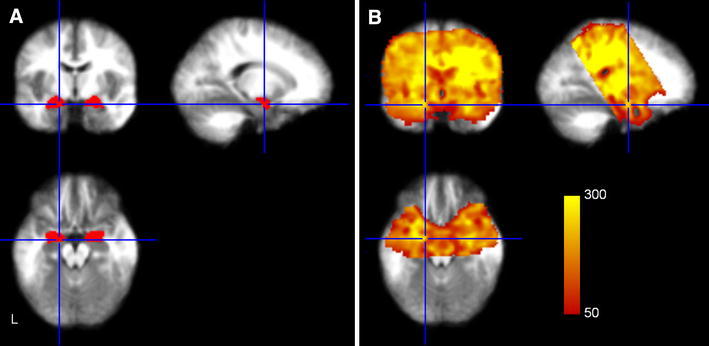
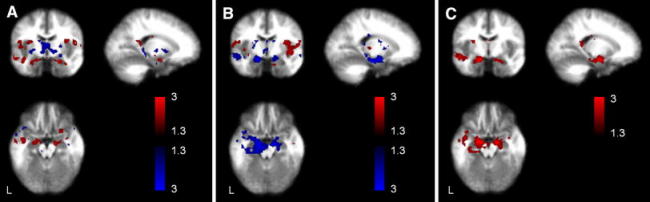
The amygdalae are involved in the perception of emotions such as happiness, anger and fear. Because of their proximity to the sinuses, the image signal intensity in T2* weighted fMRI data is often affected by signal loss due to through-slice dephasing, especially at high field strength. In this study, the feasibility of fMRI in the amygdalae at 7 Tesla was investigated. A paradigm based on the presentation of fearful faces was used for stimulation. Previously, opposite effects have been found for presentation of averted and direct gaze fearful faces. Here, we show that (1) sufficiently high temporal SNR values are reached in the amygdalae for detection of small BOLD signal changes and (2) that the BOLD signal in the amygdalae for presentation of a direct or averted gaze in a fearful face depends on stimulus duration.
杏仁核参与感知情绪,如快乐、愤怒和恐惧。由于它们靠近鼻窦,T2*加权 fMRI 数据中的图像信号强度经常受到切片间去相位导致的信号丢失的影响,尤其是在高场强下。在这项研究中,我们探讨了在 7 特斯拉下进行杏仁核 fMRI 的可行性。使用基于呈现恐惧面孔的范式进行刺激。之前的研究发现,呈现回避和直视恐惧面孔会产生相反的效果。在这里,我们表明:(1) 在杏仁核中达到了足够高的时间 SNR 值,可用于检测小的 BOLD 信号变化;(2) 呈现恐惧面孔中的直接或回避注视时,杏仁核中的 BOLD 信号取决于刺激持续时间。