Sukata Tokuo, Uwagawa Satoshi, Ozaki Keisuke, Sumida Kayo, Kushida Masahiko, Kakehashi Anna, Wanibuchi Hideki, Miyata Kaori, Ogata Keiko, Fukushima Shoji
J Toxicol Pathol. 2009 Dec;22(4):281-8. doi: 10.1293/tox.22.281. Epub 2009 Dec 21.
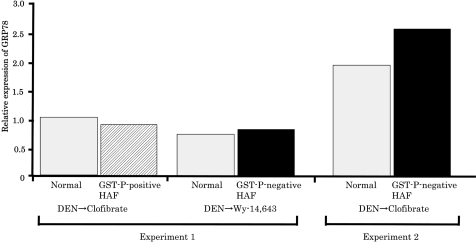
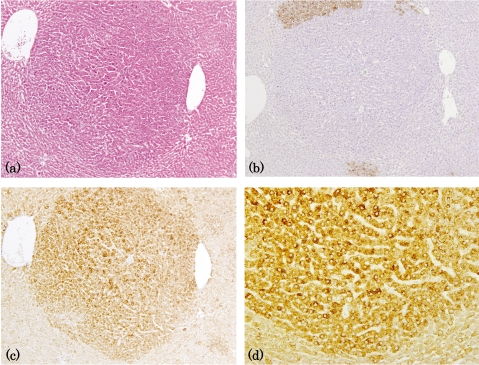
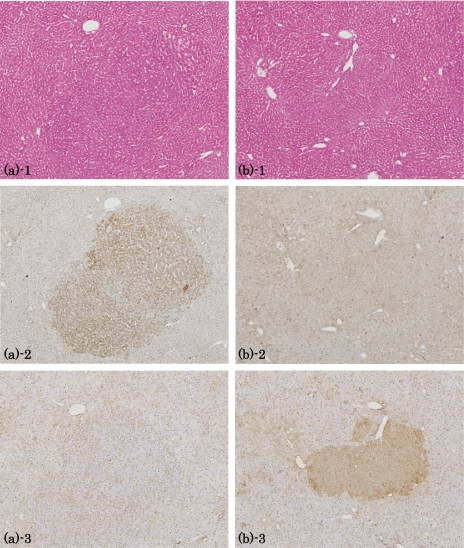
Previously, we reported α(2)-macroglobulin (α(2)M) to be a novel marker characteristic of rat hepatocellular preneoplastic and neoplastic lesions negative for hitherto well-established markers. In the present study, we further examined other candidate markers with specificity for the same type of lesions. Glutathione S-transferase-placental form (GST-P)-negative hepatocellular altered foci (HAF) were generated using a two-stage (initiation and promotion) carcinogenesis protocol with N,N-diethylnitrosamine (DEN) and either Wy-14,643 or clofibrate, two peroxisome proliferators. Microarray analysis using total RNAs isolated from laser-microdissected GST-P-negative HAF (amphophilic cell foci) and adjacent normal tissues was conducted along with immunohistochemistry and real-time RT-PCR. Staining for glucose-regulated protein 78 (GRP78) was detected in GST-P-negative HAF and hepatocellular adenomas, and slightly increased GRP78 mRNA expression was observed in the lesions by real-time RT-PCR analysis. Thus, an early increase of GRP78 expression in hepatocarcinogenesis is likely a feature of the amphophilic subset of HAF.
此前,我们报道α(2)-巨球蛋白(α(2)M)是一种新型标志物,其特征为在迄今已确立的标志物检测呈阴性的大鼠肝细胞癌前病变和肿瘤性病变中出现。在本研究中,我们进一步检测了对同一类型病变具有特异性的其他候选标志物。使用N,N-二乙基亚硝胺(DEN)与两种过氧化物酶体增殖剂Wy-14,643或氯贝丁酯,通过两阶段(启动和促进)致癌方案生成谷胱甘肽S-转移酶胎盘型(GST-P)阴性的肝细胞改变灶(HAF)。使用从激光显微切割的GST-P阴性HAF(嗜酸性细胞灶)和相邻正常组织中分离的总RNA进行微阵列分析,并结合免疫组织化学和实时RT-PCR。在GST-P阴性HAF和肝细胞腺瘤中检测到葡萄糖调节蛋白78(GRP78)染色,并且通过实时RT-PCR分析在病变中观察到GRP78 mRNA表达略有增加。因此,在肝癌发生过程中GRP78表达的早期增加可能是HAF嗜酸性亚群的一个特征。