Yamairi Fumiko, Utsumi Hiroyuki, Ono Yuuichi, Komorita Naruyasu, Tanaka Masaharu, Fukunari Atsushi
Research Division, Mitsubishi Tanabe Pharma Corporation, 1000, Kamoshida-cho, Aoba-ku, Yokohama 227-0033, Japan.
J Toxicol Pathol. 2011 Jun;24(2):137-42. doi: 10.1293/tox.24.137. Epub 2011 Jun 30.
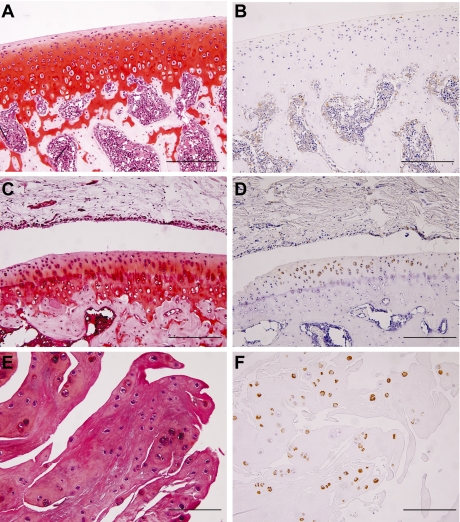
Vascular endothelial growth factor (VEGF) and its receptors have recently reported to be expressed in human osteoarthritis (OA), suggesting that VEGF could be implicated in the pathogenesis of this disease. In the present study, expression of VEGF in the articular cartilage was determined in three different OA models: medial meniscectomy and monoiodoacetate (MIA) injection in rats and age-associated spontaneous joint cartilage destruction in guinea pigs. VEGF was detected by immunohistochemical analysis in the regenerative and hypertrophic chondrocytes, perichondrium and osteophyte areas and chondrocyte clones. Stain intensity of VEGF immunoreactivity increased simultaneously with the degree of cartilage destruction and reparation. These results suggest that VEGF is a key factor in the articular cartilage in human OA and animal OA models.
血管内皮生长因子(VEGF)及其受体最近有报道称在人类骨关节炎(OA)中表达,这表明VEGF可能与该疾病的发病机制有关。在本研究中,在三种不同的OA模型中测定了关节软骨中VEGF的表达:大鼠内侧半月板切除术和单碘乙酸盐(MIA)注射,以及豚鼠年龄相关性自发性关节软骨破坏。通过免疫组织化学分析在再生和肥大软骨细胞、软骨膜和骨赘区域以及软骨细胞克隆中检测到VEGF。VEGF免疫反应性的染色强度随着软骨破坏和修复程度同时增加。这些结果表明VEGF是人类OA和动物OA模型关节软骨中的关键因素。