Blood Transfusion Service of the Swiss Red Cross, Lausanne, Switzerland.
BMC Med. 2012 Jan 24;10:8. doi: 10.1186/1741-7015-10-8.
Iron deficiency without anemia is related to adverse symptoms that can be relieved by supplementation. Since a blood donation can induce such an iron deficiency, we investigated the clinical impact of iron treatment after a blood donation.
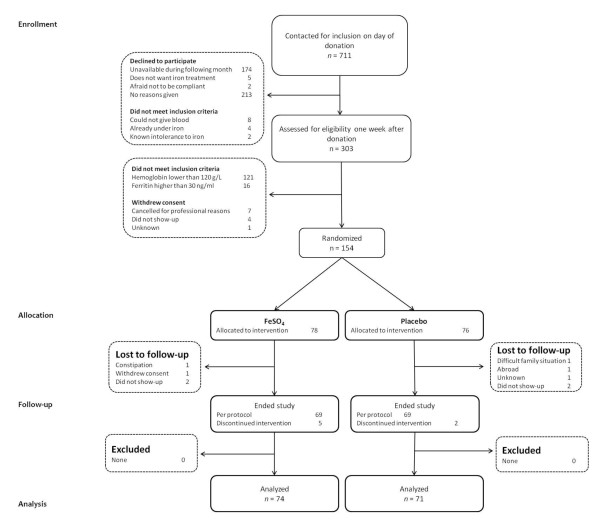
One week after donation, we randomly assigned 154 female donors with iron deficiency without anemia, aged below 50 years, to a four-week oral treatment of ferrous sulfate versus a placebo. The main outcome was the change in the level of fatigue before and after the intervention. Aerobic capacity, mood disorder, quality of life, compliance and adverse events were also evaluated. Hemoglobin and ferritin were used as biological markers.
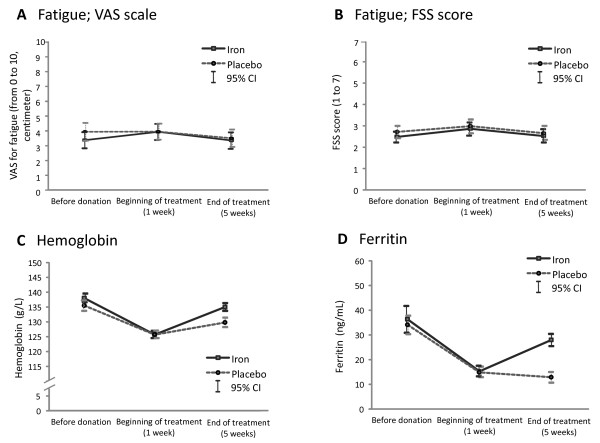
The effect of the treatment from baseline to four weeks of iron treatment was an increase in hemoglobin and ferritin levels to 5.2 g/L (P < 0.01) and 14.8 ng/mL (P < 0.01), respectively. No significant clinical effect was observed for fatigue (-0.15 points, 95% confidence interval -0.9 points to 0.6 points, P = 0.697) or for other outcomes. Compliance and interruption for side effects was similar in both groups. Additionally, blood donation did not induce overt symptoms of fatigue in spite of the significant biological changes it produces.
These data are valuable as they enable us to conclude that donors with iron deficiency without anemia after a blood donation would not clinically benefit from iron supplementation.
ClinicalTrials.gov: NCT00981877.
铁缺乏但不伴贫血与可通过补充铁缓解的不良症状相关。由于献血可导致这种铁缺乏,因此我们研究了献血后铁治疗的临床影响。
在献血后一周,我们将 154 名年龄低于 50 岁、铁缺乏但不伴贫血的女性献血者随机分为四组,分别接受为期四周的硫酸亚铁治疗或安慰剂治疗。主要结局是干预前后疲劳水平的变化。还评估了有氧运动能力、情绪障碍、生活质量、依从性和不良事件。血红蛋白和铁蛋白用作生物学标志物。
从基线到四周铁治疗的治疗效果为血红蛋白和铁蛋白水平分别升高 5.2 g/L(P < 0.01)和 14.8 ng/mL(P < 0.01)。疲劳(-0.15 分,95%置信区间 -0.9 分至 0.6 分,P = 0.697)或其他结局均未观察到显著的临床效果。两组的依从性和因副作用中断治疗的情况相似。此外,尽管献血会产生明显的生物学变化,但不会引起明显的疲劳症状。
这些数据很有价值,因为它们使我们能够得出结论,即献血后铁缺乏但不伴贫血的献血者不会从铁补充中获得临床益处。
ClinicalTrials.gov:NCT00981877。