Flythe Jennifer E, Lacson Eduardo
Semin Dial. 2012 Jan-Feb;25(1):1-8. doi: 10.1111/j.1525-139X.2011.01015.x.
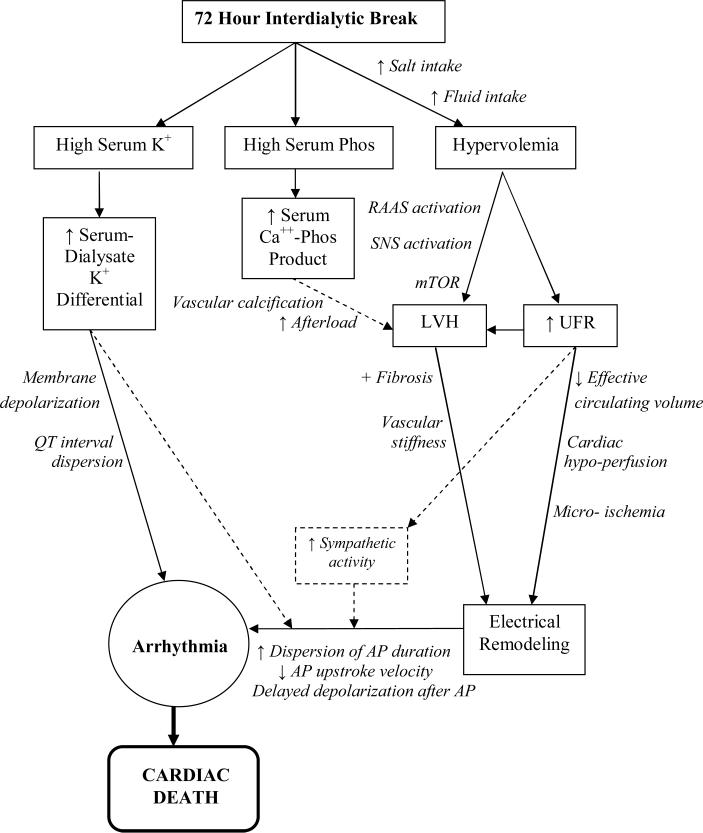
A thrice-weekly schedule dominates hemodialysis practice today. Inherent in such a schedule is a 72-hour interweek break over the weekend. A growing body of evidence suggests that this break may be associated with increased cardiovascular morbidity and mortality. Five recent studies have linked dialysis session timing to higher cardiovascular event rates, and have shed light on possible underlying physiologic mechanisms. We reviewed outcome data linking the "long break" to cardiovascular outcomes, and suggest physiologic rationale for this relationship while identifying knowledge gaps that require further study to inform discussions regarding the application and composition of individualized dialysis prescriptions. Further work is needed to determine the relative importance of electrolyte perturbations and hemodynamic shifts in the relationship between the long break and cardiovascular mortality. The evidence suggests that at least in some at-risk patients, an individualized approach to the dialytic schedule and prescription is warranted.
如今,每周三次的透析方案主导着血液透析实践。这样的方案在周末会有72小时的周间休息。越来越多的证据表明,这种休息可能与心血管疾病发病率和死亡率的增加有关。最近的五项研究将透析时段与较高的心血管事件发生率联系起来,并揭示了可能的潜在生理机制。我们回顾了将“长时间休息”与心血管结局联系起来的结果数据,并提出了这种关系的生理依据,同时确定了知识空白,这些空白需要进一步研究,以为关于个体化透析处方的应用和组成的讨论提供信息。需要进一步开展工作,以确定在长时间休息与心血管死亡率之间的关系中,电解质紊乱和血流动力学变化的相对重要性。证据表明,至少在一些高危患者中,有必要采取个体化的透析方案和处方。