Department of Medicine, Division of Nephrology, Stanford University School of Medicine, Stanford, CA, USA.
Am J Kidney Dis. 2011 Dec;58(6):956-63. doi: 10.1053/j.ajkd.2011.06.030. Epub 2011 Aug 27.
Patients on in-center nocturnal hemodialysis therapy typically experience higher interdialytic weight gain (IDWG) than patients on conventional hemodialysis therapy. We determined the safety and effects of decreasing dialysate sodium concentration on IDWG and blood pressure in patients on thrice-weekly in-center nocturnal hemodialysis therapy.
Quality improvement, pre-post intervention.
SETTINGS & PARTICIPANTS: 15 participants in a single facility.
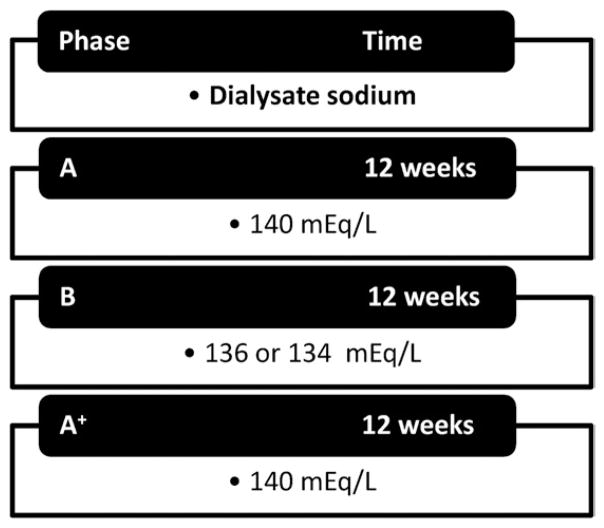
Participants underwent three 12-week treatment phases, each with different dialysate sodium concentrations, as follows: phase A, 140 mEq/L; phase B, 136 or 134 mEq/L; and phase A(+), 140 mEq/L. Participants were blinded to the exact timing of the intervention.
IDWG, IDWG/dry weight (IDWG%), and blood pressure.
Outcome data were obtained during the last 2 weeks of each phase and compared with mixed models. The fraction of sessions with adverse events (eg, cramping and hypotension) also was reported.
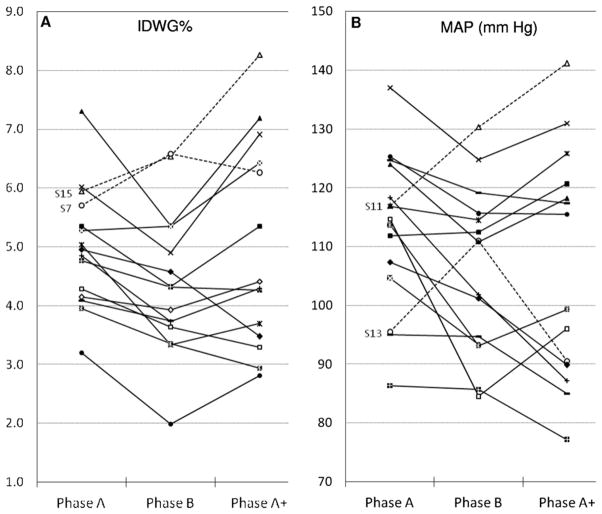
IDWG, IDWG%, and predialysis systolic blood pressure decreased significantly by 0.6 ± 0.6 kg, 0.6% ± 0.8%, and 8.3 ± 14.9 mm Hg, respectively, in phase B compared with phase A (P < 0.05 for all comparisons). No differences in predialysis diastolic and mean arterial or postdialysis blood pressures were found (P > 0.05 for all comparisons). The proportion of treatments with intradialytic hypotension was low and similar in each phase (P = 0.9). In phase B compared with phase A, predialysis plasma sodium concentration was unchanged (P > 0.05), whereas postdialysis plasma sodium concentration decreased by 3.7 ± 1.9 mEq/L (P < 0.05).
Modest sample size.
Decreasing dialysate sodium concentrations in patients undergoing thrice-weekly in-center nocturnal hemodialysis resulted in a clinical and statistically significant decrease in IDWG, IDWG%, postdialysis plasma sodium concentration, and predialysis systolic blood pressure without increasing adverse events. Prolonged exposure to higher than required dialysate sodium concentrations may drive IDWG and counteract some of the purported benefits of "go-slow" (longer session length) hemodialysis.
在中心夜间血液透析治疗的患者通常比常规血液透析治疗的患者经历更高的透析间体重增加(IDWG)。我们确定了降低透析液钠浓度对每周三次中心夜间血液透析治疗患者的 IDWG 和血压的安全性和影响。
质量改进,前后干预。
一个设施中的 15 名参与者。
参与者接受了三个为期 12 周的治疗阶段,每个阶段的透析液钠浓度不同,如下所示:阶段 A,140 mEq/L;阶段 B,136 或 134 mEq/L;和阶段 A(+),140 mEq/L。参与者对干预的确切时间不知情。
IDWG、IDWG/干体重(IDWG%)和血压。
在每个阶段的最后 2 周获得结果数据,并使用混合模型进行比较。还报告了有不良事件(例如抽筋和低血压)的会话比例。
与阶段 A 相比,阶段 B 时 IDWG、IDWG%和透析前收缩压分别显著降低 0.6±0.6kg、0.6%±0.8%和 8.3±14.9mmHg(所有比较均 P<0.05)。透析前舒张压和平均动脉压或透析后血压无差异(所有比较均 P>0.05)。有低血压的治疗比例较低,各阶段相似(P=0.9)。与阶段 A 相比,阶段 B 时透析前血浆钠浓度保持不变(P>0.05),而透析后血浆钠浓度降低 3.7±1.9mEq/L(P<0.05)。
样本量适中。
在每周三次中心夜间血液透析治疗的患者中降低透析液钠浓度可导致 IDWG、IDWG%、透析后血浆钠浓度和透析前收缩压临床和统计学显著降低,而不会增加不良事件。长时间暴露于高于所需的透析液钠浓度可能会导致 IDWG,并抵消一些“慢走”(更长的治疗时间)血液透析的所谓益处。