Flinders Centre for Cancer Prevention and Control, Flinders University of South Australia, Adelaide, South Australia, Australia.
PLoS One. 2012;7(1):e29059. doi: 10.1371/journal.pone.0029059. Epub 2012 Jan 19.
BACKGROUND & AIMS: Colorectal cancer incidence and deaths are reduced by the detection and removal of early-stage, treatable neoplasia but we lack proven biomarkers sensitive for both cancer and pre-invasive adenomas. The aims of this study were to determine if adenomas and cancers exhibit characteristic patterns of biomarker expression and to explore whether a tissue-discovered (and validated) biomarker is differentially expressed in the plasma of patients with colorectal adenomas or cancer.
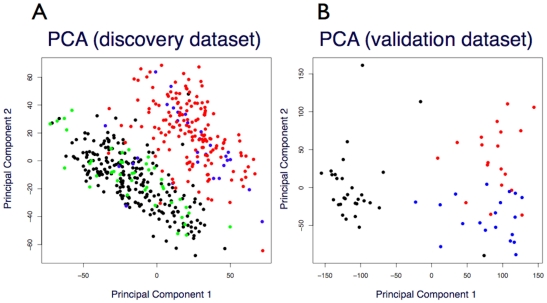
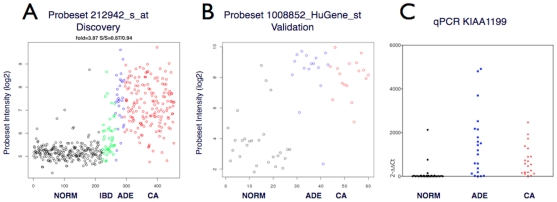
Candidate RNA biomarkers were identified by oligonucleotide microarray analysis of colorectal specimens (222 normal, 29 adenoma, 161 adenocarcinoma and 50 colitis) and validated in a previously untested cohort of 68 colorectal specimens using a custom-designed oligonucleotide microarray. One validated biomarker, KIAA1199, was assayed using qRT-PCR on plasma extracted RNA from 20 colonoscopy-confirmed healthy controls, 20 patients with adenoma, and 20 with cancer.
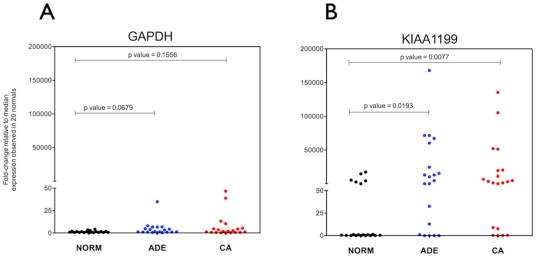
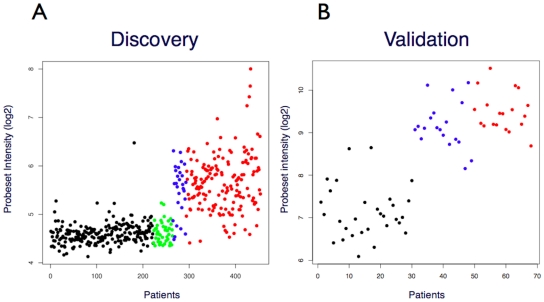
Genome-wide analysis uncovered reproducible gene expression signatures for both adenomas and cancers compared to controls. 386/489 (79%) of the adenoma and 439/529 (83%) of the adenocarcinoma biomarkers were validated in independent tissues. We also identified genes differentially expressed in adenomas compared to cancer. KIAA1199 was selected for further analysis based on consistent up-regulation in neoplasia, previous studies and its interest as an uncharacterized gene. Plasma KIAA1199 RNA levels were significantly higher in patients with either cancer or adenoma (31/40) compared to neoplasia-free controls (6/20).
Colorectal neoplasia exhibits characteristic patterns of gene expression. KIAA1199 is differentially expressed in neoplastic tissues and KIAA1199 transcripts are more abundant in the plasma of patients with either cancer or adenoma compared to controls.
通过检测和消除早期可治疗的肿瘤,可以降低结直肠癌的发病率和死亡率,但我们缺乏对癌症和癌前腺瘤均敏感的经过验证的生物标志物。本研究的目的是确定腺瘤和癌症是否表现出特征性的生物标志物表达模式,并探讨组织中发现(并经过验证)的生物标志物在结直肠腺瘤或癌症患者的血浆中是否存在差异表达。
通过对 222 份正常、29 份腺瘤、161 份腺癌和 50 份结肠炎的结直肠标本进行寡核苷酸微阵列分析,鉴定候选 RNA 生物标志物,并使用定制的寡核苷酸微阵列在以前未经测试的 68 份结直肠标本中进行验证。使用 qRT-PCR 对从 20 例结肠镜确诊的健康对照者、20 例腺瘤患者和 20 例癌症患者的血浆提取 RNA 进行了一个验证的生物标志物 KIAA1199 的检测。
与对照组相比,全基因组分析揭示了腺瘤和癌症均具有可重复的基因表达特征。在独立组织中验证了 489 个腺瘤和 529 个腺癌标志物中的 386/489(79%)和 439/529(83%)。我们还发现了腺瘤与癌症相比差异表达的基因。基于在肿瘤中一致上调、先前的研究以及作为一个未被表征基因的兴趣,选择 KIAA1199 进行进一步分析。与无肿瘤对照者(6/20)相比,癌症或腺瘤患者(31/40)的血浆 KIAA1199 RNA 水平显著升高。
结直肠肿瘤表现出特征性的基因表达模式。KIAA1199 在肿瘤组织中差异表达,并且与对照相比,癌症或腺瘤患者的血浆中 KIAA1199 转录本更为丰富。