Department of Primary Care and Public Health Sciences, King's College London, London, United Kingdom.
PLoS One. 2012;7(1):e29776. doi: 10.1371/journal.pone.0029776. Epub 2012 Jan 19.
To evaluate the coding, recording and incidence of coronary heart disease (CHD) in primary care electronic medical records.
Data were drawn from the UK General Practice Research Database. Analyses evaluated the occurrence of 271 READ medical diagnostic codes, including categories for 'Angina', 'Myocardial Infarction', 'Coronary Artery Bypass Grafting' (CABG), 'percutaneous transluminal coronary angioplasty' (PCTA) and 'Other Coronary Heart Disease'. Time-to-event analyses were implemented to evaluate occurrences of different groups of codes after the index date.
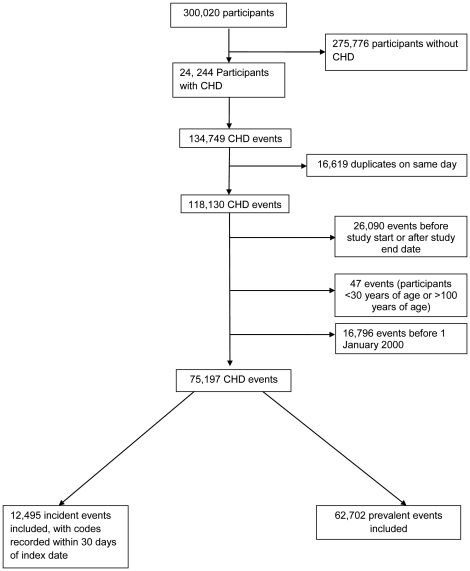
Among 300,020 participants aged greater than 30 years there were 75,197 unique occurrences of coronary heart disease codes in 24,244 participants, with 12,495 codes for incident events and 62,702 for prevalent events. Among incident event codes, 3,607 (28.87%) were for angina, 3,262 (26.11%) were for MI, 514 (4.11%) for PCTA, 161 (1.29%) for CABG and 4,951 (39.62%) were for 'Other CHD'. Among prevalent codes, 20,254 (32.30%) were for angina, 3,644 (5.81%) for MI, 34,542 (55.09%) for 'Other CHD' and 4,262 (6.80%) for CABG or PCTA. Among 3,685 participants initially diagnosed exclusively with 'Other CHD' codes, 17.1% were recorded with angina within 5 years, 5.6% with myocardial infarction, 6.3% with CABG and 8.6% with PCTA. From 2000 to 2010, the overall incidence of CHD declined, as did the incidence of angina, but the incidence of MI did not change. The frequency of CABG declined, while PCTA increased.
In primary care electronic records, a substantial proportion of coronary heart disease events are recorded with codes that do not distinguish between different clinical presentations of CHD. The results draw attention to the need to improve coding practice in primary care. The results also draw attention to the importance of code selection in research studies and the need for sensitivity analyses using different sets of codes.
评估初级保健电子病历中的冠心病(CHD)编码、记录和发病情况。
数据来自英国全科医学研究数据库。分析评估了 271 个 READ 医学诊断代码的发生情况,包括“心绞痛”、“心肌梗死”、“冠状动脉旁路移植术”(CABG)、“经皮腔内冠状动脉血管成形术”(PCTA)和“其他冠心病”等类别。采用时间事件分析评估索引日期后不同组代码的发生情况。
在 300020 名年龄大于 30 岁的参与者中,24244 名参与者中有 75197 例独特的冠心病代码,24244 名参与者中有 12495 例为新发事件代码,62702 例为现患事件代码。在新发事件代码中,3607 例(28.87%)为心绞痛,3262 例(26.11%)为心肌梗死,514 例(4.11%)为 PCTA,161 例(1.29%)为 CABG,4951 例(39.62%)为“其他 CHD”。在现患代码中,20254 例(32.30%)为心绞痛,3644 例(5.81%)为心肌梗死,34542 例(55.09%)为“其他 CHD”,4262 例(6.80%)为 CABG 或 PCTA。在最初仅被诊断为“其他 CHD”代码的 3685 名参与者中,17.1%在 5 年内记录为心绞痛,5.6%为心肌梗死,6.3%为 CABG,8.6%为 PCTA。2000 年至 2010 年期间,CHD 的总体发病率下降,心绞痛的发病率也下降,但心肌梗死的发病率没有变化。CABG 的频率下降,而 PCTA 的频率增加。
在初级保健电子记录中,很大一部分冠心病事件是用不能区分 CHD 不同临床表现的代码记录的。结果提请注意需要改进初级保健中的编码实践。结果还提请注意在研究中选择代码的重要性,以及使用不同代码集进行敏感性分析的必要性。