Dobes Martin, Khurana Vini G, Shadbolt Bruce, Jain Sanjiv, Smith Sarah F, Smee Robert, Dexter Mark, Cook Raymond
Medical School, Australian National University, Canberra, Australia.
Surg Neurol Int. 2011;2:176. doi: 10.4103/2152-7806.90696. Epub 2011 Dec 13.
The incidence of primary brain tumors by subtype is currently unknown in Australia. We report an analysis of incidence by tumor subtype in a retrospective multicenter study in the state of New South Wales (NSW) and the Australian Capital Territory (ACT), with a combined population of >7 million with >97% retention rate for medical care.
Data from histologically confirmed primary brain tumors diagnosed from January 2000 through December 2008 were weighted for patient outflow and data completeness, and age standardized and analyzed using joinpoint analysis.
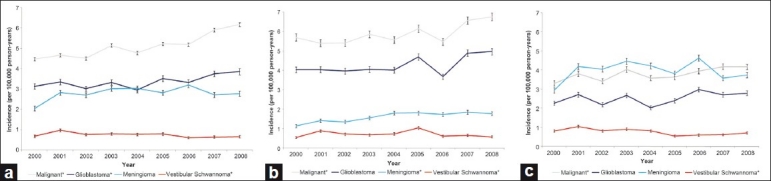
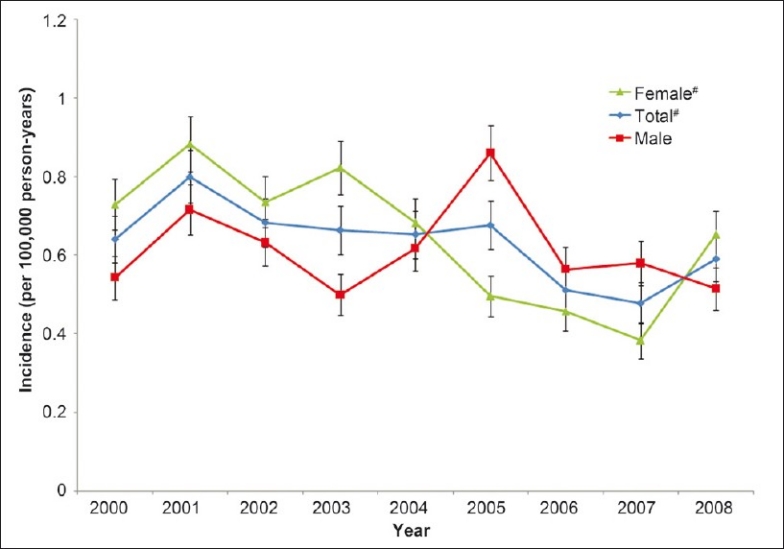
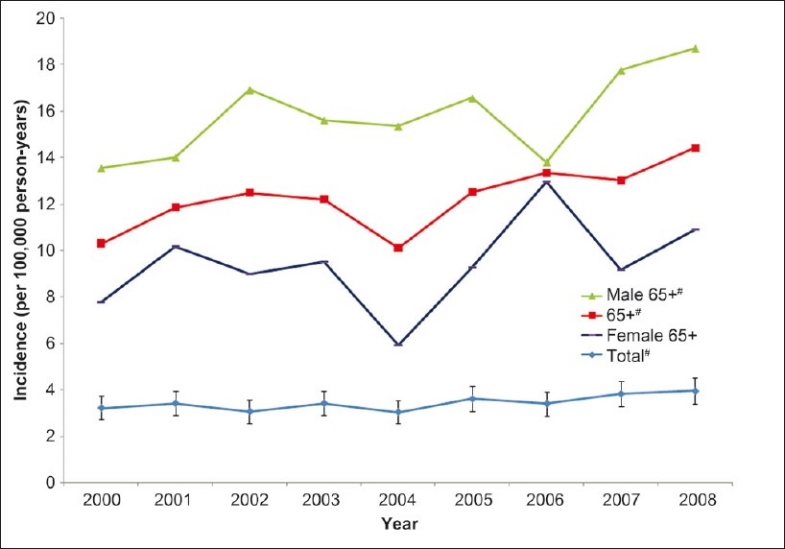
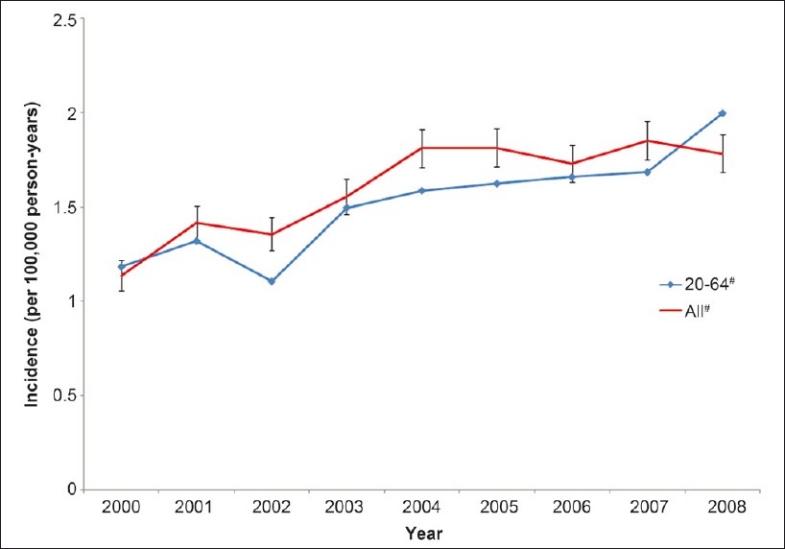
A significant increasing incidence in glioblastoma multiforme (GBM) was observed in the study period (annual percentage change [APC], 2.5; 95% confidence interval [CI], 0.4-4.6, n = 2275), particularly after 2006. In GBM patients in the ≥65-year group, a significantly increasing incidence for men and women combined (APC, 3.0; 95% CI, 0.5-5.6) and men only (APC, 2.9; 95% CI, 0.1-5.8) was seen. Rising trends in incidence were also seen for meningioma in the total male population (APC, 5.3; 95% CI, 2.6-8.1, n = 515) and males aged 20-64 years (APC, 6.3; 95% CI, 3.8-8.8). Significantly decreasing incidence trends were observed for Schwannoma for the total study population (APC, -3.5; 95% CI, -7.2 to -0.2, n = 492), significant in women (APC, -5.3; 95% CI, -9.9 to -0.5) but not men.
This collection is the most contemporary data on primary brain tumor incidence in Australia. Our registries may observe an increase in malignant tumors in the next few years that they are not detecting now due to late ascertainment. We recommend a direct, uniform, and centralized approach to monitoring primary brain tumor incidence by subtype, including the introduction of nonmalignant data collection.
目前澳大利亚原发性脑肿瘤按亚型分类的发病率尚不清楚。我们报告了一项在新南威尔士州(NSW)和澳大利亚首都直辖区(ACT)进行的回顾性多中心研究中按肿瘤亚型分类的发病率分析,该地区总人口超过700万,医疗保健留存率超过97%。
对2000年1月至2008年12月期间经组织学确诊的原发性脑肿瘤数据进行患者流出和数据完整性加权,并进行年龄标准化,使用连接点分析进行分析。
在研究期间观察到多形性胶质母细胞瘤(GBM)的发病率显著上升(年百分比变化[APC],2.5;95%置信区间[CI],0.4 - 4.6,n = 2275),特别是在2006年之后。在≥65岁组的GBM患者中,男性和女性合并发病率显著上升(APC,3.0;95% CI,0.5 - 5.6),仅男性发病率显著上升(APC,2.9;95% CI,0.1 - 5.8)。在男性总人口中脑膜瘤发病率也呈上升趋势(APC,5.3;95% CI,2.6 - 8.1,n = 515),在20 - 64岁男性中也是如此(APC,6.3;95% CI,3.8 - 8.8)。在整个研究人群中观察到神经鞘瘤发病率显著下降趋势(APC, - 3.5;95% CI, - 7.2至 - 0.2,n = 492),在女性中显著(APC, - 5.3;95% CI, - 9.9至 - 0.5),但在男性中不显著。
该数据集是澳大利亚原发性脑肿瘤发病率的最新数据。我们的登记处可能会在未来几年观察到恶性肿瘤发病率的增加,由于确诊延迟,目前尚未检测到。我们建议采用直接、统一和集中的方法来监测原发性脑肿瘤按亚型分类的发病率,包括引入非恶性数据收集。