Department of Systematic and Evolutionary Botany, University of Vienna, Rennweg 14, Vienna, Austria.
Mol Ecol. 2012 Mar;21(5):1255-70. doi: 10.1111/j.1365-294X.2012.05456.x. Epub 2012 Jan 25.
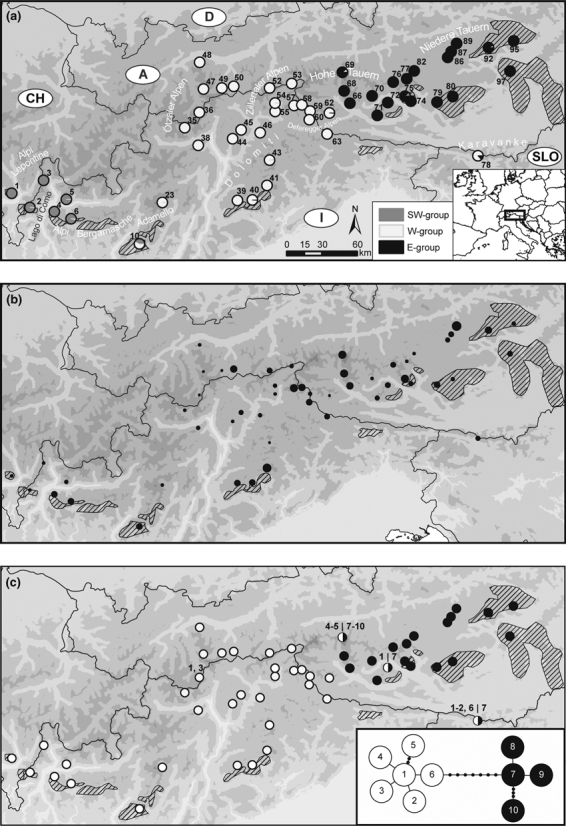
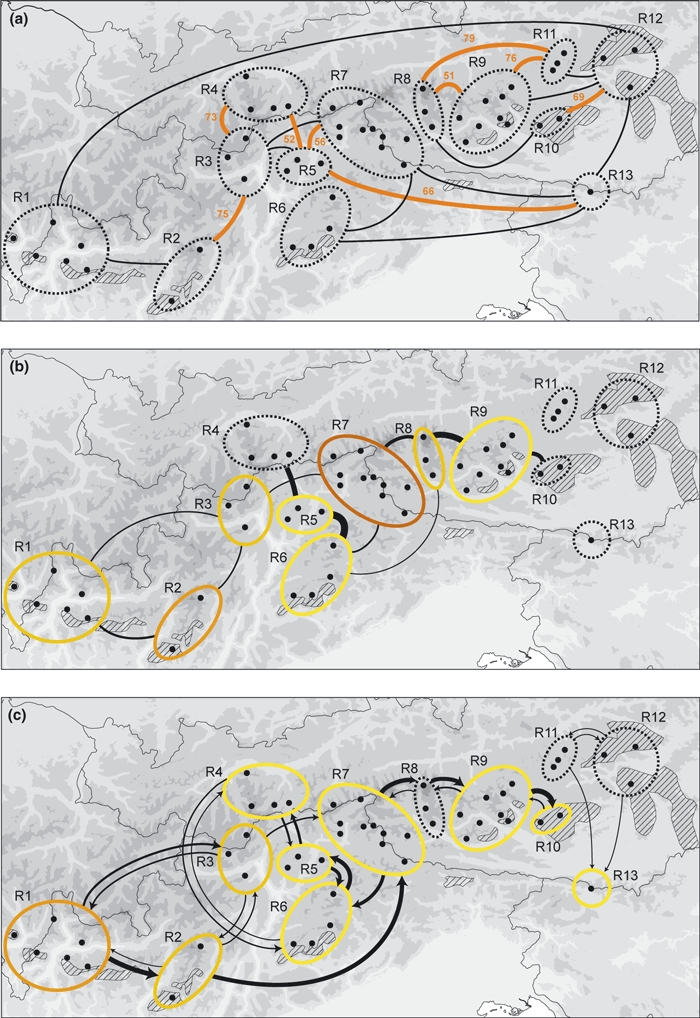
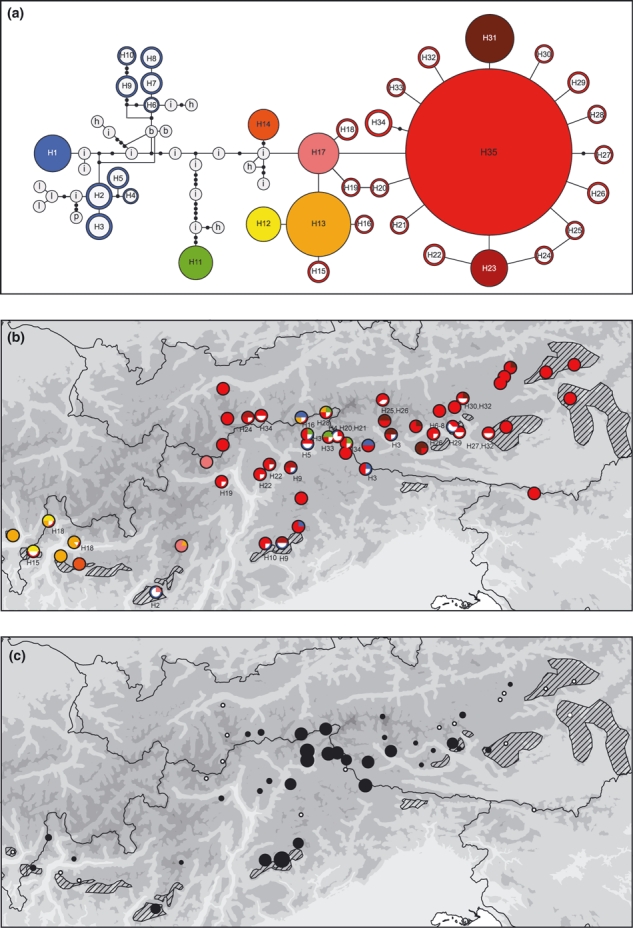
Recent evidence suggests that survival of arctic-alpine organisms in peripheral or interior glacial refugia are not mutually exclusive and may both be involved in shaping an organism's Pleistocene history, yet potentially at different time levels. Here, we test this hypothesis in a high-mountain plant (diploid lineage of Senecio carniolicus, Asteraceae) from the Eastern European Alps, in which patterns of morphological variation and current habitat requirements suggest survival in both types of refugia. To this end, we used AFLPs, nuclear and plastid DNA sequences and analysed them, among others, within a graph theoretic framework and using novel Bayesian methods of phylogeographic inference. On the basis of patterns of genetic diversity, occurrence of rare markers, distribution of distinct genetic lineages and patterns of range connectivity both interior refugia in the formerly strongly glaciated central Alps and peripheral refugia along the southern margin of the Alps were identified. The presence of refugia congruently inferred by markers resolving at different time levels suggests that these refugia acted as such throughout several glacial cycles. The high degree of range persistence together with gradual range expansion, which contrasts with the extent of range shifts implied for other Alpine species, is likely responsible for incipient lineage differentiation evident from the genetic data. Replacing a simplistic peripheral vs. interior refugia dualism by more complex models involving both types of refugia and considering different time levels will help identifying common phylogeographic patterns with respect to, for instance, location of refugia and colonization routes and elucidating their underlying genetic and/or ecological causes. DNA sequences have been deposited in GenBank under accession nos. FR796701–FR797793 and nos. HE614296–HE614583.
最近的证据表明,北极高山生物在边缘或内部冰川避难所中的生存并不是相互排斥的,它们都可能参与塑造生物的更新世历史,但可能处于不同的时间水平。在这里,我们在来自东欧阿尔卑斯山的一种高山植物(菊科千里光属的二倍体谱系)中检验了这一假设,该植物的形态变异模式和当前的生境需求表明它在两种避难所中都有生存。为此,我们使用 AFLPs、核和质体 DNA 序列进行了分析,并在图论框架内进行了分析,还使用了新的贝叶斯系统地理学推断方法。基于遗传多样性模式、稀有标记的出现、不同遗传谱系的分布以及范围连接模式,确定了曾经强烈冰川作用的中央阿尔卑斯山内部避难所和阿尔卑斯山南缘的边缘避难所。通过解决不同时间水平的标记推断出的避难所的存在表明,这些避难所在几个冰川周期中都起到了避难所的作用。范围的高度持续存在与逐渐的范围扩张,与其他高山物种所暗示的范围转移程度形成对比,这可能是遗传数据中明显的谱系分化的原因。用涉及两种避难所并考虑不同时间水平的更复杂模型替代简单的边缘与内部避难所二元论,将有助于确定常见的系统地理学模式,例如,避难所的位置和殖民化路线,并阐明其潜在的遗传和/或生态原因。DNA 序列已在 GenBank 中注册,登录号为 FR796701-FR797793 和 HE614296-HE614583。