Department of Botany and Biodiversity Research, University of Vienna, Vienna, Austria.
Mol Ecol. 2020 Jan;29(1):172-183. doi: 10.1111/mec.15316. Epub 2019 Dec 12.
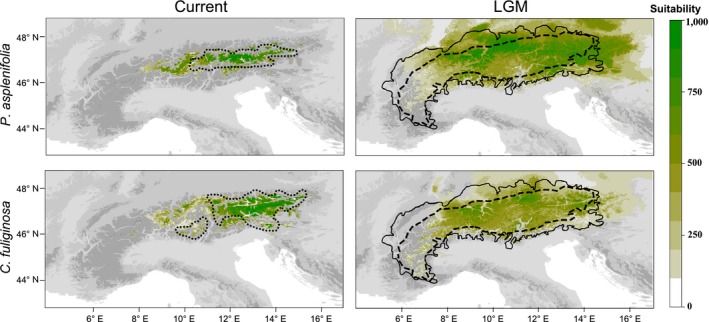
Pleistocene climate fluctuations had profound influence on the biogeographical history of many biota. As large areas in high mountain ranges were covered by glaciers, biota were forced either to peripheral refugia (and possibly beyond to lowland refugia) or to interior refugia (nunataks). However, nunatak survival remains controversial as it relies solely on correlative genetic evidence. Here, we test hypotheses of glacial survival using two high alpine plant species (the insect-pollinated Pedicularis asplenifolia and wind-pollinated Carex fuliginosa) in the European Alps. Employing the iDDC (integrative Distributional, Demographic and Coalescent) approach, which couples species distribution modelling, spatial and temporal demographic simulation and Approximate Bayesian Computation, we explicitly test three hypotheses of glacial survival: (a) peripheral survival only, (b) nunatak survival only and (c) peripheral plus nunatak survival. In P. asplenifolia the peripheral plus nunatak survival hypothesis was supported by Bayes factors (BF> 100), whereas in C. fuliginosa the peripheral survival only hypothesis, although best supported, could not be unambiguously distinguished from the peripheral plus nunatak survival hypothesis (BF = 5.58). These results are consistent with current habitat preferences (P. asplenifolia extends to higher elevations) and the potential for genetic swamping (i.e., replacement of local genotypes via hybridization with immigrating genotypes [expected to be higher in the wind-pollinated C. fuliginosa]). Although the persistence of plants on nunataks during glacial periods has been debated and studied over decades, this is one of the first studies to explicitly test the hypothesis instead of solely using correlative evidence.
更新世气候波动对许多生物的生物地理历史产生了深远的影响。由于高山山脉的大片地区被冰川覆盖,生物要么被迫进入外围避难所(可能更远的低地避难所),要么进入内部避难所(冰原孤岛)。然而,冰原孤岛的生存仍然存在争议,因为它仅依赖于相关的遗传证据。在这里,我们使用两种高山植物物种(传粉昆虫的报春花属和风传粉的黑麦草属)来测试欧洲阿尔卑斯山的冰川生存假说。采用 iDDC(综合分布、人口和合并)方法,该方法结合了物种分布模型、空间和时间人口模拟以及近似贝叶斯计算,我们明确地测试了三种冰川生存假说:(a)仅外围生存,(b)仅冰原孤岛生存,(c)外围加冰原孤岛生存。在报春花属中,外围加冰原孤岛生存假说得到了贝叶斯因子(BF>100)的支持,而在黑麦草属中,尽管外围生存假说得到了最好的支持,但与外围加冰原孤岛生存假说之间无法明确区分(BF=5.58)。这些结果与当前的栖息地偏好一致(报春花属延伸到更高的海拔),以及遗传淹没的潜力(即,通过与迁入基因型杂交取代当地基因型[预期在风传粉的黑麦草属中更高])。尽管几十年来,植物在冰川时期在冰原孤岛的生存一直存在争议和研究,但这是首次明确测试该假说的研究之一,而不是仅仅使用相关证据。