Department of Medicine, Boston University School of Medicine, 650 Albany Street, Boston, MA 02118, USA.
Breast Cancer Res. 2012 Jan 25;14(1):R18. doi: 10.1186/bcr3102.
It is still uncertain whether metastasis is predominantly an early or late event in tumor progression. The detection of early metastases and cells responsible for the dissemination may therefore have significant clinical implications.
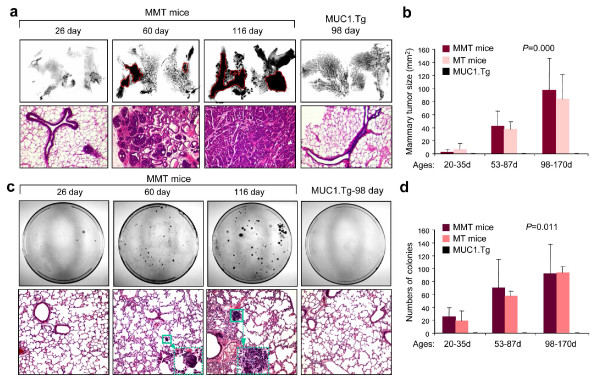
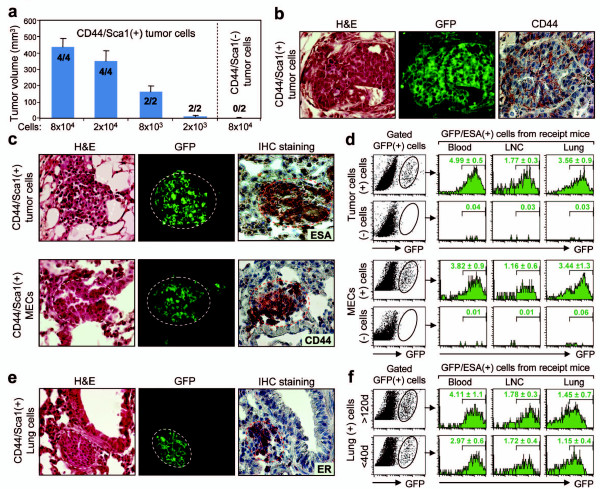
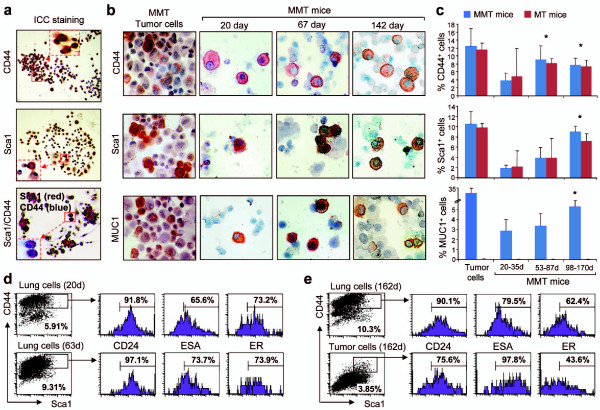
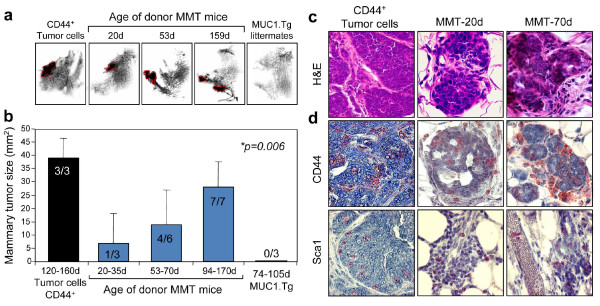
Lung dissemination and/or metastasis were investigated in mice carrying the polyomavirus middle-T oncogene (PyMT) during different stages of mammary tumorigenesis using the colony forming assay. Immunocytochemical or immunohistochemical staining was used to identify subpopulations of cells responsible for lung dissemination and metastasis. Histological examination was used to show primary and metastatic tumors. The tumor-initiating and metastatic capacity of cells expressing stem cell markers was assessed in syngeneic wild-type (WT) mice whose mammary fat pads were injected with these cells.
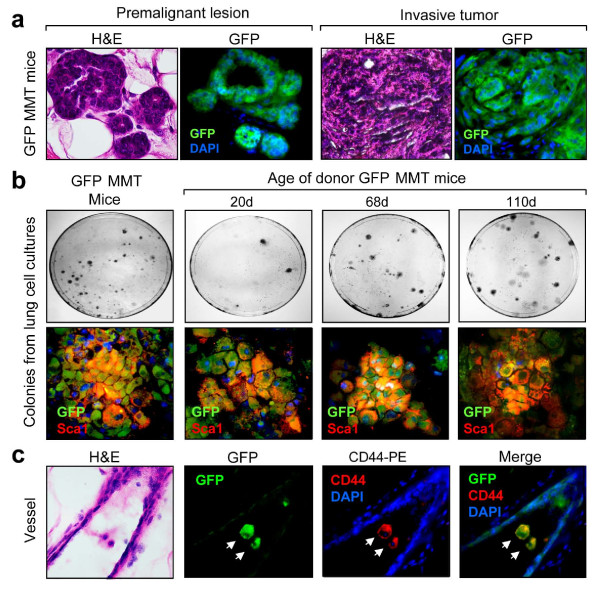
Metastatic mammary epithelial cells were detected in the lungs of mice carrying the PyMT oncogene (MMT mice). These cells were observed early in breast tumorigenesis when the mammary tree appeared by histological inspection to be normal (or at a premalignant stage), suggesting the possession of disseminating and metastatic capacity even before full malignant transformation. Some of the disseminated cells and lung metastases displayed surface stem cell markers. These findings suggest that stem cells from apparently precancerous primary lesions could be a source of metastasis. Indeed, injection of lung tissue cells from MMT mice into syngeneic WT mice resulted in the formation of mammary tumors. These tumors resembled their parent mammary tumors in the MMT donors as well as grafted tumors derived from mammary tumor cells. Furthermore, when we injected lung tissue cells from GFP MMT mice into the fat pads of recipient WT mice, disseminated or metastatic GFP-expressing cells were detected in the lungs, lymph nodes and blood of the recipient WT mice. We finally identified a subpopulation of mammary epithelial/tumor cells expressing CD44 and Sca1 that was largely responsible for dissemination and metastasis in MMT mice.
The tumorigenic and metastatic potential of a subpopulation of mammary epithelial/tumor cells in MMT mice is endowed relatively early in mammary neoplasms and suggests a potential role for cancer stem cell sub-populations in metastasis.
转移是肿瘤进展中早期还是晚期事件尚不确定。因此,检测早期转移和负责播散的细胞可能具有重要的临床意义。
在不同阶段的乳腺癌发生过程中,使用集落形成实验研究携带多瘤病毒中 T 抗原(PyMT)的小鼠中的肺播散和/或转移。免疫细胞化学或免疫组织化学染色用于鉴定负责肺播散和转移的细胞亚群。组织学检查用于显示原发性和转移性肿瘤。将表达干细胞标志物的细胞的肿瘤起始和转移能力评估为接受这些细胞注射的同基因野生型(WT)小鼠。
携带 PyMT 致癌基因(MMT 小鼠)的小鼠肺部检测到转移性乳腺上皮细胞。这些细胞在乳腺树似乎正常(或处于癌前阶段)时在乳腺癌发生的早期观察到,表明即使在完全恶性转化之前,也具有播散和转移能力。一些播散细胞和肺转移瘤显示表面干细胞标志物。这些发现表明,来自明显癌前原发性病变的干细胞可能是转移的来源。事实上,将 MMT 小鼠的肺组织细胞注射到同基因 WT 小鼠中导致乳腺肿瘤的形成。这些肿瘤在 MMT 供体中类似于其母系乳腺肿瘤,以及从乳腺肿瘤细胞移植的肿瘤。此外,当我们将 GFP MMT 小鼠的肺组织细胞注射到受体 WT 小鼠的脂肪垫中时,在受体 WT 小鼠的肺部、淋巴结和血液中检测到 GFP 表达的播散或转移性细胞。最后,我们鉴定出表达 CD44 和 Sca1 的乳腺上皮/肿瘤细胞的一个亚群,该亚群在 MMT 小鼠中主要负责播散和转移。
MMT 小鼠中乳腺上皮/肿瘤细胞的一个亚群具有致瘤和转移潜力,在乳腺肿瘤中相对较早获得,提示癌症干细胞亚群在转移中可能具有潜在作用。