Department of Systems Biology, Harvard Medical School, Boston, MA 02115, USA.
Mol Biol Cell. 2012 Mar;23(6):1024-34. doi: 10.1091/mbc.E11-08-0721. Epub 2012 Jan 25.
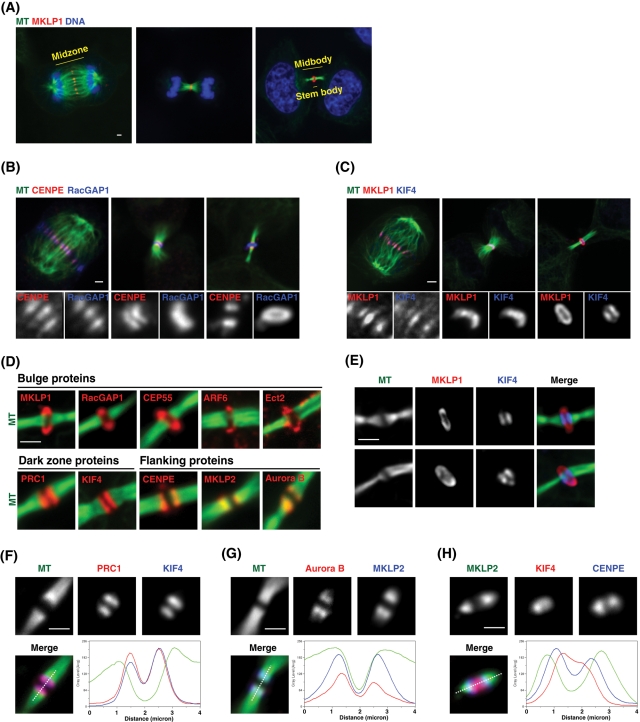
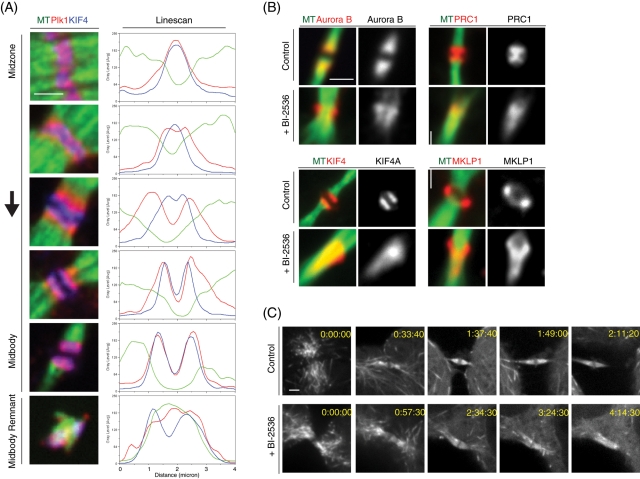
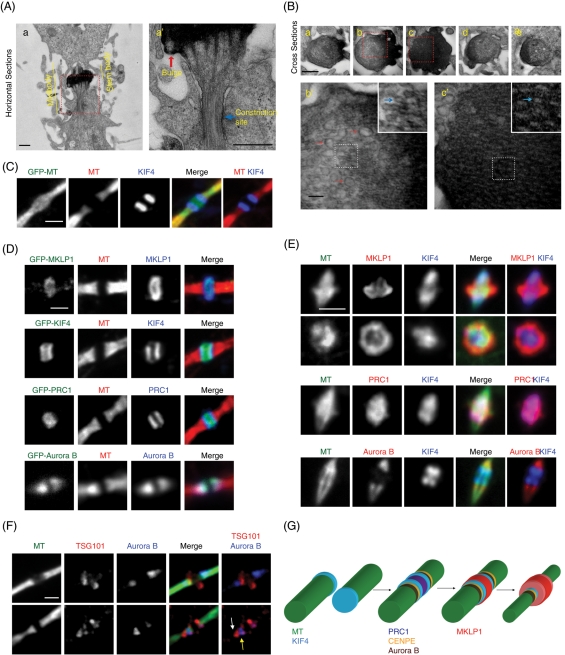
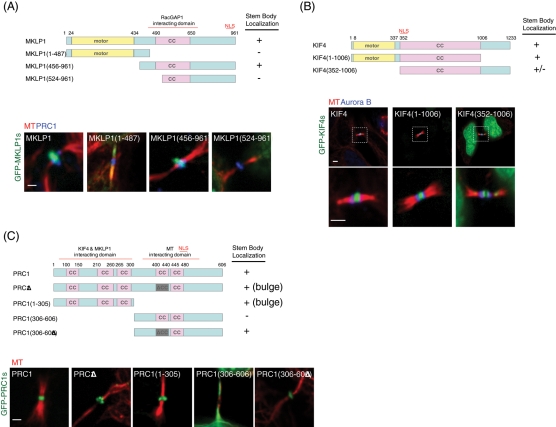
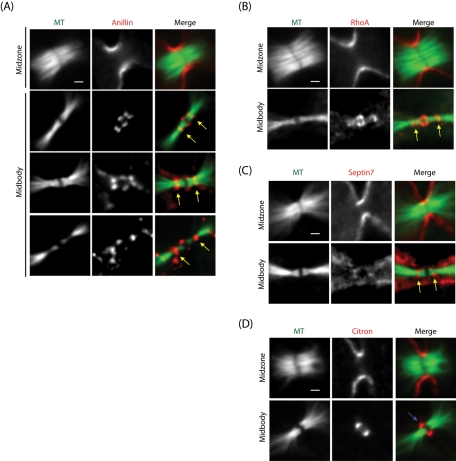
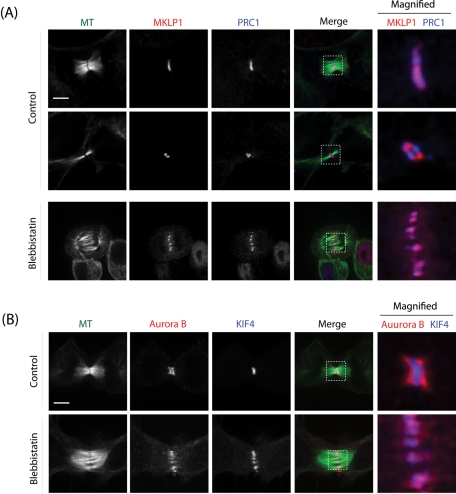
The midbody is a transient structure that connects two daughter cells at the end of cytokinesis, with the principal function being to localize the site of abscission, which physically separates two daughter cells. Despite its importance, understanding of midbody assembly and its regulation is still limited. Here we describe how the structural composition of the midbody changes during progression throughout cytokinesis and explore the functional implications of these changes. Deriving from midzones, midbodies are organized by a set of microtubule interacting proteins that colocalize to a zone of microtubule overlap in the center. We found that these proteins split into three subgroups that relocalize to different parts of the midbody: the bulge, the dark zone, and the flanking zone. We characterized these relocalizations and defined domain requirements for three key proteins: MKLP1, KIF4, and PRC1. Two cortical proteins-anillin and RhoA-localized to presumptive abscission sites in mature midbodies, where they may regulate the endosomal sorting complex required for transport machinery. Finally, we characterized the role of Plk1, a key regulator of cytokinesis, in midbody assembly. Our findings represent the most detailed description of midbody assembly and maturation to date and may help elucidate how abscission sites are positioned and regulated.
中体是在胞质分裂末期连接两个子细胞的瞬态结构,其主要功能是定位胞质分裂的分离点,从而将两个子细胞物理分离。尽管中体非常重要,但其组装和调控机制仍知之甚少。本文描述了中体在胞质分裂过程中的结构组成是如何变化的,并探讨了这些变化的功能意义。从中区衍生而来的中体由一组微管相互作用蛋白组成,这些蛋白在微管重叠的中心区域聚集在一起。我们发现这些蛋白可分为三个亚群,重新定位到中体的不同区域:隆起部、暗区和侧翼区。我们对这些重定位进行了表征,并定义了三个关键蛋白(MKLP1、KIF4 和 PRC1)的结构域要求。两种皮质蛋白——肌动蛋白和 RhoA——定位于成熟中体的假定分离部位,在那里它们可能调节内体分选复合物所必需的运输机制。最后,我们研究了细胞分裂关键调节因子 Plk1 在中体组装中的作用。我们的研究结果代表了迄今为止对中体组装和成熟的最详细描述,可能有助于阐明分离点的定位和调控机制。