Jeloka T K, Upase S, Chitikeshi S
Department of Nephrology, Hemodialysis Unit, Aditya Birla Memorial Hospital, Chinchwad, Pune, India.
Indian J Nephrol. 2012 Jan;22(1):39-41. doi: 10.4103/0971-4065.83739.
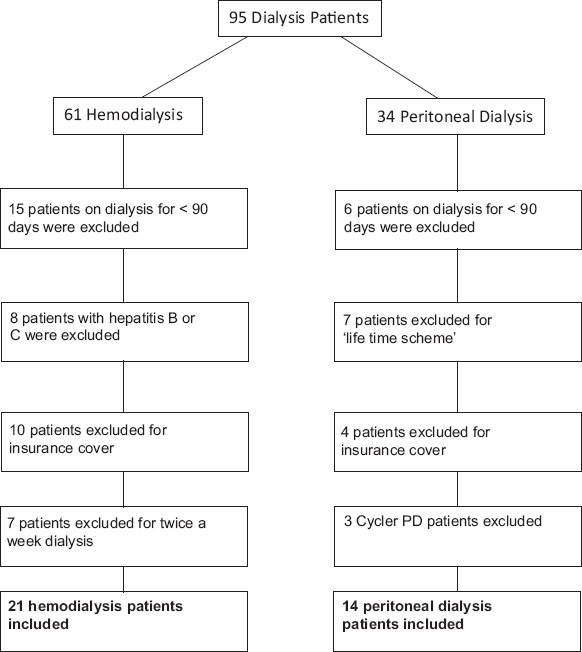
In India, majority of patients on dialysis are 'self paying' because of limited health insurance coverage available from government as well as private insurance providers. Hence, cost of treatment becomes one deciding factor to choose between the two modalities of dialysis - hemodialysis (HD) and peritoneal dialysis (PD). Aim is to compare the monthly cost of maintenance hemodialysis and peritoneal dialysis at our center. Majority of patients at our center are on thrice a week hemodialysis and three times a day peritoneal dialysis. These patients were asked to submit their total direct cost of treatment of last three months. It included cost of dialysis, erythropoietin, other medicines, monthly laboratory tests, hospitalization cost, travel cost, and any other directly involved in the treatment. Monthly cost (Indian Rupees, ) was then calculated by averaging the three month cost for each patient. The monthly cost of hemodialysis and peritoneal dialysis was then compared using 'independent sample t-test'. Thirty five patients were finally included in the analysis (21 on HD and 14 on PD). Demographic profile between the two groups was similar in terms of age, sex ratio, period on dialysis, hemoglobin, blood urea nitrogen, and creatinine. Total monthly cost of dialysis was similar in both the groups ( 29,252 ± 6859 vs. 28,763 ± 5486, P = 0.85). The lower cost of hemodialysis procedure per se as compared to peritoneal dialysis procedure cost ( 14,669 ± 1376 vs. 19,528 ± 4072, P = 0.000) was compensated by higher cost of erythropoietin ( 7160 ± 3353 vs. 3093 ± 1889, P = 0.002) and travel cost ( 1654 ± 1085 vs. 76 ± 66, P < 0.0001) to equalize the monthly cost between the two groups. Our analysis showed no difference in the monthly cost of hemodialysis and peritoneal dialysis and hence, for self-paying patient in India, cost of treatment should not be a deciding factor while choosing between the two modalities.
在印度,由于政府及私人保险提供商提供的医疗保险覆盖范围有限,大多数接受透析治疗的患者需“自费”。因此,治疗费用成为在两种透析方式——血液透析(HD)和腹膜透析(PD)之间进行选择的一个决定性因素。目的是比较我们中心维持性血液透析和腹膜透析的每月费用。我们中心的大多数患者接受每周三次的血液透析和每天三次的腹膜透析。这些患者被要求提交过去三个月的总直接治疗费用。这包括透析费用、促红细胞生成素、其他药物、每月实验室检查费用、住院费用、交通费用以及治疗中涉及的任何其他直接费用。然后通过计算每位患者三个月费用的平均值得出每月费用(印度卢比)。随后使用“独立样本t检验”比较血液透析和腹膜透析的每月费用。最终35名患者被纳入分析(21名接受血液透析,14名接受腹膜透析)。两组之间在年龄、性别比例、透析时间、血红蛋白、血尿素氮和肌酐方面的人口统计学特征相似。两组的每月透析总费用相似(29252±6859对比28763±5486,P = 0.85)。血液透析本身较低的治疗费用与腹膜透析治疗费用相比(14669±1376对比19528±4072,P = 0.000),被促红细胞生成素较高的费用(7160±3353对比3093±1889,P = 0.002)和交通费用(1654±1085对比76±66,P < 0.0001)所抵消,从而使两组的每月费用相等。我们的分析表明血液透析和腹膜透析的每月费用没有差异,因此,对于印度的自费患者而言,在选择这两种透析方式时,治疗费用不应成为决定性因素。