Intercollege Graduate Degree Program in Plant Biology, The Pennsylvania State University, University Park, PA 16802, USA.
Genome Biol. 2012 Jan 26;13(1):R3. doi: 10.1186/gb-2012-13-1-r3.
Although it is agreed that a major polyploidy event, gamma, occurred within the eudicots, the phylogenetic placement of the event remains unclear.
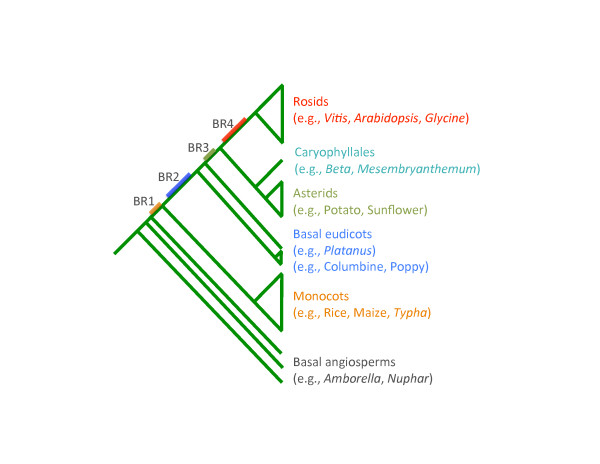
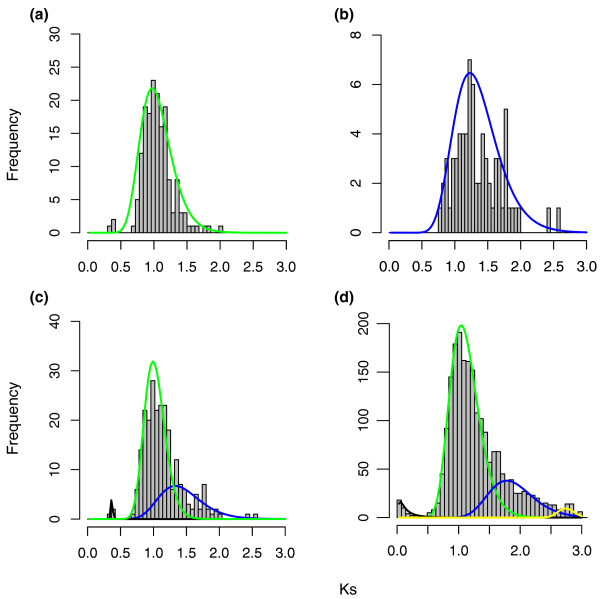
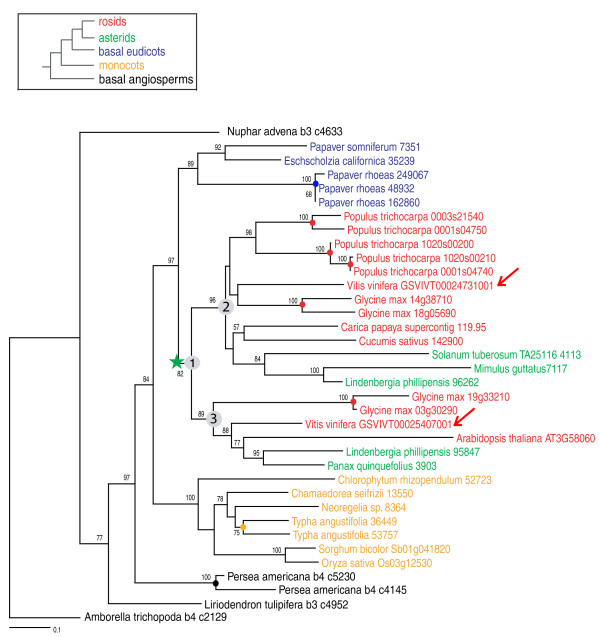
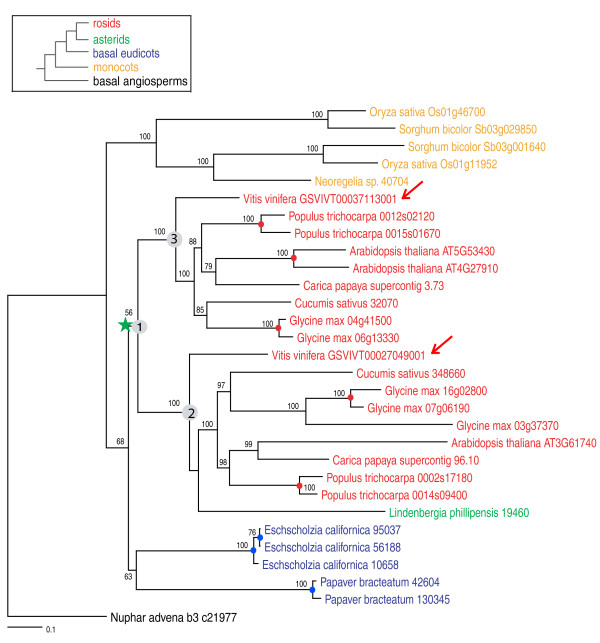
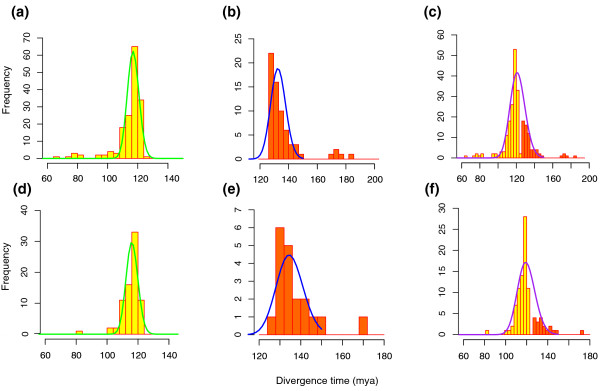
To determine when this polyploidization occurred relative to speciation events in angiosperm history, we employed a phylogenomic approach to investigate the timing of gene set duplications located on syntenic gamma blocks. We populated 769 putative gene families with large sets of homologs obtained from public transcriptomes of basal angiosperms, magnoliids, asterids, and more than 91.8 gigabases of new next-generation transcriptome sequences of non-grass monocots and basal eudicots. The overwhelming majority (95%) of well-resolved gamma duplications was placed before the separation of rosids and asterids and after the split of monocots and eudicots, providing strong evidence that the gamma polyploidy event occurred early in eudicot evolution. Further, the majority of gene duplications was placed after the divergence of the Ranunculales and core eudicots, indicating that the gamma appears to be restricted to core eudicots. Molecular dating estimates indicate that the duplication events were intensely concentrated around 117 million years ago.
The rapid radiation of core eudicot lineages that gave rise to nearly 75% of angiosperm species appears to have occurred coincidentally or shortly following the gamma triplication event. Reconciliation of gene trees with a species phylogeny can elucidate the timing of major events in genome evolution, even when genome sequences are only available for a subset of species represented in the gene trees. Comprehensive transcriptome datasets are valuable complements to genome sequences for high-resolution phylogenomic analysis.
尽管人们普遍认为在真双子叶植物中发生了一次重大的多倍体事件γ,但该事件的系统发育位置仍不清楚。
为了确定这种多倍化事件相对于被子植物历史上的物种形成事件发生的时间,我们采用了一种基因组学方法来研究位于同线性γ块上的基因集复制的时间。我们用来自基干被子植物、木兰类植物、类堇菜类植物的公共转录组中获得的大量同源物填充了 769 个假定的基因家族,并且使用了超过 91.8 千兆碱基的非禾本科单子叶植物和基干真双子叶植物的新一代转录组序列的新的下一代转录组序列。绝大多数(95%)解析良好的γ复制发生在蔷薇类和类堇菜类植物分离之前,单子叶植物和真双子叶植物分裂之后,这有力地证明了γ多倍体事件发生在真双子叶植物进化的早期。此外,大多数基因复制发生在毛茛目植物和核心真双子叶植物分化之后,表明γ似乎仅限于核心真双子叶植物。分子定年估计表明,复制事件集中发生在大约 1.17 亿年前。
导致近 75%的被子植物物种快速辐射的核心真双子叶植物谱系的辐射似乎与γ三倍体事件同时或之后不久发生。基因树与物种系统发育的整合可以阐明基因组进化中的重大事件的时间,即使基因组序列仅可用于基因树中代表的一部分物种。全面的转录组数据集是高分辨率基因组学分析的基因组序列的有价值的补充。