Centre for Brain and Cognitive Development, Birkbeck College, University of London, London WC1E 7HX, UK.
Curr Biol. 2012 Feb 21;22(4):338-42. doi: 10.1016/j.cub.2011.12.056. Epub 2012 Jan 26.
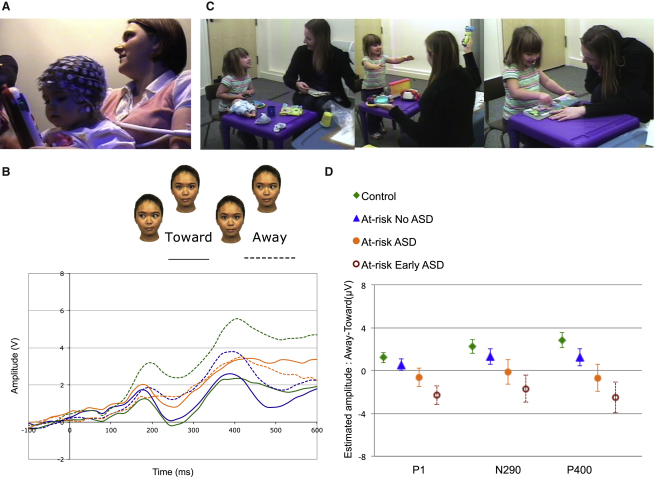
Autism spectrum disorders (henceforth autism) are diagnosed in around 1% of the population [1]. Familial liability confers risk for a broad spectrum of difficulties including the broader autism phenotype (BAP) [2, 3]. There are currently no reliable predictors of autism in infancy, but characteristic behaviors emerge during the second year, enabling diagnosis after this age [4, 5]. Because indicators of brain functioning may be sensitive predictors, and atypical eye contact is characteristic of the syndrome [6-9] and the BAP [10, 11], we examined whether neural sensitivity to eye gaze during infancy is associated with later autism outcomes [12, 13]. We undertook a prospective longitudinal study of infants with and without familial risk for autism. At 6-10 months, we recorded infants' event-related potentials (ERPs) in response to viewing faces with eye gaze directed toward versus away from the infant [14]. Longitudinal analyses showed that characteristics of ERP components evoked in response to dynamic eye gaze shifts during infancy were associated with autism diagnosed at 36 months. ERP responses to eye gaze may help characterize developmental processes that lead to later emerging autism. Findings also elucidate the mechanisms driving the development of the social brain in infancy.
自闭症谱系障碍(下文简称自闭症)在人群中约占 1%[1]。家族易感性使个体面临一系列广泛的困难,包括更广泛的自闭症表型(BAP)[2,3]。目前,婴儿期还没有可靠的自闭症预测指标,但在这个年龄段之后,会出现典型的行为,从而可以进行诊断[4,5]。由于大脑功能的指标可能是敏感的预测指标,并且非典型的眼神接触是该综合征[6-9]和 BAP[10,11]的特征,我们研究了婴儿期对眼神注视的神经敏感性是否与日后的自闭症结果相关[12,13]。我们对有和没有自闭症家族风险的婴儿进行了一项前瞻性纵向研究。在 6-10 个月时,我们记录了婴儿对注视着自己或看向别处的人脸的事件相关电位(ERPs)[14]。纵向分析表明,婴儿期对动态眼神注视转移的 ERP 成分特征与 36 个月时诊断出的自闭症有关。眼动注视的 ERP 反应可能有助于描述导致日后出现自闭症的发育过程。研究结果还阐明了驱动婴儿期社交大脑发育的机制。