Department of Psychology, Counselling and Therapy, School of Psychology and Public Health, La Trobe University, Melbourne, VIC, Australia.
Menzies Health Institute Queensland, Griffith University, Gold Coast, Australia.
Sci Rep. 2024 Mar 1;14(1):5117. doi: 10.1038/s41598-024-55643-z.
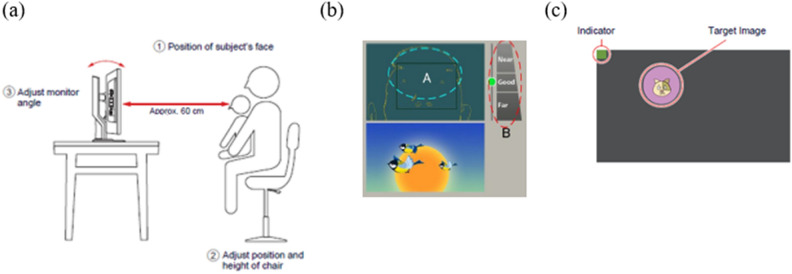
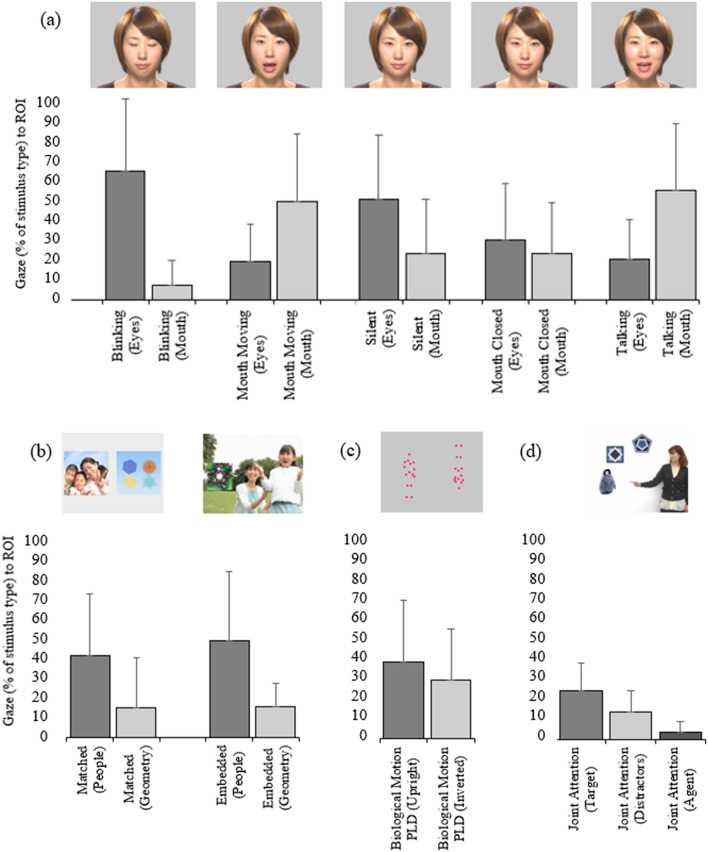
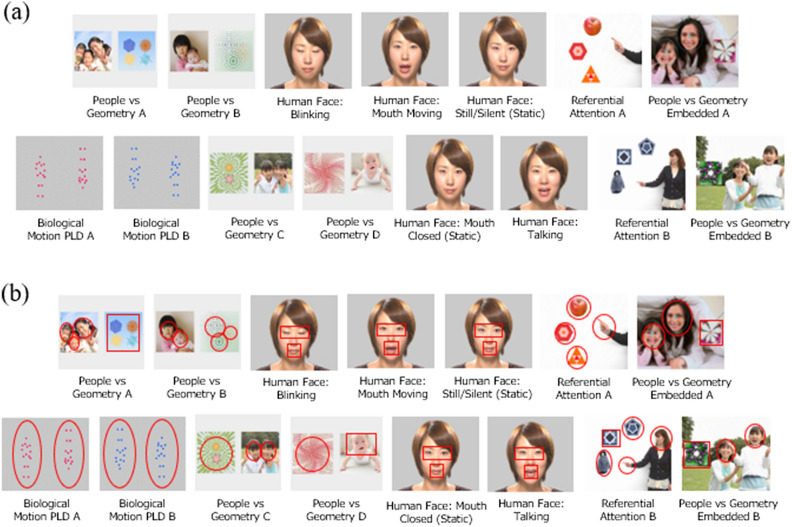
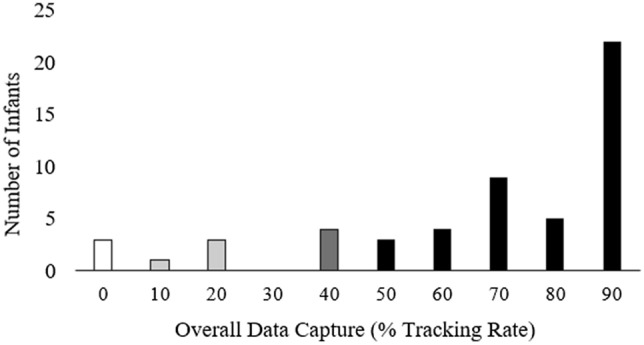
We tested the potential for Gazefinder eye-tracking to support early autism identification, including feasible use with infants, and preliminary concurrent validity of trial-level gaze data against clinical assessment scores. We embedded the ~ 2-min 'Scene 1S4' protocol within a comprehensive clinical assessment for 54 consecutively-referred, clinically-indicated infants (prematurity-corrected age 9-14 months). Alongside % tracking rate as a broad indicator of feasible assessment/data capture, we report infant gaze data to pre-specified regions of interest (ROI) across four trial types and associations with scores on established clinical/behavioural tools. Most infants tolerated Gazefinder eye-tracking well, returning high overall % tracking rate. As a group, infants directed more gaze towards social vs. non-social (or more vs. less socially-salient) ROIs within trials. Behavioural autism features were correlated with increased gaze towards non-social/geometry (vs. social/people) scenes. No associations were found for gaze directed to ROIs within other stimulus types. Notably, there were no associations between developmental/cognitive ability or adaptive behaviour with gaze towards any ROI. Gazefinder assessment seems highly feasible with clinically-indicated infants, and the people vs. geometry stimuli show concurrent predictive validity for behavioural autism features. Aggregating data across the ~ 2-min autism identification protocol might plausibly offer greater utility than stimulus-level analysis alone.
我们测试了 Gazefinder 眼动追踪在支持自闭症早期识别方面的潜力,包括在婴儿中的可行使用,以及试验水平的注视数据与临床评估评分的初步同时有效性。我们将大约 2 分钟的“场景 1S4”协议嵌入到对 54 名连续转诊的、临床指征明显的婴儿(校正胎龄 9-14 个月)进行的全面临床评估中。除了作为可行评估/数据采集的广泛指标的跟踪率外,我们还报告了婴儿在四个试验类型中的特定注视数据感兴趣区(ROI),以及与既定临床/行为工具的分数的关联。大多数婴儿都能很好地耐受 Gazefinder 眼动追踪,总体跟踪率很高。作为一个群体,婴儿在试验中更多地将目光投向社会区域,而不是非社会区域(或更社会相关的区域)。行为自闭症特征与非社会/几何区域(与社会/人)的注视增加有关。在其他刺激类型的 ROI 中,注视方向没有发现任何关联。值得注意的是,在任何 ROI 注视方向上,与发育/认知能力或适应行为都没有关联。Gazefinder 评估对于临床指征明显的婴儿来说非常可行,并且人与几何图形刺激对于行为自闭症特征具有同时的预测有效性。在大约 2 分钟的自闭症识别协议中,跨数据的聚合可能比仅在刺激水平上的分析更具实用性。