College of Electronics and Information Engineering, Sichuan University, 610065, P.R. China.
Magn Reson Imaging. 2012 May;30(4):485-95. doi: 10.1016/j.mri.2011.12.017. Epub 2012 Jan 27.
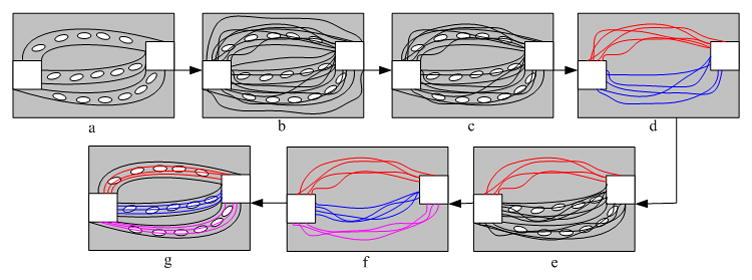
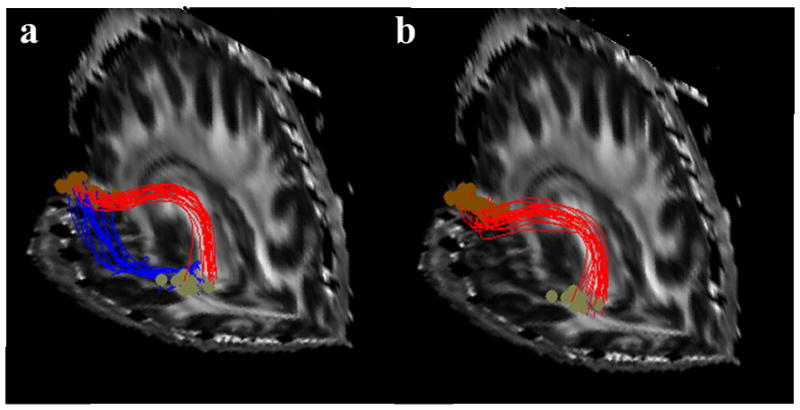
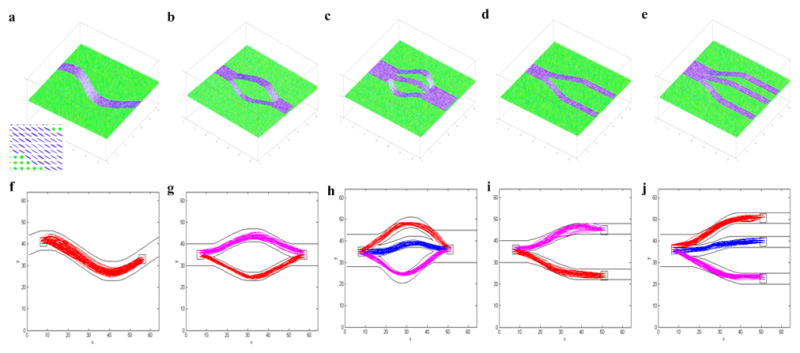
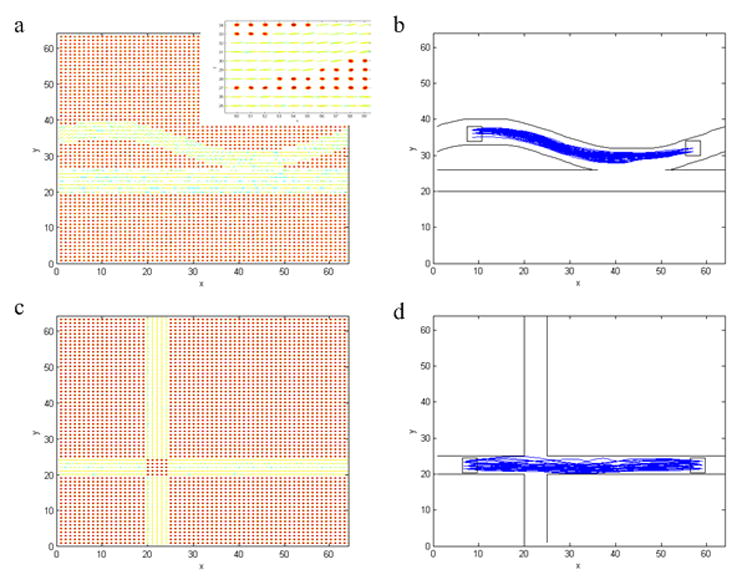
Structural connectivity between cortical regions of the human brain can be characterized noninvasively with diffusion tensor imaging (DTI)-based fiber tractography. In this paper, a novel fiber tractography technique, globally optimized fiber tracking and hierarchical fiber clustering, is presented. The proposed technique uses k-means clustering in conjunction with modified Hubert statistic to partition fiber pathways, which are evaluated with simultaneous consideration of consistency with underlying DTI data and smoothness of fiber courses in the sense of global optimality, into individual anatomically coherent fiber bundles. In each resulting bundle, fibers are sampled, perturbed and clustered iteratively to approach the optimal solution. The global optimality allows the proposed technique to resist local image artifacts and to possess inherent capabilities of handling complex fiber structures and tracking fibers between gray matter regions. The embedded hierarchical clustering allows multiple fiber bundles between a pair of seed regions to be naturally reconstructed and partitioned. The integration of globally optimized tracking and hierarchical clustering greatly benefits applications of DTI-based fiber tractography to clinical studies, particularly to studies of structure-function relations of the complex neural network of the human. Experiments with synthetic and in vivo human DTI data have demonstrated the effectiveness of the proposed technique in tracking complex fiber structures, thus proving its significant advantages over traditionally used streamline fiber tractography.
利用基于扩散张量成像(DTI)的纤维束示踪技术,可以对人脑皮质区域之间的结构连接进行非侵入性的描述。在本文中,我们提出了一种新颖的纤维束示踪技术,即全局优化纤维跟踪和层次纤维聚类。该技术使用 k-均值聚类结合修改后的 Hubert 统计量来划分纤维通路,然后同时考虑与基础 DTI 数据的一致性以及纤维路径在全局最优意义上的平滑性,将这些纤维通路划分成单独的解剖学上连贯的纤维束。在每个生成的束中,通过迭代抽样、扰动和聚类来逼近最优解。全局最优性使得该技术能够抵抗局部图像伪影,并具有处理复杂纤维结构和在灰质区域之间跟踪纤维的固有能力。嵌入式层次聚类允许自然地重建和划分一对种子区域之间的多个纤维束。全局优化跟踪和层次聚类的集成极大地促进了基于 DTI 的纤维束示踪技术在临床研究中的应用,特别是在研究人类复杂神经网络的结构-功能关系方面。对合成和体内人类 DTI 数据的实验表明,该技术在跟踪复杂纤维结构方面非常有效,因此证明了它相对于传统使用的流线纤维束示踪技术具有显著的优势。