Department of Psychiatry, Warneford Hospital, University of Oxford, Oxford, United Kingdom.
J Abnorm Psychol. 2012 Nov;121(4):795-809. doi: 10.1037/a0026847. Epub 2012 Jan 30.
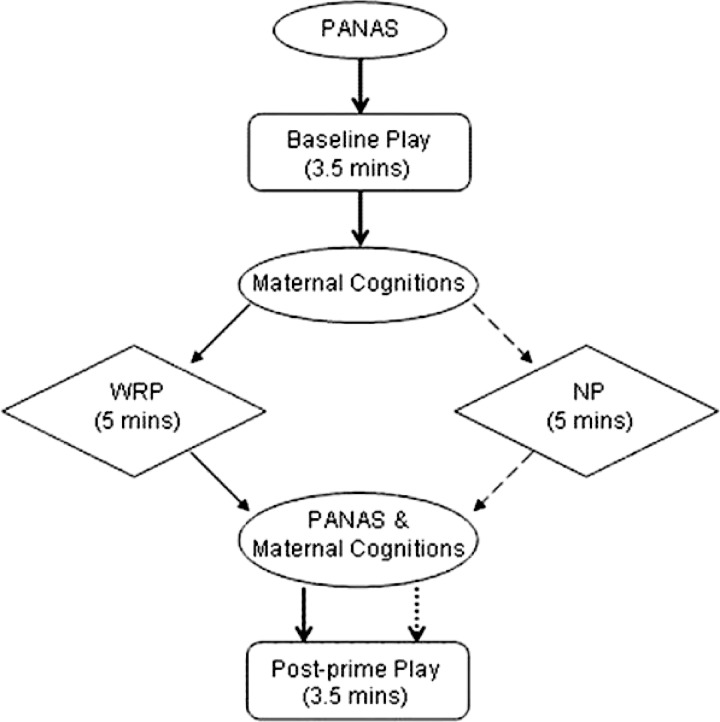
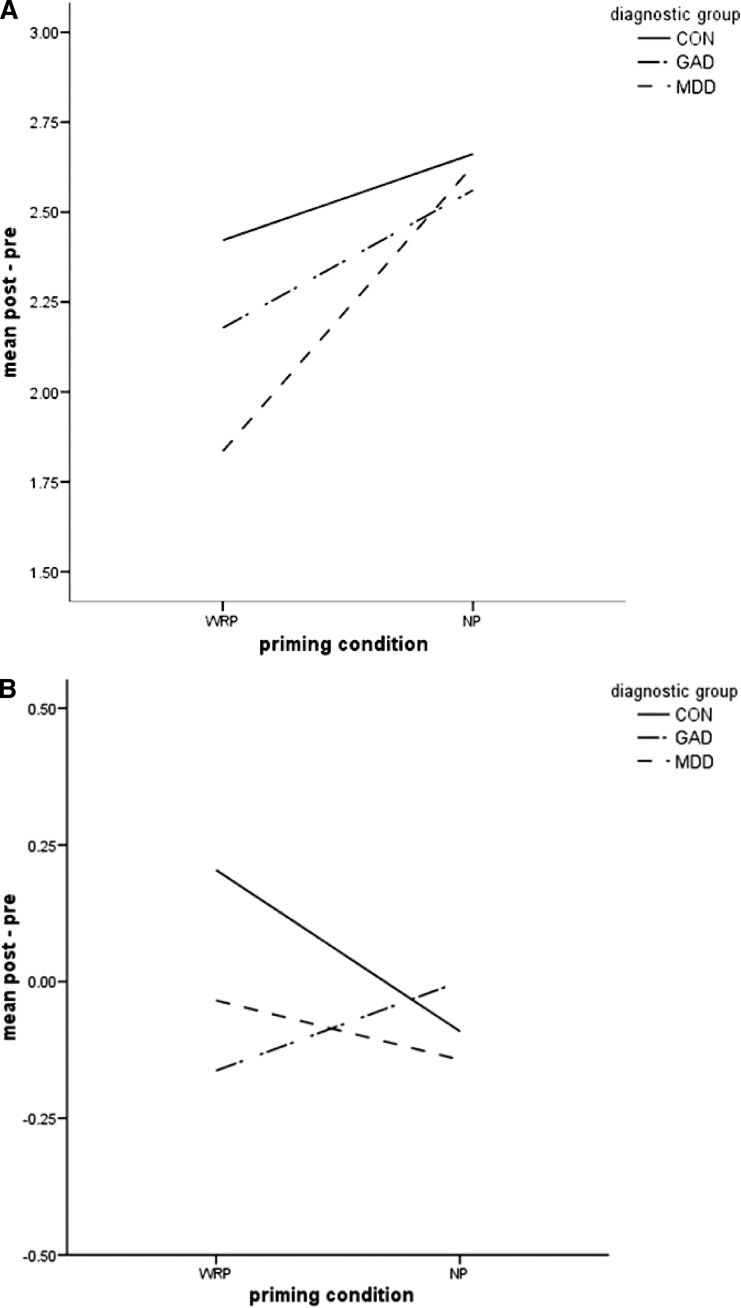
Postnatal depression and anxiety have been shown to increase the risk of disturbances in mother-child interaction and child development. Research into mechanisms has focused on genetics and maternal behavior; maternal cognitions have received little attention. Our aim was to experimentally determine if worry and rumination in mothers with generalized anxiety disorder (GAD) and major depressive disorder (MDD), diagnosed in the postnatal 6 months, interfered with maternal responsiveness to their 10-month old infants. Mothers (N = 253: GAD n = 90; MDD n = 57; control n = 106) and their infants were randomized to either a worry/rumination prime (WRP) or a neutral prime (NP); mother-infant interactions were assessed before and after priming. Type of priming was a significant predictor of maternal cognitions, with WRP resulting in more negative thoughts, higher thought recurrence and more self-focus relative to NP across the entire sample. Interaction effects between group and priming were significant for two parenting variables: Compared with controls, WRP had a more negative impact on maternal responsiveness to infant vocalization for GAD, and to a lesser extent for MDD; WRP led to decreased maternal vocalization for GAD. Also, mothers with GAD used stronger control after the NP than WRP, as well as compared with other groups, and overall post-priming, their children exhibited lower emotional tone and more withdrawal. Across the entire sample, WRP was associated with increased child vocalization relative to NP. This study demonstrated that disturbances in maternal cognitions, in the context of postnatal anxiety and to a lesser degree depression, play a significant role in mother-child interaction.
产后抑郁和焦虑已被证明会增加母婴互动和儿童发育障碍的风险。机制研究集中在遗传学和母婴行为上;而母亲的认知则很少受到关注。我们的目的是通过实验确定患有广泛性焦虑症(GAD)和重度抑郁症(MDD)的母亲(产后 6 个月内被诊断出)的担忧和沉思是否会干扰她们对 10 个月大婴儿的反应能力。母亲(N=253:GAD 组 n=90;MDD 组 n=57;对照组 n=106)及其婴儿被随机分为担忧/沉思启动组(WRP)或中性启动组(NP);在启动前后评估母婴互动。启动类型是母亲认知的一个显著预测因素,与 NP 相比,WRP 导致整个样本中更多的负面想法、更高的思维重现和更多的自我关注。组间和启动间的相互作用对两个育儿变量有显著影响:与对照组相比,WRP 对 GAD 婴儿的哭声反应能力产生了更负面的影响,对 MDD 的影响较小;WRP 导致 GAD 母亲的语言减少。此外,GAD 母亲在 NP 后比 WRP 后以及与其他组相比,使用了更强的控制,并且整体上,NP 后她们的孩子表现出更低的情绪和更多的退缩。在整个样本中,与 NP 相比,WRP 与儿童的语言增加有关。这项研究表明,产后焦虑(在一定程度上也与产后抑郁有关)会导致母亲认知的紊乱,这在母婴互动中起着重要作用。