Mishra Anusha, Newman Eric A
Department of Neuroscience, University of Minnesota Minneapolis, MN, USA.
Front Neuroenergetics. 2012 Jan 10;3:10. doi: 10.3389/fnene.2011.00010. eCollection 2011.
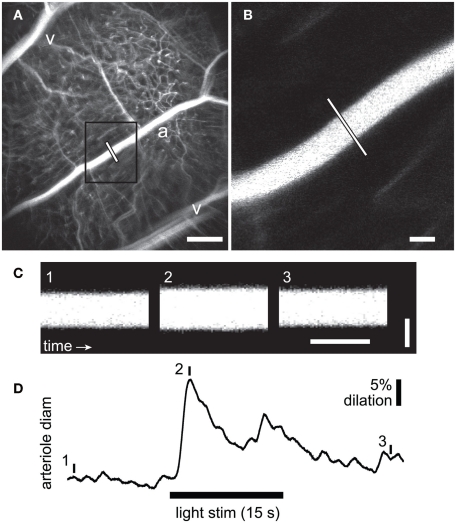
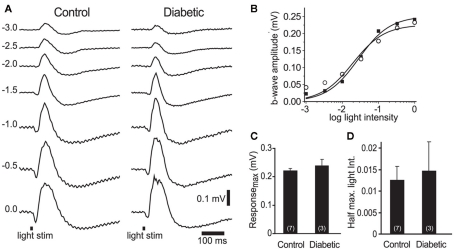
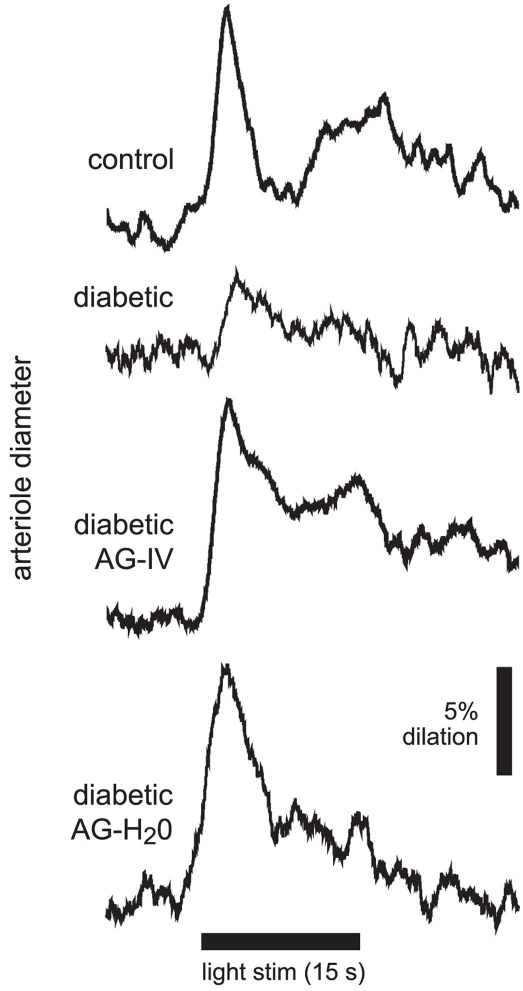
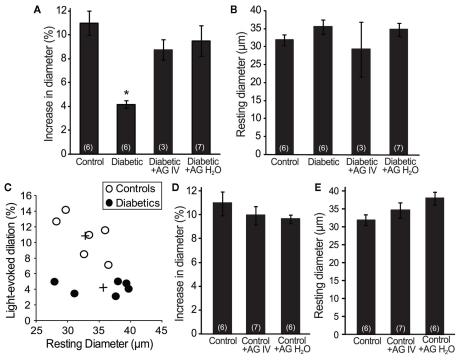
Flickering light dilates retinal arterioles and increases retinal blood flow, a response termed functional hyperemia. This response is diminished in diabetic patients even before the appearance of overt clinical retinopathy. The loss of functional hyperemia could deprive retinal neurons of oxygen and nutrients, possibly exacerbating the development of diabetic retinopathy. We have tested whether inhibiting inducible nitric oxide synthase (iNOS) reverses the loss of functional hyperemia in diabetic rat retinas in vivo. Changes in retinal arteriole diameter were measured following diffuse flickering light stimulation in control rats, streptozotocin-induced type 1 diabetic rats and diabetic rats treated with aminoguanidine (AG; an iNOS inhibitor), either acutely via IV injection or chronically in drinking water. Flickering light-evoked large arteriole dilations (10.8 ± 1.1%) in control rats. This response was diminished by 61% in diabetic animals (4.2 ± 0.3%). Both acute and chronic treatment with AG restored flicker-induced arteriole dilations in diabetic rats (8.8 ± 0.9 and 9.5 ± 1.3%, respectively). The amplitude of the corneal electroretinogram b-wave was similar in control and diabetic animals. These findings demonstrate that inhibiting iNOS with AG is effective in preventing the loss of, and restoring, normal functional hyperemia in the diabetic rat retina. Previous work has demonstrated the efficacy of iNOS inhibitors in slowing the progression of diabetic retinopathy. This effect could be due, in part, to a restoration of functional hyperemia.
闪烁光可使视网膜小动脉扩张并增加视网膜血流量,这种反应被称为功能性充血。即使在明显的临床视网膜病变出现之前,糖尿病患者的这种反应就已减弱。功能性充血的丧失可能会使视网膜神经元得不到氧气和营养物质,这可能会加剧糖尿病视网膜病变的发展。我们已经测试了抑制诱导型一氧化氮合酶(iNOS)是否能逆转糖尿病大鼠视网膜在体内功能性充血的丧失。在对照大鼠、链脲佐菌素诱导的1型糖尿病大鼠以及用氨基胍(AG;一种iNOS抑制剂)治疗的糖尿病大鼠中,通过静脉注射急性给药或在饮用水中长期给药后,在弥漫性闪烁光刺激下测量视网膜小动脉直径的变化。在对照大鼠中,闪烁光可诱发大的小动脉扩张(10.8±1.1%)。在糖尿病动物中,这种反应减弱了61%(4.2±0.3%)。AG的急性和慢性治疗均恢复了糖尿病大鼠中闪烁诱导的小动脉扩张(分别为8.8±0.9%和9.5±1.3%)。对照动物和糖尿病动物的角膜视网膜电图b波振幅相似。这些发现表明,用AG抑制iNOS可有效防止糖尿病大鼠视网膜正常功能性充血的丧失并使其恢复。先前的研究已经证明iNOS抑制剂在减缓糖尿病视网膜病变进展方面的疗效。这种作用可能部分归因于功能性充血的恢复。