New York City Department of Health and Mental Hygiene, New York, New York, United States of America.
PLoS One. 2012;7(1):e29679. doi: 10.1371/journal.pone.0029679. Epub 2012 Jan 24.
Monitoring of the uptake and efficacy of ART in a population often relies on cross-sectional data, providing limited information that could be used to design specific targeted intervention programs. Using repeated measures of viral load (VL) surveillance data, we aimed to estimate and characterize the proportion of persons living with HIV/AIDS (PLWHA) in New York City (NYC) with sustained high VL (SHVL) and durably suppressed VL (DSVL).
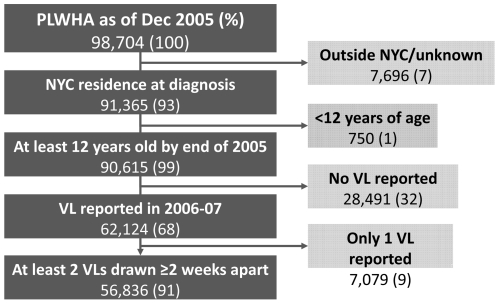
METHODS/PRINCIPAL FINDINGS: Retrospective cohort study of all persons reported to the NYC HIV Surveillance Registry who were alive and ≥12 years old by the end of 2005 and who had ≥2 VL tests in 2006 and 2007. SHVL and DSVL were defined as PLWHA with 2 consecutive VLs ≥100,000 copies/mL and PLWHA with all VLs ≤400 copies/mL, respectively. Logistic regression models using generalized estimating equations were used to model the association between SHVL and covariates. There were 56,836 PLWHA, of whom 7% had SHVL and 38% had DSVL. Compared to those without SHVL, persons with SHVL were more likely to be younger, black and have injection drug use (IDU) risk. PLWHA with SHVL were more likely to die by 2007 and be younger by nearly ten years, on average.
CONCLUSIONS/SIGNIFICANCE: Nearly 60% of PLWHA in 2005 had multiple VLs, of whom almost 40% had DSVL, suggesting successful ART uptake. A small proportion had SHVL, representing groups known to have suboptimal engagement in care. This group should be targeted for additional outreach to reduce morbidity and secondary transmission. Measures based on longitudinal analyses of surveillance data in conjunction with cross-sectional measures such as community viral load represent more precise and powerful tools for monitoring ART effectiveness and potential impact on disease transmission than cross-sectional measures alone.
在人群中监测抗逆转录病毒疗法(ART)的吸收和疗效通常依赖于横断面数据,提供的信息有限,无法用于设计具体的针对性干预方案。本研究使用重复的病毒载量(VL)监测数据,旨在估计和描述纽约市(NYC)艾滋病毒/艾滋病感染者(PLWHA)中持续高 VL(SHVL)和持续低 VL(DSVL)的比例。
方法/主要发现:对 2005 年底存活且年龄≥12 岁并在 2006 年和 2007 年至少有 2 次 VL 检测的 NYC HIV 监测登记处报告的所有 PLWHA 进行回顾性队列研究。SHVL 和 DSVL 定义为 2 次连续 VL≥100,000 拷贝/mL 的 PLWHA 和所有 VL≤400 拷贝/mL 的 PLWHA。使用广义估计方程的 logistic 回归模型来对 SHVL 与协变量之间的关联进行建模。共有 56836 名 PLWHA,其中 7%有 SHVL,38%有 DSVL。与无 SHVL 的患者相比,SHVL 患者更年轻、黑人且有注射吸毒(IDU)风险。到 2007 年,SHVL 患者的死亡率更高,平均年龄小近十岁。
结论/意义:2005 年,近 60%的 PLWHA 有多次 VL 检测,其中近 40%有 DSVL,提示 ART 吸收良好。一小部分患者有 SHVL,代表着已知治疗参与度不佳的群体。应针对这一群体开展更多的外联工作,以降低发病率和二次传播。基于纵向监测数据分析的措施与横断面措施(如社区病毒载量)相结合,代表了监测 ART 效果和对疾病传播潜在影响的更精确、更有力的工具,比单纯的横断面措施更有效。