Epigenetics Group, International Agency for Research on Cancer (IARC), 150 Cours Albert Thomas, 69372 Lyon CEDEX 08, France.
Genome Med. 2012 Jan 31;4(1):8. doi: 10.1186/gm307.
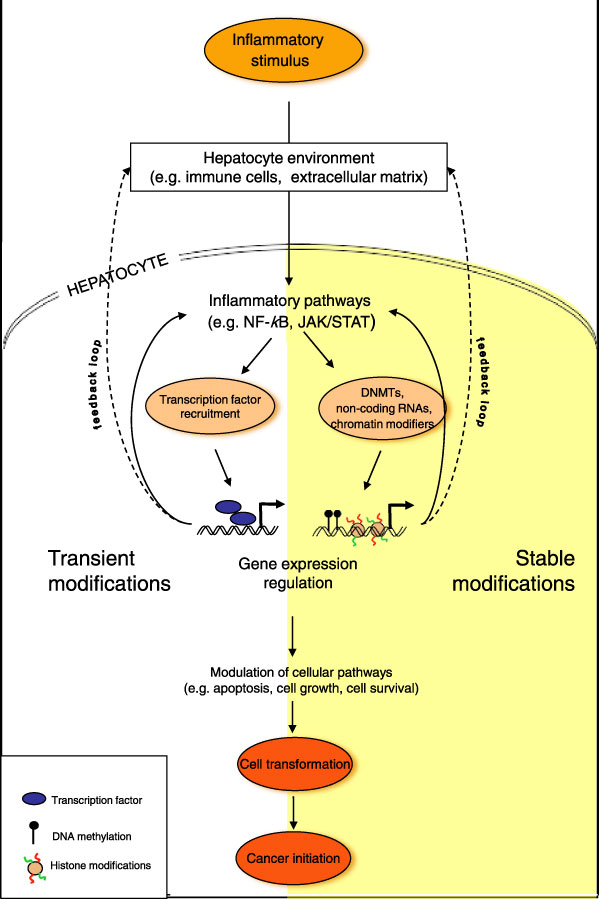
Inflammation represents the body's natural response to tissue damage; however, chronic inflammation may activate cell proliferation and induce deregulation of cell death in affected tissues. Chronic inflammation is an important factor in the development of hepatocellular carcinoma (HCC), although the precise underlying mechanism remains unknown. Epigenetic events, which are considered key mechanisms in the regulation of gene activity states, are also commonly deregulated in HCC. Here, we review the evidence that chronic inflammation might deregulate epigenetic processes, thus promoting oncogenic transformation, and we propose a working hypothesis that epigenetic deregulation is an underlying mechanism by which inflammation might promote HCC development. In this scenario, different components of the inflammatory response might directly and indirectly induce changes in epigenetic machineries ('epigenetic switch'), including those involved in setting and propagating normal patterns of DNA methylation, histone modifications and non-coding RNAs in hepatocytes. We discuss the possibility that self-reinforcing cross-talk between inflammation and epigenetic mechanisms might amplify inflammatory signals and maintain a chronic state of inflammation culminating in cancer development. The potential role of inflammation-epigenome interactions in the emergence and maintenance of cancer stem cells is also discussed.
炎症反应代表了机体对组织损伤的自然应答;然而,慢性炎症可能会激活细胞增殖,并导致受影响组织中的细胞死亡失调。慢性炎症是肝细胞癌 (HCC) 发展的一个重要因素,尽管其确切的潜在机制尚不清楚。表观遗传事件被认为是调节基因活性状态的关键机制,在 HCC 中也经常失调。在这里,我们回顾了慢性炎症可能会使表观遗传过程失调,从而促进致癌转化的证据,并提出了一个工作假设,即表观遗传失调是炎症促进 HCC 发展的潜在机制。在这种情况下,炎症反应的不同成分可能直接或间接地诱导表观遗传机制发生变化(“表观遗传开关”),包括那些参与建立和传播肝细胞中正常的 DNA 甲基化、组蛋白修饰和非编码 RNA 模式的机制。我们讨论了炎症和表观遗传机制之间可能存在的自我强化的交叉对话,这种对话可能会放大炎症信号,并维持导致癌症发生的慢性炎症状态。炎症-表观基因组相互作用在癌症干细胞的出现和维持中的潜在作用也在讨论之中。