Laboratory of Intracellular Regulation, Institute of Plant Physiology, Russian Academy of Sciences, Botanicheskaya street 35, 127276, Moscow, Russia.
Sensors (Basel). 2010;10(3):2386-415. doi: 10.3390/s100302386. Epub 2010 Mar 23.
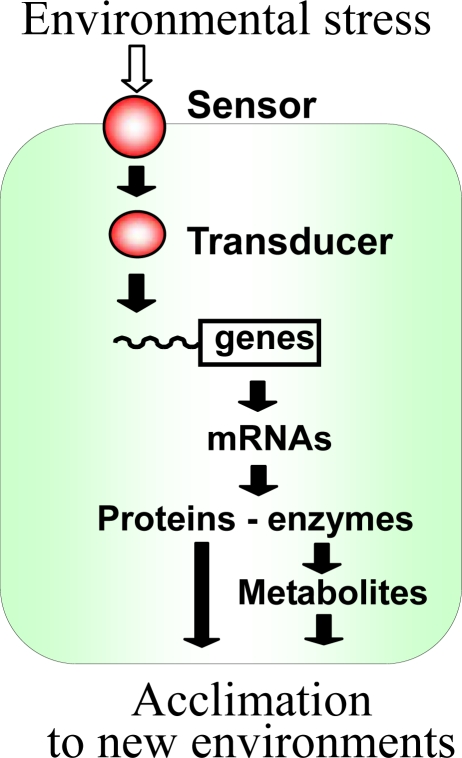
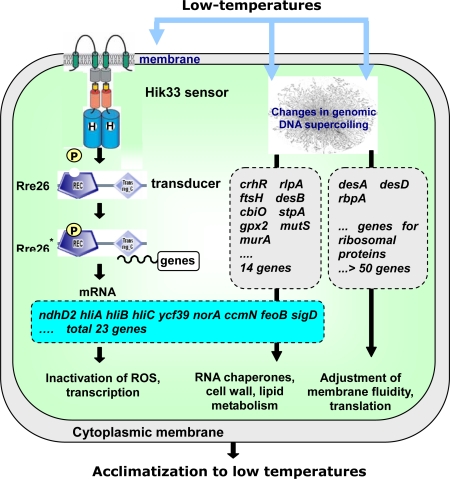
In living cells, the perception of environmental stress and the subsequent transduction of stress signals are primary events in the acclimation to changes in the environment. Some molecular sensors and transducers of environmental stress cannot be identified by traditional and conventional methods. Based on genomic information, a systematic approach has been applied to the solution of this problem in cyanobacteria, involving mutagenesis of potential sensors and signal transducers in combination with DNA microarray analyses for the genome-wide expression of genes. Forty-five genes for the histidine kinases (Hiks), 12 genes for serine-threonine protein kinases (Spks), 42 genes for response regulators (Rres), seven genes for RNA polymerase sigma factors, and nearly 70 genes for transcription factors have been successfully inactivated by targeted mutagenesis in the unicellular cyanobacterium Synechocystis sp. PCC 6803. Screening of mutant libraries by genome-wide DNA microarray analysis under various stress and non-stress conditions has allowed identification of proteins that perceive and transduce signals of environmental stress. Here we summarize recent progress in the identification of sensory and regulatory systems, including Hiks, Rres, Spks, sigma factors, transcription factors, and the role of genomic DNA supercoiling in the regulation of the responses of cyanobacterial cells to various types of stress.
在活细胞中,环境胁迫的感知以及随后的胁迫信号转导是适应环境变化的首要事件。一些环境胁迫的分子传感器和转导器不能通过传统的方法识别。基于基因组信息,一种系统的方法已经被应用于蓝藻中这个问题的解决,包括潜在的传感器和信号转导器的诱变,结合 DNA 微阵列分析进行全基因组基因表达。通过靶向诱变,成功地使单细胞蓝藻集胞藻 PCC 6803 中的 45 个组氨酸激酶(Hiks)基因、12 个丝氨酸-苏氨酸蛋白激酶(Spks)基因、42 个应答调节子(Rres)基因、7 个 RNA 聚合酶 sigma 因子基因和近 70 个转录因子基因失活。通过在各种胁迫和非胁迫条件下的全基因组 DNA 微阵列分析对突变文库进行筛选,鉴定出了能够感知和转导环境胁迫信号的蛋白质。在这里,我们总结了在鉴定感应和调控系统方面的最新进展,包括 Hiks、Rres、Spks、sigma 因子、转录因子以及基因组 DNA 超螺旋在调控蓝藻细胞对各种类型胁迫反应中的作用。