Laboratory of Toxicology and Safety Science, Graduate School of Pharmaceutical Sciences, Osaka University, 1-6, Yamadaoka, Suita, Osaka 565-0871, Japan.
Part Fibre Toxicol. 2012 Feb 2;9:3. doi: 10.1186/1743-8977-9-3.
Due to the rising use of nanomaterials (NMs), there is concern that NMs induce undesirable biological effects because of their unique physicochemical properties. Recently, we reported that amorphous silica nanoparticles (nSPs), which are one of the most widely used NMs, can penetrate the skin barrier and induce various biological effects, including an immune-modulating effect. Thus, it should be clarified whether nSPs can be a risk factor for the aggravation of skin immune diseases. Thus, in this study, we investigated the relationship between the size of SPs and adjuvant activity using a model for atopic dermatitis.
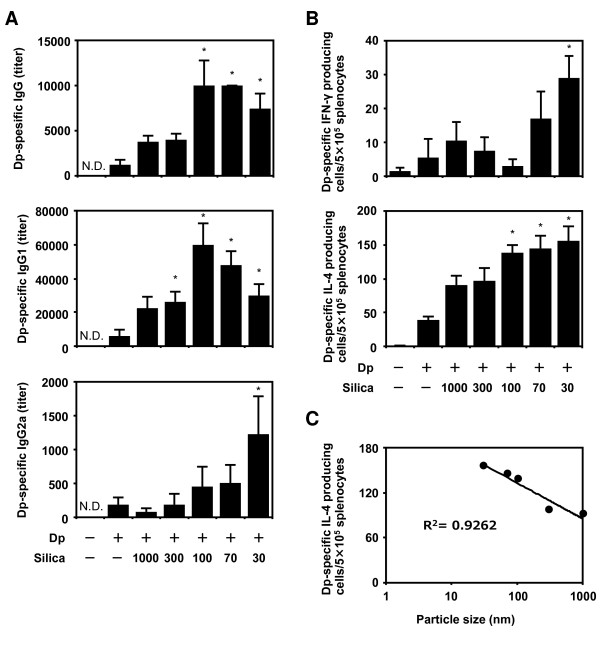
We investigated the effects of nSPs on the AD induced by intradermaly injected-mite antigen Dermatophagoides pteronyssinus (Dp) in NC/Nga mice. Ear thickness measurements and histopathological analysis revealed that a combined injection of amorphous silica particles (SPs) and Dp induced aggravation of AD in an SP size-dependent manner compared to that of Dp alone. In particular, aggravation was observed remarkably in nSP-injected groups. Furthermore, these effects were correlated with the excessive induction of total IgE and a stronger systemic Th2 response. We demonstrated that these results are associated with the induction of IL-18 and thymic stromal lymphopoietin (TSLP) in the skin lesions.
A particle size reduction in silica particles enhanced IL-18 and TSLP production, which leads to systemic Th2 response and aggravation of AD-like skin lesions as induced by Dp antigen treatment. We believe that appropriate regulation of nanoparticle physicochemical properties, including sizes, is a critical determinant for the design of safer forms of NMs.
由于纳米材料(NMs)的使用不断增加,人们担心由于其独特的物理化学特性,NMs 会引起不良的生物效应。最近,我们报道了一种广泛使用的纳米材料——无定形二氧化硅纳米颗粒(nSPs),可以穿透皮肤屏障并引起各种生物效应,包括免疫调节作用。因此,应该明确 nSPs 是否可以成为皮肤免疫性疾病恶化的危险因素。因此,在这项研究中,我们使用特应性皮炎模型研究了 SP 大小与佐剂活性之间的关系。
我们研究了无定形硅颗粒(SPs)对经皮注射螨抗原屋尘螨(Dp)诱导的 AD 的影响。耳厚度测量和组织病理学分析显示,与单独注射 Dp 相比,无定形硅颗粒(SPs)和 Dp 的联合注射以 SP 大小依赖的方式加重了 AD。特别是在 nSP 注射组中观察到明显的加重。此外,这些效应与总 IgE 的过度诱导和更强的全身性 Th2 反应相关。我们证明这些结果与皮肤病变中 IL-18 和胸腺基质淋巴细胞生成素(TSLP)的诱导有关。
硅颗粒粒径减小增强了 IL-18 和 TSLP 的产生,导致全身性 Th2 反应和 Dp 抗原治疗诱导的类似 AD 皮肤损伤的加重。我们认为,适当调节纳米颗粒的物理化学特性,包括大小,是设计更安全的纳米材料形式的关键决定因素。