Centre of Microbial and Plant Genetics, K,U,Leuven, Kasteelpark Arenberg 20, box 2460, B-3001 Leuven, Belgium.
Microb Cell Fact. 2012 Feb 1;11:15. doi: 10.1186/1475-2859-11-15.
Although the occurrence, biosynthesis and possible functions of glycoproteins are increasingly documented for pathogens, glycoproteins are not yet widely described in probiotic bacteria. Nevertheless, knowledge of protein glycosylation holds important potential for better understanding specific glycan-mediated interactions of probiotics and for glycoengineering in food-grade microbes.
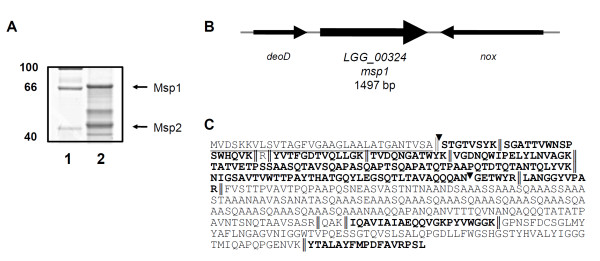
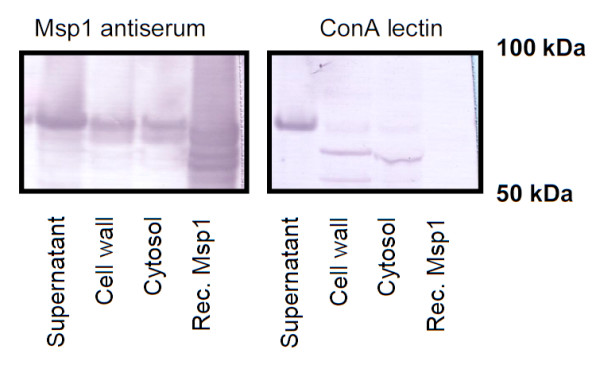
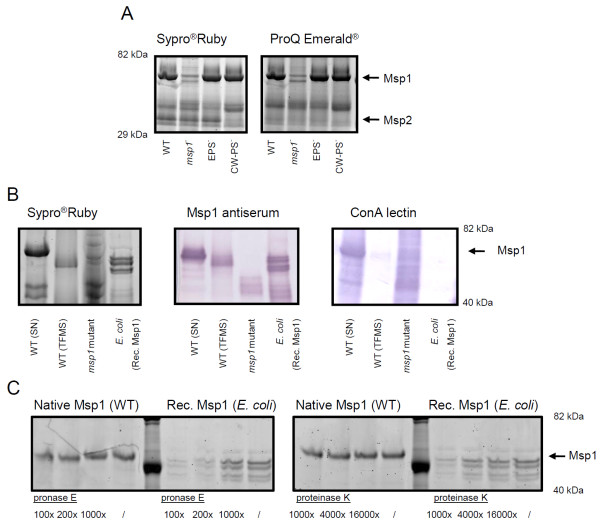
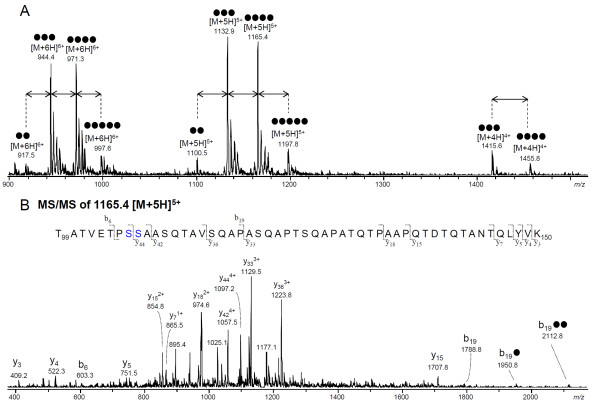
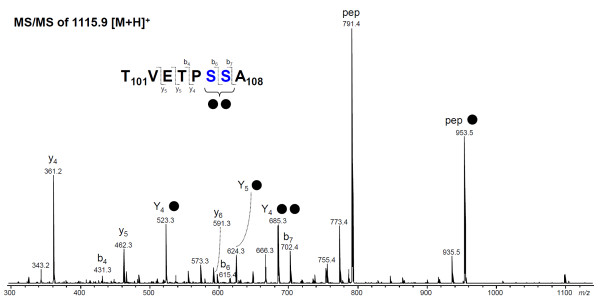
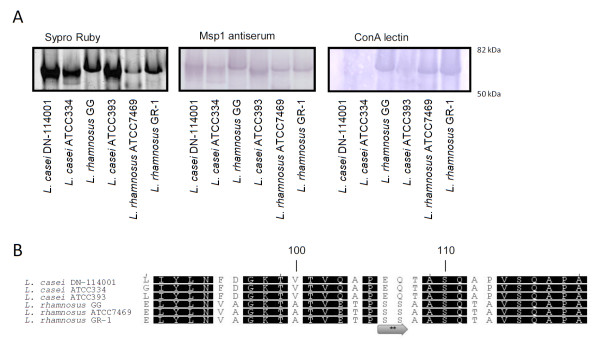
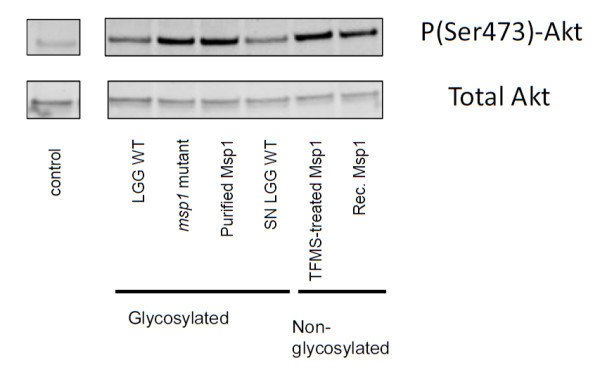
Here, we provide evidence that the major secreted protein Msp1/p75 of the probiotic Lactobacillus rhamnosus GG is glycosylated. Msp1 was shown to stain positive with periodic-acid Schiff staining, to be susceptible to chemical deglycosylation, and to bind with the mannose-specific Concanavalin A (ConA) lectin. Recombinant expression in Escherichia coli resulted in a significant reduction in molecular mass, loss of ConA reactivity and increased sensitivity towards pronase E and proteinase K. Mass spectrometry showed that Msp1 is O-glycosylated and identified a glycopeptide TVETPSSA (amino acids 101-108) bearing hexoses presumably linked to the serine residues. Interestingly, these serine residues are not present in the homologous protein of several Lactobacillus casei strains tested, which also did not bind to ConA. The role of the glycan substitutions in known functions of Msp1 was also investigated. Glycosylation did not seem to impact significantly on the peptidoglycan hydrolase activity of Msp1. In addition, the glycan chain appeared not to be required for the activation of Akt signaling in intestinal epithelial cells by Msp1. On the other hand, examination of different cell extracts showed that Msp1 is a glycosylated protein in the supernatant, but not in the cell wall and cytosol fraction, suggesting a link between glycosylation and secretion of this protein.
In this study we have provided the first evidence of protein O-glycosylation in the probiotic L rhamnosus GG. The major secreted protein Msp1 is glycosylated with ConA reactive sugars at the serine residues at 106 and 107. Glycosylation is not required for the peptidoglycan hydrolase activity of Msp1 nor for Akt activation capacity in epithelial cells, but appears to be important for its stability and protection against proteases.
尽管糖蛋白的发生、生物合成和可能的功能在病原体中越来越多地被记录下来,但在益生菌细菌中糖蛋白尚未广泛描述。然而,蛋白质糖基化的知识对于更好地理解益生菌中特定糖介导的相互作用以及食品级微生物的糖工程具有重要的潜在意义。
在这里,我们提供了证据表明,益生菌乳杆菌 GG 的主要分泌蛋白 Msp1/p75 是糖基化的。Msp1 对过碘酸 Schiff 染色呈阳性,易受化学去糖基化影响,并与甘露糖特异性伴刀豆球蛋白 A(ConA)凝集素结合。在大肠杆菌中的重组表达导致分子量显著降低,失去 ConA 反应性,对蛋白酶 E 和蛋白水解酶 K 的敏感性增加。质谱分析表明 Msp1 是 O-糖基化的,并鉴定出一个糖肽 TVETPSSA(氨基酸 101-108),其中含有可能与丝氨酸残基相连的己糖。有趣的是,这些丝氨酸残基不存在于测试的几种乳杆菌属菌株的同源蛋白中,这些菌株也不与 ConA 结合。还研究了糖基取代对 Msp1 已知功能的作用。糖基化似乎没有显著影响 Msp1 的肽聚糖水解酶活性。此外,聚糖链似乎不是 Msp1 激活肠上皮细胞 Akt 信号所必需的。另一方面,检查不同的细胞提取物表明,Msp1 在上清液中是一种糖基化蛋白,但不在细胞壁和细胞质部分,这表明糖基化与该蛋白的分泌之间存在联系。
在这项研究中,我们首次提供了益生菌 L 鼠李糖乳杆菌 GG 中蛋白质 O-糖基化的证据。主要分泌蛋白 Msp1 在丝氨酸残基 106 和 107 处被 ConA 反应性糖基化。糖基化对于 Msp1 的肽聚糖水解酶活性和上皮细胞中的 Akt 激活能力不是必需的,但对于其稳定性和对蛋白酶的保护似乎很重要。