University of Iceland, Saemundargata, Reykjavik IS101, Iceland.
BMC Public Health. 2012 Feb 2;12:96. doi: 10.1186/1471-2458-12-96.
The aim of this study was to assess if widowers had an increased mortality rate during the first 6 to 9 years after the death of their wife, compared initially to an age-matched control group and also compared to the general population of Iceland.
The study base was comprised of all 371 men born in 1924-1969 who were widowed in Iceland in 1999-2001 and 357 controls, married men, who were matched by age and residence.The widowers and controls were followed through the years 2002-2007 using information from Statistics Iceland. Mortality rates were compared between the groups and also with the general population. The mortality rate comparisons were: study group vs. control group, on the one hand, and study group vs. general population on the other. Causes of death were also compared between widowers and their wives.
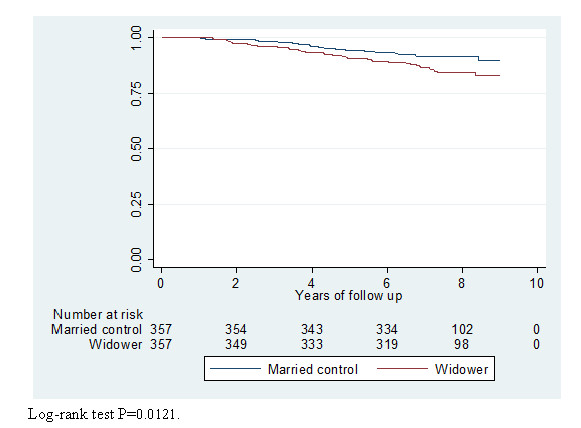
A statistically significant increase in mortality in the widowers' group, compared to controls, was observed.Lifestyle-related factors could not be excluded as contributing to cause of death in these cases.
Being a widower was related to an increased risk of death for at least 9 years after the death of their wife.
本研究旨在评估丧偶男性在妻子去世后的 6 至 9 年内死亡率是否高于最初与年龄匹配的对照组以及冰岛的一般人群。
研究基础包括所有 1924 年至 1969 年出生的 371 名在 1999 年至 2001 年冰岛丧偶的男性和 357 名已婚男性,这些已婚男性通过年龄和居住地与丧偶男性相匹配。通过冰岛统计局的信息,对丧偶男性和对照组在 2002 年至 2007 年期间进行了随访。对两组人群与一般人群之间的死亡率进行了比较。死亡率比较包括:研究组与对照组比较,以及研究组与一般人群比较。还比较了丧偶男性和他们妻子的死因。
与对照组相比,丧偶男性组的死亡率存在统计学显著增加。不能排除生活方式相关因素是导致这些病例死亡的原因。
丧偶与妻子去世后至少 9 年内死亡风险增加有关。