Department of Psychiatry, National Institute of Mental Health and Neurosciences, Bangalore, Karnataka, India.
Indian J Psychiatry. 2011 Oct;53(4):319-23. doi: 10.4103/0019-5545.91905.
Longer duration of untreated psychosis (DUP) is known to be associated with poorer outcome of schizophrenia. DUP is also known to be longer in lower- and middle-income countries. Methodologically sound studies that have examined the association of DUP and outcome of schizophrenia in these countries are lacking.
The aim was to evaluate the association between DUP and outcome of never-treated schizophrenia patients.
This study was conducted at the National Institute of Mental Health and Neurosciences, Bangalore, using a prospective cohort design.
119 patients with schizophrenia/schizophreniform disorder diagnosed using the computerized diagnostic interview schedule for DSM-IV (CDIS-IV) were further assessed for DUP with the interview for retrospective assessment of onset of schizophrenia (IRAOS). After a mean (SD) follow-up period of 55.9 (37.2) weeks, the social and occupational functioning and psychopathology of 93 (80.2% of the surviving patients) patients were assessed using the social and occupational functioning scale (SOFS) and the positive and negative syndrome scale (PANSS), by raters blind to the DUP data. Spearman's correlation and Kendall's tau-B test were used to analyze the relationship between DUP and the outcome variables.
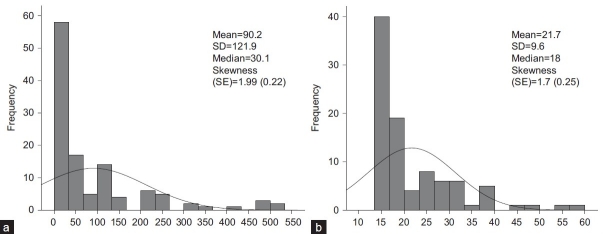
The mean DUP was 90.2 (median=30.1; SD=121.9) weeks. SOFS and PANSS scores at follow-up were statistically significantly associated with DUP, but not with other baseline variables (SOFS: rho=0.22, P=0.03; PANSS: rho=0.23, P=0.03). Among those with the shortest DUP (<16 weeks; n=33), 45.5%, 30.3%, and 24.2% had no impairment, mild-moderate impairment, and severe impairment, respectively. In contrast, 19.4%, 38.7%, and 41.9% of those with the longest DUP (>72 weeks; n=31) had no, mild-moderate, and severe impairment, respectively (Kendall's Tau-b=0.194; P=0.025).
The delay in accessing treatment among patients with psychosis is considerable in India, a lower- to middle-income country. Longer DUP is associated with poorer psychopathological and functional outcomes in persons with schizophrenia/schizophreniform disorder.
较长的未治疗精神病期(DUP)与精神分裂症的预后较差有关。DUP 在中低收入国家也较长。缺乏方法学上合理的研究来检查这些国家 DUP 与精神分裂症结果之间的关联。
旨在评估 DUP 与未经治疗的精神分裂症患者结果之间的关联。
这项研究是在班加罗尔的国家心理健康与神经科学研究所进行的,采用前瞻性队列设计。
使用计算机化诊断访谈时间表进行 DSM-IV(CDIS-IV)诊断的 119 名精神分裂症/分裂情感障碍患者进一步使用回顾性评估精神分裂症发病的访谈(IRAOS)评估 DUP。在平均(SD)55.9(37.2)周的随访后,93 名(幸存患者的 80.2%)患者的社会和职业功能和精神病理学由盲于 DUP 数据的评估者使用社会和职业功能量表(SOFS)和阳性和阴性综合征量表(PANSS)进行评估。使用 Spearman 相关和 Kendall 的 tau-B 检验分析 DUP 与结局变量之间的关系。
平均 DUP 为 90.2(中位数=30.1;SD=121.9)周。随访时的 SOFS 和 PANSS 评分与 DUP 呈统计学显著相关,但与其他基线变量无关(SOFS:rho=0.22,P=0.03;PANSS:rho=0.23,P=0.03)。在最短 DUP(<16 周;n=33)的患者中,分别有 45.5%、30.3%和 24.2%没有受损、轻度至中度受损和严重受损。相比之下,在最长 DUP(>72 周;n=31)的患者中,分别有 19.4%、38.7%和 41.9%没有、轻度至中度和严重受损(Kendall 的 Tau-b=0.194;P=0.025)。
在印度这样一个中低收入国家,精神疾病患者获得治疗的延迟相当大。较长的 DUP 与精神分裂症/分裂情感障碍患者的精神病理学和功能结局较差有关。