Department of Global Health and Population, Harvard School of Public Health, Boston, Massachusetts, United States of America.
PLoS Med. 2012 Jan;9(1):e1001166. doi: 10.1371/journal.pmed.1001166. Epub 2012 Jan 31.
Neuropsychiatric conditions comprise 14% of the global burden of disease and 30% of all noncommunicable disease. Despite the existence of cost-effective interventions, including administration of psychotropic medicines, the number of persons who remain untreated is as high as 85% in low- and middle-income countries (LAMICs). While access to psychotropic medicines varies substantially across countries, no studies to date have empirically investigated potential health systems factors underlying this issue.
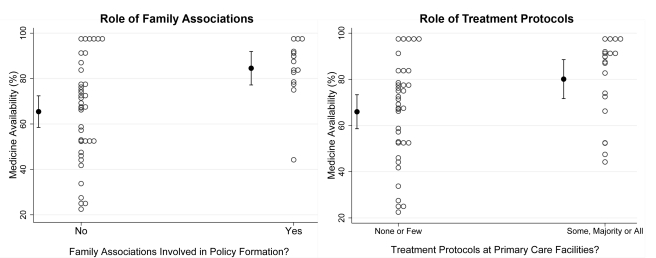
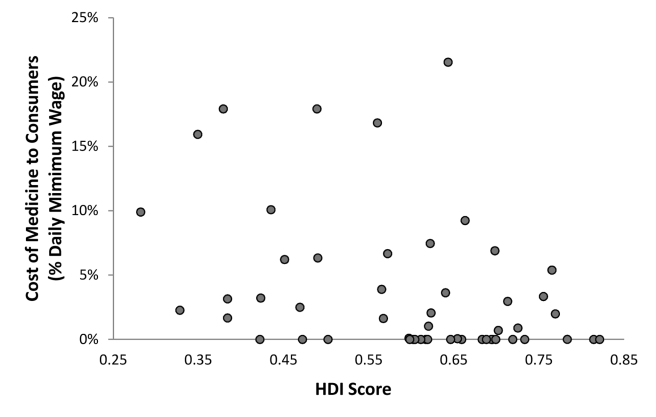
This study uses a cross-sectional sample of 63 LAMICs and country regions to identify key health systems components associated with access to psychotropic medicines. Data from countries that completed the World Health Organization Assessment Instrument for Mental Health Systems (WHO-AIMS) were included in multiple regression analyses to investigate the role of five major mental health systems domains in shaping medicine availability and affordability. These domains are: mental health legislation, human rights implementations, mental health care financing, human resources, and the role of advocacy groups. Availability of psychotropic medicines was associated with features of all five mental health systems domains. Most notably, within the domain of mental health legislation, a comprehensive national mental health plan was associated with 15% greater availability; and in terms of advocacy groups, the participation of family-based organizations in the development of mental health legislation was associated with 17% greater availability. Only three measures were related with affordability of medicines to consumers: level of human resources, percentage of countries' health budget dedicated to mental health, and availability of mental health care in prisons. Controlling for country development, as measured by the Human Development Index, health systems features were associated with medicine availability but not affordability.
Results suggest that strengthening particular facets of mental health systems might improve availability of psychotropic medicines and that overall country development is associated with affordability.
神经精神疾病占全球疾病负担的 14%,占所有非传染性疾病的 30%。尽管存在包括精神药物管理在内的具有成本效益的干预措施,但在低收入和中等收入国家(LMICs),未得到治疗的人数仍高达 85%。尽管各国获得精神药物的机会存在很大差异,但迄今为止尚无研究从实证角度调查导致这一问题的潜在卫生系统因素。
本研究使用了来自 63 个 LMIC 国家和地区的横断面样本,以确定与获得精神药物相关的关键卫生系统组成部分。完成世界卫生组织精神卫生系统评估工具(WHO-AIMS)的国家的数据被纳入多项回归分析中,以调查五个主要精神卫生系统领域在塑造药物可及性和可负担性方面的作用。这些领域是:精神卫生立法、人权实施、精神卫生保健筹资、人力资源以及倡导团体的作用。精神药物的可获得性与所有五个精神卫生系统领域的特征都有关联。最值得注意的是,在精神卫生立法领域,全面的国家精神卫生计划与 15%的更高可获得性相关联;而在倡导团体方面,家庭为基础的组织参与制定精神卫生立法与 17%的更高可获得性相关联。只有三个指标与消费者购买药物的可负担性有关:人力资源水平、国家卫生预算中用于精神卫生的百分比,以及监狱中提供的精神卫生保健。在控制国家发展的情况下,用人类发展指数衡量,卫生系统特征与药物的可获得性有关,但与可负担性无关。
结果表明,加强精神卫生系统的特定方面可能会提高精神药物的可获得性,而国家的总体发展与可负担性有关。