Leamy Larry J, Gordon Ryan R, Pomp Daniel
Department of Biology, University of North Carolina at Charlotte Charlotte, NC, USA.
Front Genet. 2011 Oct 28;2:71. doi: 10.3389/fgene.2011.00071. eCollection 2011.
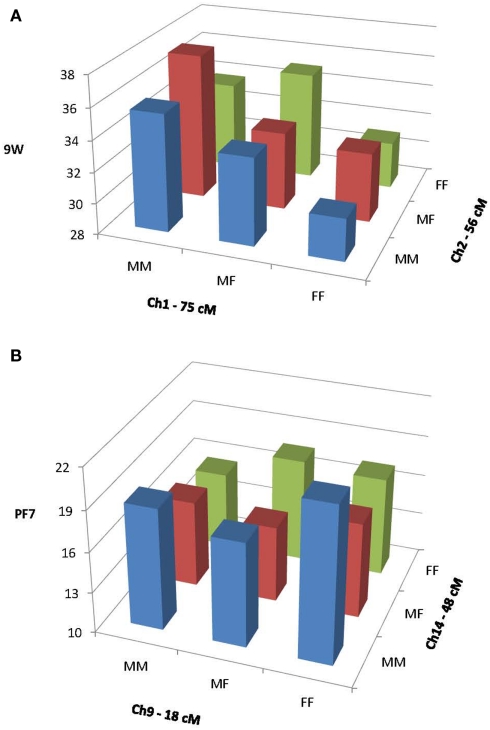
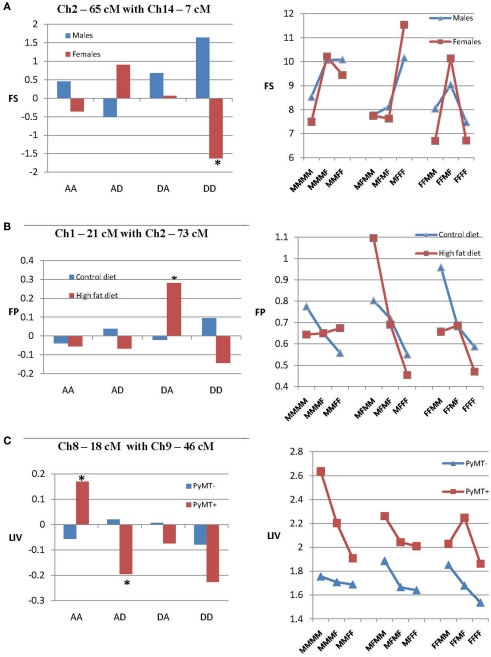
The genetic basis of quantitative traits such as body weight and obesity is complex, with several hundred quantitative trait loci (QTLs) known to affect these and related traits in humans and mice. It also has become increasingly evident that the single-locus effects of these QTLs vary considerably depending on factors such as the sex of the individuals and their dietary environment, and we were interested to know whether this context-dependency also applies to two-locus epistatic effects of QTLs as well. We therefore conducted a genome scan to search for epistatic effects on 13 different weight and adiposity traits in an F(2) population of mice (created from an original intercross of the FVB strain with M16i, a polygenic obesity model) that were fed either a control or a high-fat diet and half of which harbored a transgene (PyMT) that caused the development of metastatic mammary cancer. We used a conventional interval mapping approach with SNPs to scan all 19 autosomes, and found extensive epistasis affecting all of these traits. More importantly, we also discovered that the majority of these epistatic effects exhibited significant interactions with sex, diet, and/or presence of PyMT. Analysis of these interactions showed that many of them appeared to involve QTLs previously identified as affecting these traits, but whose single-locus effects were variously modified by two-locus epistatic effects of other QTLs depending on the sex, diet, or PyMT environment. It was concluded that this context-dependency of epistatic effects is an important component of the genetic architecture of complex traits such as those contributing to weight and obesity.
体重和肥胖等数量性状的遗传基础很复杂,已知有数百个数量性状基因座(QTL)影响人类和小鼠的这些及相关性状。越来越明显的是,这些QTL的单基因座效应会因个体性别和饮食环境等因素而有很大差异,我们很想知道这种背景依赖性是否也适用于QTL的双基因座上位效应。因此,我们进行了一项全基因组扫描,以寻找在F(2)小鼠群体(由FVB品系与多基因肥胖模型M16i的原始杂交产生)中对13种不同体重和肥胖性状的上位效应,这些小鼠分别喂食对照饮食或高脂饮食,其中一半携带导致转移性乳腺癌发生的转基因(PyMT)。我们使用了一种基于单核苷酸多态性(SNP)的传统区间定位方法来扫描所有19条常染色体,发现有广泛的上位性影响所有这些性状。更重要的是,我们还发现这些上位效应中的大多数与性别、饮食和/或PyMT的存在表现出显著的相互作用。对这些相互作用的分析表明,其中许多似乎涉及先前确定为影响这些性状的QTL,但其单基因座效应会因其他QTL的双基因座上位效应而根据性别、饮食或PyMT环境发生不同程度的改变。得出的结论是,上位效应的这种背景依赖性是复杂性状(如那些导致体重和肥胖的性状)遗传结构的一个重要组成部分。