Harrison Alan, Parle-McDermott Anne
Nutritional Genomics Group, School of Biotechnology, Dublin City University Dublin, Ireland.
Front Genet. 2011 Oct 25;2:74. doi: 10.3389/fgene.2011.00074. eCollection 2011.
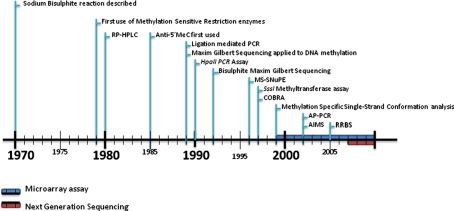
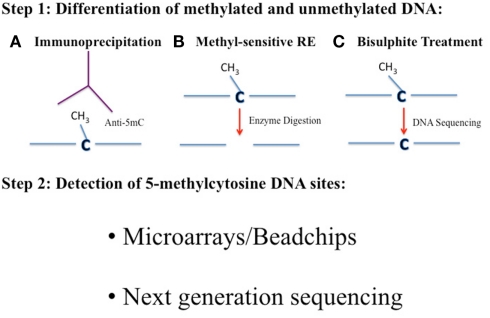
DNA methylation is a biochemical process where a DNA base, usually cytosine, is enzymatically methylated at the 5-carbon position. An epigenetic modification associated with gene regulation, DNA methylation is of paramount importance to biological health and disease. Recently, the quest to unravel the Human Epigenome commenced, calling for a modernization of previous DNA methylation profiling techniques. Here, we describe the major developments in the methodologies used over the past three decades to examine the elusive epigenome (or methylome). The earliest techniques were based on the separation of methylated and unmethylated cytosines via chromatography. The following years would see molecular techniques being employed to indirectly examine DNA methylation levels at both a genome-wide and locus-specific context, notably immunoprecipitation via anti-5'methylcytosine and selective digestion with methylation-sensitive restriction endonucleases. With the advent of sodium bisulfite treatment of DNA, a deamination reaction that converts cytosine to uracil only when unmethylated, the epigenetic modification can now be identified in the same manner as a DNA base-pair change. More recently, these three techniques have been applied to more technically advanced systems such as DNA microarrays and next-generation sequencing platforms, bringing us closer to unveiling a complete human epigenetic profile.
DNA甲基化是一个生化过程,在此过程中,一个DNA碱基(通常是胞嘧啶)在其5碳位置被酶促甲基化。作为一种与基因调控相关的表观遗传修饰,DNA甲基化对生物健康和疾病至关重要。最近,解开人类表观基因组的探索已经开始,这就要求对以前的DNA甲基化分析技术进行现代化改进。在此,我们描述了过去三十年中用于检测难以捉摸的表观基因组(或甲基化组)的方法的主要进展。最早的技术是基于通过色谱法分离甲基化和未甲基化的胞嘧啶。在接下来的几年里,分子技术被用于在全基因组和位点特异性背景下间接检测DNA甲基化水平,特别是通过抗5'甲基胞嘧啶免疫沉淀和用甲基化敏感的限制性内切酶进行选择性消化。随着DNA亚硫酸氢盐处理的出现,这种脱氨基反应仅在未甲基化时将胞嘧啶转化为尿嘧啶,现在可以以与DNA碱基对变化相同的方式识别这种表观遗传修饰。最近,这三种技术已应用于更具技术先进性的系统,如DNA微阵列和下一代测序平台,使我们更接近揭示完整的人类表观遗传图谱。