School of Chemical and Biomolecular Engineering, Georgia Institute of Technology, 311 Ferst Drive, Atlanta, GA 30332-0100, USA.
Microb Cell Fact. 2012 Feb 3;11:17. doi: 10.1186/1475-2859-11-17.
The ability to synthesize exopolysaccharides (EPS) is widespread among microorganisms, and microbial EPS play important roles in biofilm formation, pathogen persistence, and applications in the food and medical industries. Although it is well established that EPS synthesis is invariably in response to environmental cues, it remains largely unknown how various environmental signals trigger activation of the biochemical synthesis machinery.
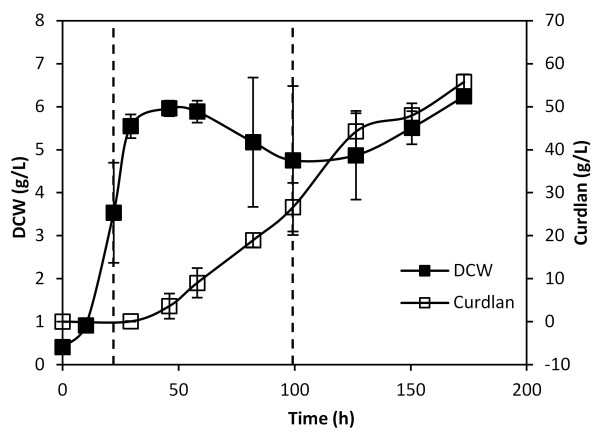
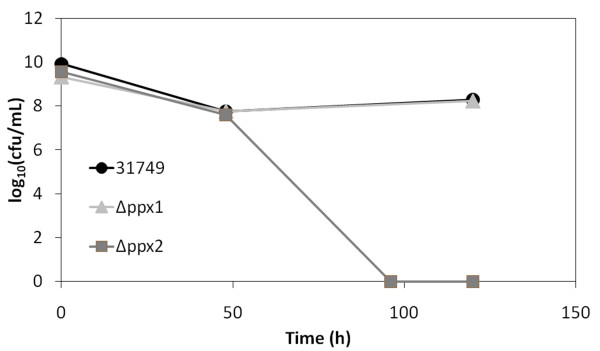
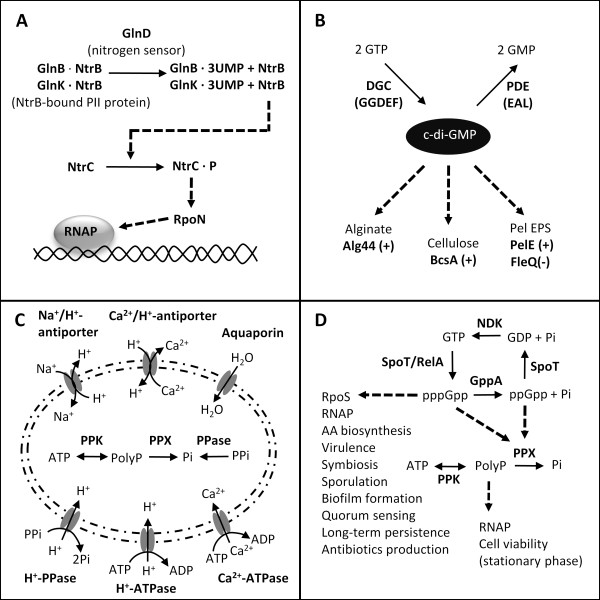
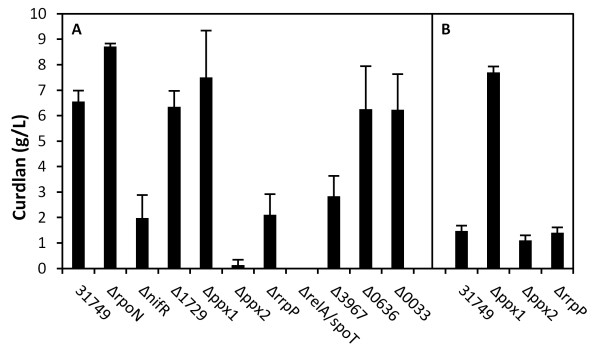
We report here the transcriptome profiling of Agrobacterium sp. ATCC 31749, a microorganism that produces large amounts of a glucose polymer known as curdlan under nitrogen starvation. Transcriptome analysis revealed a nearly 100-fold upregulation of the curdlan synthesis operon upon transition to nitrogen starvation, thus establishing the prominent role that transcriptional regulation plays in the EPS synthesis. In addition to known mechanisms of EPS regulation such as activation by c-di-GMP, we identify novel mechanisms of regulation in ATCC 31749, including RpoN-independent NtrC regulation and intracellular pH regulation by acidocalcisomes. Furthermore, we show evidence that curdlan synthesis is also regulated by conserved cell stress responses, including polyphosphate accumulation and the stringent response. In fact, the stringent response signal, pppGpp, appears to be indispensible for transcriptional activation of curdlan biosynthesis.
This study identifies several mechanisms regulating the synthesis of curdlan, an EPS with numerous applications. These mechanisms are potential metabolic engineering targets for improving the industrial production of curdlan from Agrobacterium sp. ATCC 31749. Furthermore, many of the genes identified in this study are highly conserved across microbial genomes, and we propose that the molecular elements identified in this study may serve as universal regulators of microbial EPS synthesis.
合成胞外多糖(EPS)的能力在微生物中广泛存在,微生物 EPS 在生物膜形成、病原体持续存在以及在食品和医疗行业的应用中发挥着重要作用。尽管已经确定 EPS 的合成总是对环境线索作出反应,但对于各种环境信号如何触发生化合成机制的激活,仍然知之甚少。
我们在这里报告了根癌农杆菌 ATCC 31749 的转录组分析,该微生物在氮饥饿条件下会产生大量的葡萄糖聚合物,称为卡拉胶。转录组分析显示,在过渡到氮饥饿时,卡拉胶合成操纵子的表达几乎上调了近 100 倍,从而确立了转录调控在 EPS 合成中的重要作用。除了已知的 EPS 调控机制,如 c-di-GMP 激活外,我们还在 ATCC 31749 中确定了新的调控机制,包括 RpoN 独立的 NtrC 调控和酸钙蛋白体对细胞内 pH 的调控。此外,我们还证明了卡拉胶的合成也受到保守的细胞应激反应的调控,包括多磷酸盐的积累和严格反应。事实上,严格反应信号 pppGpp 似乎是卡拉胶生物合成转录激活所必需的。
本研究确定了几种调节卡拉胶合成的机制,卡拉胶是一种具有多种应用的 EPS。这些机制是从根癌农杆菌 ATCC 31749 中提高卡拉胶工业生产的潜在代谢工程靶点。此外,本研究中鉴定的许多基因在微生物基因组中高度保守,我们提出本研究中鉴定的分子元件可能作为微生物 EPS 合成的通用调节剂。