Sir William Dunn School of Pathology, Oxford University, Oxford, UK.
EMBO J. 2012 Mar 21;31(6):1556-67. doi: 10.1038/emboj.2012.12. Epub 2012 Feb 3.
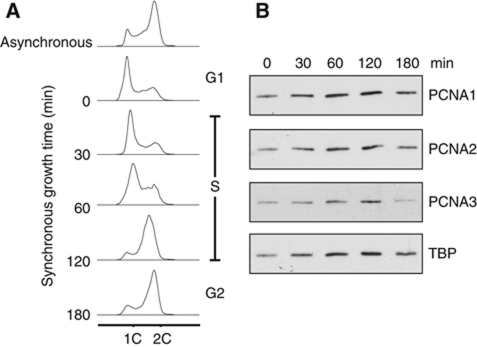
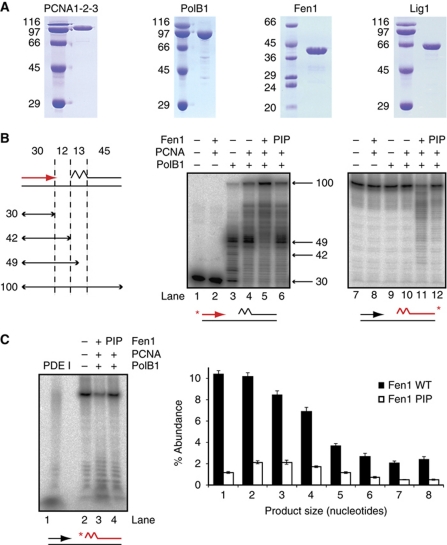
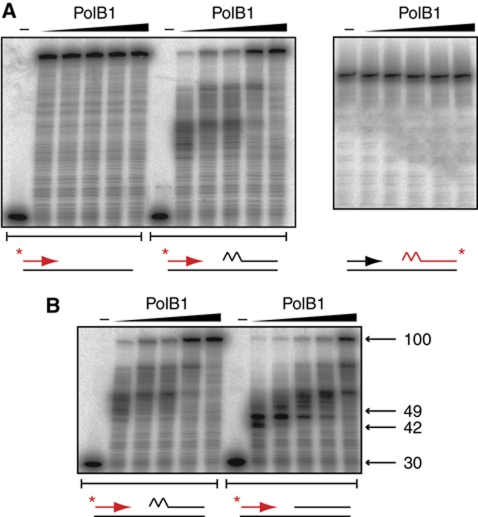
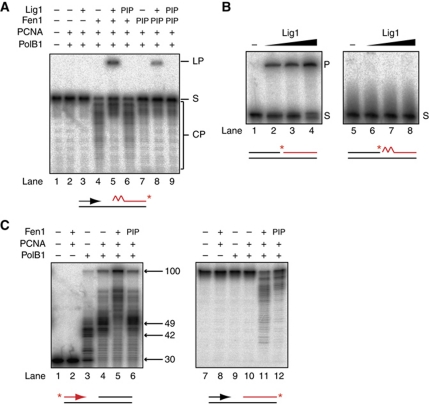
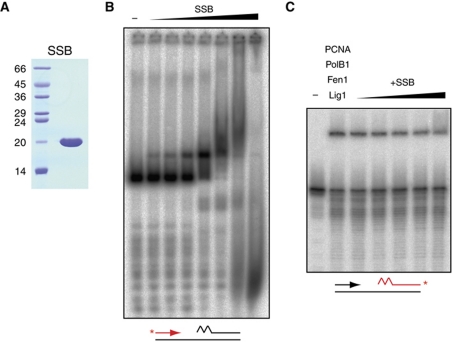
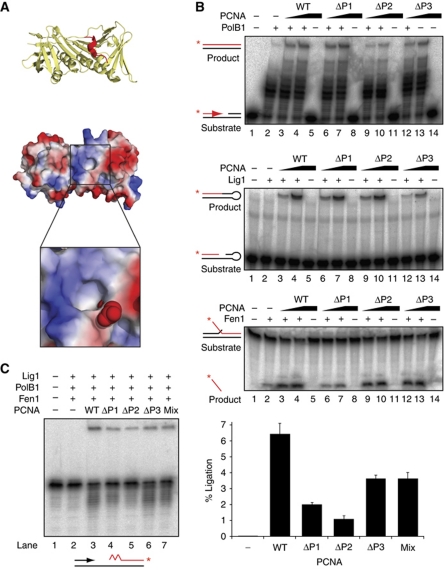
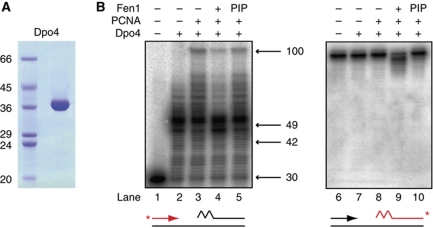
Chromosomal DNA replication requires one daughter strand-the lagging strand-to be synthesised as a series of discontinuous, RNA-primed Okazaki fragments, which must subsequently be matured into a single covalent DNA strand. Here, we describe the reconstitution of Okazaki fragment maturation in vitro using proteins derived from the archaeon Sulfolobus solfataricus. Six proteins are necessary and sufficient for coupled DNA synthesis, RNA primer removal and DNA ligation. PolB1, Fen1 and Lig1 provide the required catalytic activities, with coordination of their activities dependent upon the DNA sliding clamp, proliferating cell nuclear antigen (PCNA). S. solfataricus PCNA is a heterotrimer, with each subunit having a distinct specificity for binding PolB1, Fen1 or Lig1. Our data demonstrate that the most efficient coupling of activities occurs when a single PCNA ring organises PolB1, Fen1 and Lig1 into a complex.
染色体 DNA 复制需要一条子链——滞后链——作为一系列不连续的、RNA 引发的 Okazaki 片段合成,这些片段随后必须成熟为一条共价 DNA 链。在这里,我们使用源自古细菌 Sulfolobus solfataricus 的蛋白质在体外重建 Okazaki 片段成熟。六个蛋白质对于偶联的 DNA 合成、RNA 引物去除和 DNA 连接是必需和充分的。PolB1、Fen1 和 Lig1 提供所需的催化活性,其活性的协调取决于 DNA 滑动夹、增殖细胞核抗原 (PCNA)。S. solfataricus PCNA 是三聚体,每个亚基对结合 PolB1、Fen1 或 Lig1 具有独特的特异性。我们的数据表明,当单个 PCNA 环将 PolB1、Fen1 和 Lig1 组织成一个复合物时,活性的偶联效率最高。