Department of Psychiatry and Behavioral Sciences, Charleston Alcohol Research Center, Medical University of South Carolina, Charleston, SC 29425, USA.
Alcohol Clin Exp Res. 2012 Jul;36(7):1180-7. doi: 10.1111/j.1530-0277.2011.01717.x. Epub 2012 Feb 6.
Repeated cycles of chronic intermittent ethanol (CIE) exposure lead to increased voluntary ethanol (EtOH) intake in C57BL/6J mice. This study evaluates the development of tolerance to EtOH's aversive effects in CIE exposure.
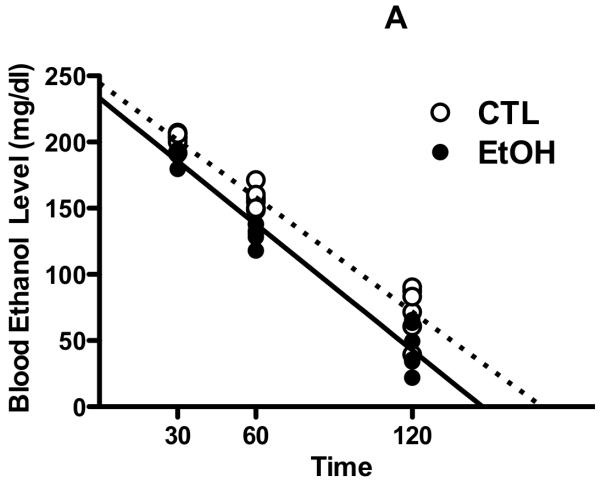
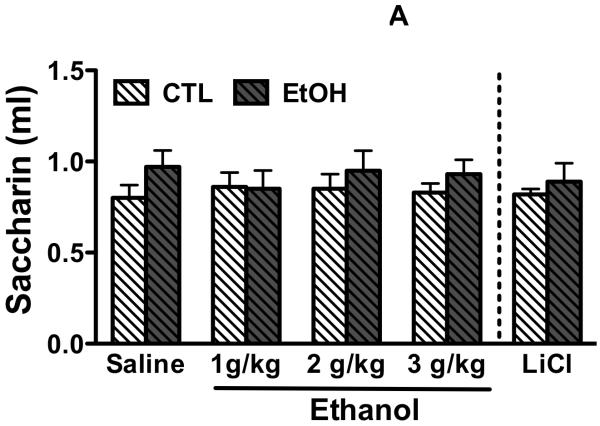
Adult male C57BL/6J mice were trained to drink 15% EtOH (vs. water) in a limited access procedure and then exposed to CIE (EtOH mice) or air (control [CTL] mice) for 5 cycles alternating with weekly access to EtOH drinking. Following the 4th CIE cycle, the aversive effects of EtOH were evaluated using a conditioned taste aversion (CTA) paradigm with 1% saccharin as the conditioned stimulus. Several doses of EtOH (0, 1, 2, and 3 g/kg) and LiCl (0.4 M, 0.02 ml/g) served as unconditioned stimuli. Finally, mice underwent a 5th CIE cycle to measure blood and brain concentrations following a 2 g/kg EtOH dose.
CIE exposure increased EtOH drinking in EtOH mice while drinking in CTL mice remained stable. The lowest EtOH dose (1 g/kg) did not induce CTA in either group, but the highest dose (3 g/kg) produced CTA in both groups (49% reduction for CTL vs. 25% reduction for EtOH) although the group differences were not statistically significant. However, the 2 g/kg EtOH dose induced a significant aversion in CTL mice (27% reduction) but not in EtOH mice (20% increase), indicating tolerance to EtOH's aversive effects. LiCl caused a similar aversion in CTL and EtOH mice (50% reduction). Finally, blood and brain ethanol concentrations were not different between CTL and EtOH mice following a 2 g/kg EtOH dose.
The data indicate that CIE exposure produces tolerance to the aversive effects of 2 g/kg EtOH. This effect does not appear to be related to a learning deficit or altered EtOH pharmacokinetics. These data support the notion that tolerance to EtOH's aversive effects may contribute to excessive EtOH drinking in EtOH-dependent mice.
反复的慢性间歇性乙醇(CIE)暴露会导致 C57BL/6J 小鼠增加自愿性乙醇(EtOH)的摄入。本研究评估了 CIE 暴露中对 EtOH 厌恶效应的耐受性发展。
成年雄性 C57BL/6J 小鼠在有限接触程序中接受 15%EtOH(vs. 水)的训练,然后暴露于 CIE(EtOH 组)或空气(CTL 组)中,共进行 5 个周期,每周交替接触 EtOH 饮酒。在第 4 个 CIE 周期之后,使用条件味觉厌恶(CTA)范式评估 EtOH 的厌恶效应,以 1%蔗糖作为条件刺激。几种剂量的 EtOH(0、1、2 和 3 g/kg)和 LiCl(0.4 M,0.02 ml/g)作为非条件刺激。最后,小鼠进行第 5 个 CIE 周期,以在给予 2 g/kg EtOH 剂量后测量血液和大脑浓度。
CIE 暴露增加了 EtOH 组小鼠的 EtOH 饮酒量,而 CTL 组小鼠的饮酒量保持稳定。最低 EtOH 剂量(1 g/kg)在两组中均未引起 CTA,但最高剂量(3 g/kg)在两组中均引起 CTA(CTL 组减少 49%,EtOH 组减少 25%),尽管组间差异无统计学意义。然而,2 g/kg EtOH 剂量在 CTL 组引起明显的厌恶(减少 27%),而在 EtOH 组则没有引起厌恶(增加 20%),表明对 EtOH 的厌恶效应产生了耐受性。LiCl 在 CTL 和 EtOH 组中引起相似的厌恶(减少 50%)。最后,在给予 2 g/kg EtOH 剂量后,CTL 和 EtOH 组的血液和大脑乙醇浓度没有差异。
数据表明,CIE 暴露会导致对 2 g/kg EtOH 的厌恶效应产生耐受性。这种效应似乎与学习缺陷或改变的 EtOH 药代动力学无关。这些数据支持这样一种观点,即对 EtOH 厌恶效应的耐受性可能导致 EtOH 依赖小鼠过度摄入 EtOH。