Department of Pharmacology, Medical Research Council Centre for Drug Safety Science, University of Liverpool, Sherrington Buildings, Ashton Street, Liverpool L69 3GE, United Kingdom.
Department of Pharmacology, Medical Research Council Centre for Drug Safety Science, University of Liverpool, Sherrington Buildings, Ashton Street, Liverpool L69 3GE, United Kingdom.
J Biol Chem. 2012 Mar 23;287(13):10556-10564. doi: 10.1074/jbc.M111.322420. Epub 2012 Feb 6.
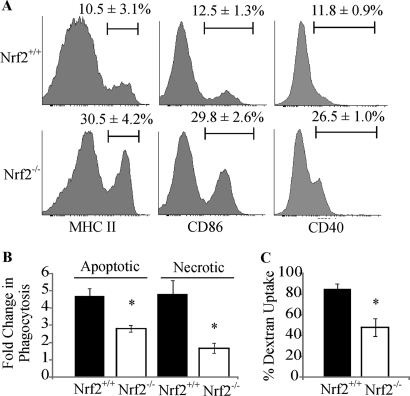
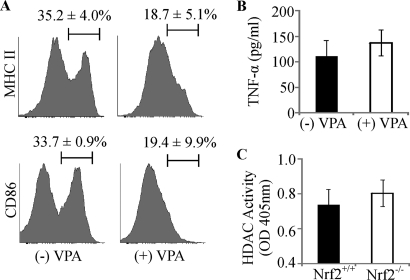
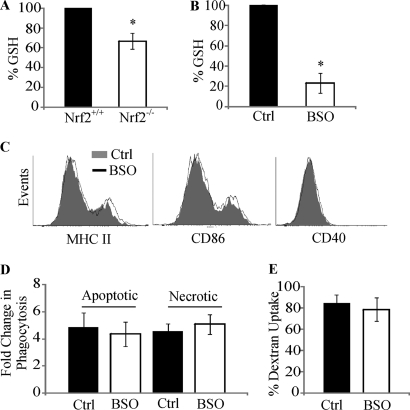
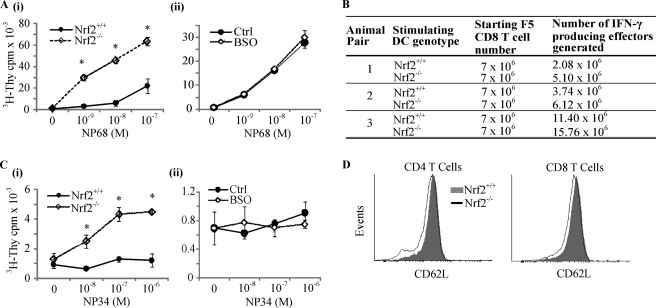
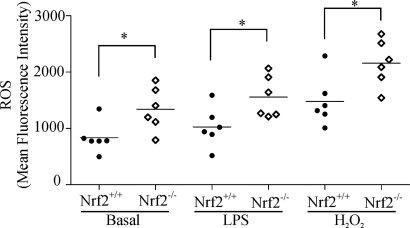
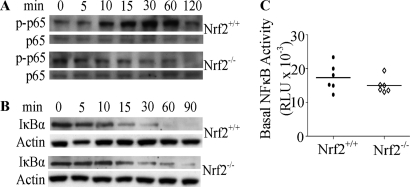
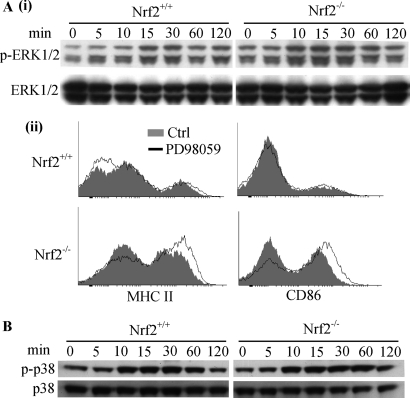
Dendritic cells (DCs) are critical mediators of immunity and immune tolerance by orchestrating multiple aspects of T cell activation and function. Immature DCs (iDCs) expressing low levels of co-stimulatory receptors are highly efficient at antigen capture but are poor activators of T cells. Maturation of DCs is associated with increased expression of co-stimulatory molecules. Co-stimulatory receptor gene expression is regulated by intracellular redox, NF-κB, and MAPK pathways and by histone deacetylase (HDAC) activity. The transcription factor, Nrf2, is important for maintaining intracellular glutathione (GSH) levels and redox homeostasis and has been implicated in modulating DC co-stimulatory receptor expression. It is unclear whether Nrf2 mediates this effect by GSH-dependent mechanisms and whether it influences DC signaling pathways. Using bone marrow-derived iDCs from Nrf2(+/+) and Nrf2(-/-) mice, we demonstrate that Nrf2(-/-) iDCs have lower basal GSH levels, enhanced co-stimulatory receptor expression, impaired phagocytic functions, and increased antigen-specific CD8 T cell stimulation capacity. Interestingly, lowering GSH levels in Nrf2(+/+) iDCs did not recapitulate the Nrf2(-/-) iDC phenotype. Loss of Nrf2 resulted in elevated basal levels of reactive oxygen species but did not affect basal NF-κB activity or p38 MAPK phosphorylation. Using pharmacological inhibitors, we demonstrate that enhanced co-stimulatory receptor phenotype of Nrf2(-/-) iDC does not require ERK activity but is dependent on HDAC activity, indicating a potential interaction between Nrf2 function and HDAC. These results suggest that Nrf2 activity is required to counter rises in intracellular reactive oxygen species and to regulate pathways that control DC co-stimulatory receptor expression.
树突状细胞(DCs)通过调控 T 细胞的激活和功能的多个方面,是免疫和免疫耐受的关键介质。表达低水平共刺激受体的未成熟 DC(iDC)具有高效的抗原捕获能力,但对 T 细胞的激活能力较差。DC 的成熟与共刺激分子表达的增加有关。共刺激受体基因的表达受到细胞内氧化还原、NF-κB 和 MAPK 途径以及组蛋白去乙酰化酶(HDAC)活性的调节。转录因子 Nrf2 对于维持细胞内谷胱甘肽(GSH)水平和氧化还原平衡很重要,并且已经被牵连到调节 DC 共刺激受体的表达。目前尚不清楚 Nrf2 是否通过 GSH 依赖性机制介导这种效应,以及它是否影响 DC 信号通路。使用 Nrf2(+/+)和 Nrf2(-/-)小鼠的骨髓来源的 iDC,我们证明 Nrf2(-/-)iDC 具有较低的基础 GSH 水平、增强的共刺激受体表达、受损的吞噬功能和增加的抗原特异性 CD8 T 细胞刺激能力。有趣的是,降低 Nrf2(+/+)iDC 中的 GSH 水平并不能重现 Nrf2(-/-)iDC 表型。Nrf2 的缺失导致基础活性氧水平升高,但不影响基础 NF-κB 活性或 p38 MAPK 磷酸化。使用药理抑制剂,我们证明 Nrf2(-/-)iDC 增强的共刺激受体表型不需要 ERK 活性,但依赖于 HDAC 活性,表明 Nrf2 功能与 HDAC 之间存在潜在的相互作用。这些结果表明,Nrf2 活性是对抗细胞内活性氧升高和调节控制 DC 共刺激受体表达的途径所必需的。