Medical Research Council Centre for Drug Safety Science and Department of Molecular and Clinical Pharmacology, Sherrington Buildings, Ashton Street, University of Liverpool, Liverpool L69 3GE, United Kingdom.
J Biol Chem. 2013 Aug 2;288(31):22281-8. doi: 10.1074/jbc.M113.483420. Epub 2013 Jun 17.
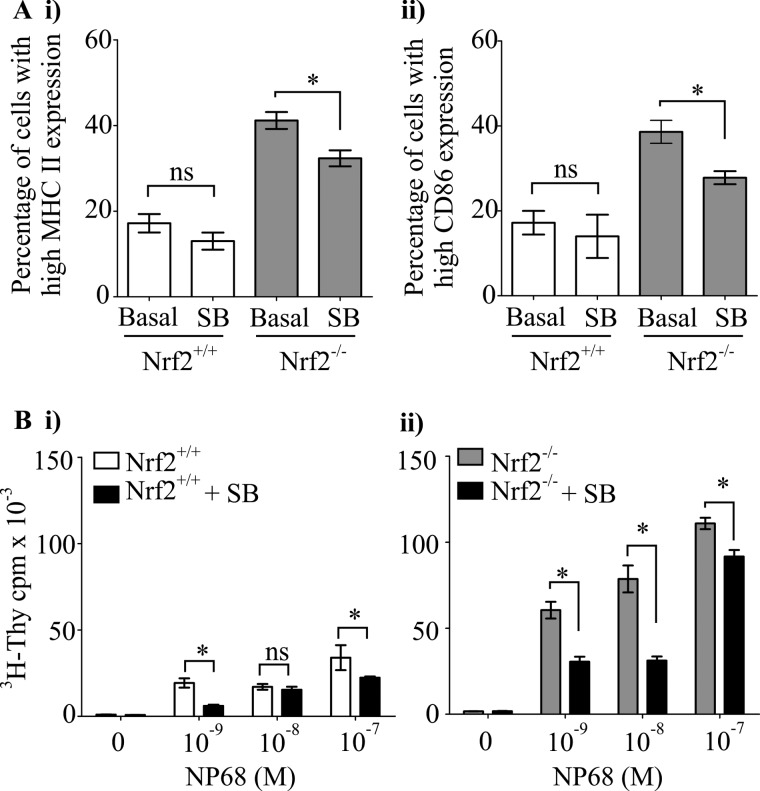
Nrf2 is a redox-responsive transcription factor that has been implicated in the regulation of DC immune function. Loss of Nrf2 results in increased co-stimulatory molecule expression, enhanced T cell stimulatory capacity, and increased reactive oxygen species (ROS) levels in murine immature DCs (iDCs). It is unknown whether altered immune function of Nrf2-deficient DCs (Nrf2(-/-) iDCs) is due to elevated ROS levels. Furthermore, it is unclear which intracellular signaling pathways are involved in Nrf2-mediated regulation of DC function. Using antioxidant vitamins to reset ROS levels in Nrf2(-/-) iDCs, we show that elevated ROS is not responsible for the altered phenotype and function of these DCs. Pharmacological inhibitors were used to explore the role of key MAPKs in mediating the altered phenotype and function in Nrf2(-/-) iDCs. We demonstrate that the increased co-stimulatory molecule expression (MHC II and CD86) and antigen-specific T cell activation capacity observed in Nrf2(-/-) iDCs was reversed by inhibition of p38 MAPK but not JNK. Importantly, we provide evidence for increased phosphorylation of cAMP-responsive element binding protein (CREB) and activating transcription factor 1 (ATF1), transcription factors that are downstream of p38 MAPK. The increased phosphorylation of CREB/ATF1 in Nrf2(-/-) iDCs was sensitive to p38 MAPK inhibition. We also show data to implicate heme oxygenase-1 as a potential molecular link between Nrf2 and CREB/ATF1. These results indicate that dysregulation of p38 MAPK-CREB/ATF1 signaling axis underlies the altered function and phenotype in Nrf2-deficient DCs. Our findings provide new insights into the mechanisms by which Nrf2 mediates regulation of DC function.
Nrf2 是一种氧化还原反应敏感的转录因子,它参与了树突状细胞(DC)免疫功能的调节。Nrf2 缺失会导致共刺激分子表达增加、T 细胞刺激能力增强以及小鼠未成熟 DC(iDC)中的活性氧(ROS)水平升高。目前尚不清楚 Nrf2 缺陷型 DC(Nrf2(-/-) iDC)免疫功能的改变是否是由于 ROS 水平升高所致。此外,Nrf2 调节 DC 功能的细胞内信号通路也尚不清楚。我们使用抗氧化维生素来重置 Nrf2(-/-) iDC 中的 ROS 水平,结果表明升高的 ROS 并不是导致这些 DC 表型和功能改变的原因。我们还使用药理学抑制剂来研究关键 MAPK 在介导 Nrf2(-/-) iDC 表型和功能改变中的作用。结果表明,Nrf2(-/-) iDC 中观察到的共刺激分子表达(MHC II 和 CD86)增加和抗原特异性 T 细胞激活能力增强,可以通过抑制 p38 MAPK 而不是 JNK 来逆转。重要的是,我们提供了证据表明 cAMP 反应元件结合蛋白(CREB)和激活转录因子 1(ATF1)的磷酸化增加,这两种转录因子是 p38 MAPK 的下游产物。Nrf2(-/-) iDC 中 CREB/ATF1 的磷酸化增加对 p38 MAPK 抑制敏感。我们还发现数据表明血红素加氧酶-1(HO-1)可能是 Nrf2 和 CREB/ATF1 之间的潜在分子联系。这些结果表明,p38 MAPK-CREB/ATF1 信号轴的失调是 Nrf2 缺陷型 DC 功能和表型改变的基础。我们的研究结果为 Nrf2 调节 DC 功能的机制提供了新的见解。