Veit Michael, Thaa Bastian
Department of Immunology and Molecular Biology, Veterinary Faculty, Free University Berlin, Philippstraße 13, 10115 Berlin, Germany.
Adv Virol. 2011;2011:370606. doi: 10.1155/2011/370606. Epub 2011 Jul 25.
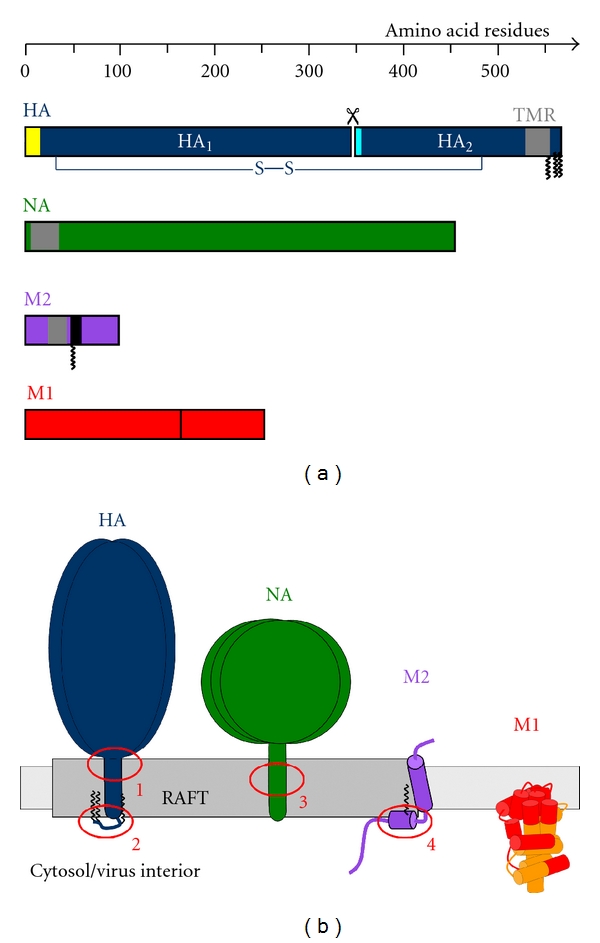
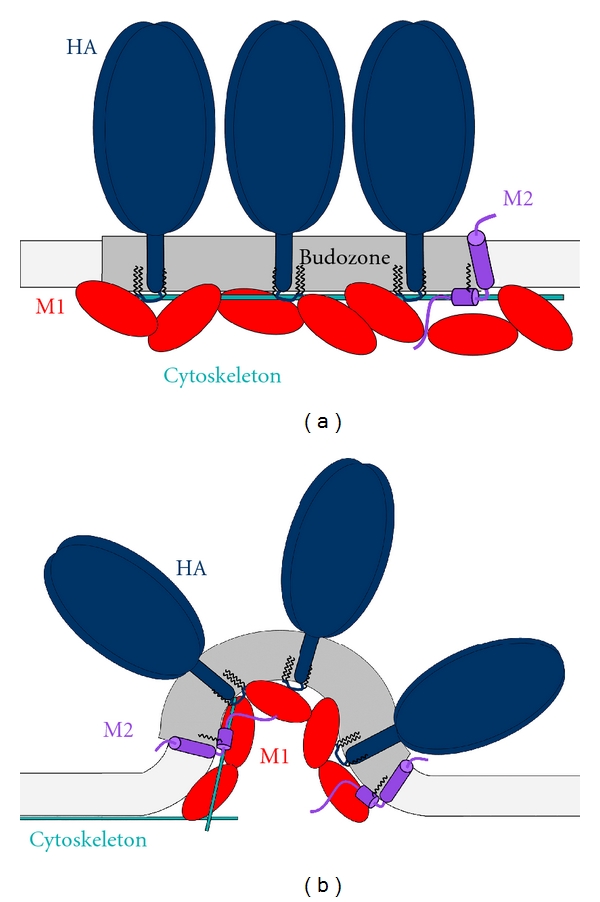
Assembly and budding of influenza virus proceeds in the viral budozone, a domain in the plasma membrane with characteristics of cholesterol/sphingolipid-rich membrane rafts. The viral transmembrane glycoproteins hemagglutinin (HA) and neuraminidase (NA) are intrinsically targeted to these domains, while M2 is seemingly targeted to the edge of the budozone. Virus assembly is orchestrated by the matrix protein M1, binding to all viral components and the membrane. Budding progresses by protein- and lipid-mediated membrane bending and particle scission probably mediated by M2. Here, we summarize the experimental evidence for this model with emphasis on the raft-targeting features of HA, NA, and M2 and review the functional importance of raft domains for viral protein transport, assembly and budding, environmental stability, and membrane fusion.
流感病毒的组装和出芽发生在病毒芽区,这是质膜中的一个区域,具有富含胆固醇/鞘脂的膜筏的特征。病毒跨膜糖蛋白血凝素(HA)和神经氨酸酶(NA)本质上靶向这些区域,而M2似乎靶向芽区边缘。病毒组装由基质蛋白M1协调,M1与所有病毒成分和膜结合。出芽通过蛋白质和脂质介导的膜弯曲以及可能由M2介导的颗粒分裂而进行。在这里,我们总结了该模型的实验证据,重点是HA、NA和M2的筏靶向特征,并综述了筏结构域对病毒蛋白运输、组装和出芽、环境稳定性以及膜融合的功能重要性。