Department of Life and Environment Sciences, Macrosection of Biomedicine, University of Cagliari, Monserrato, Cagliari, Italy.
PLoS One. 2012;7(2):e30962. doi: 10.1371/journal.pone.0030962. Epub 2012 Feb 1.
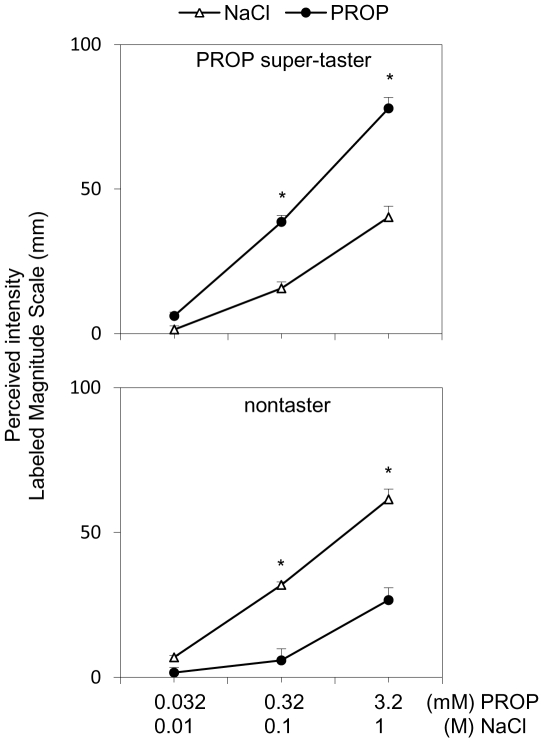
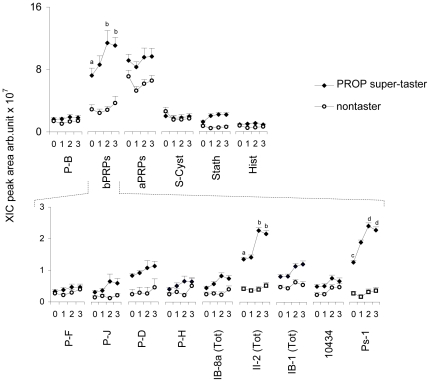
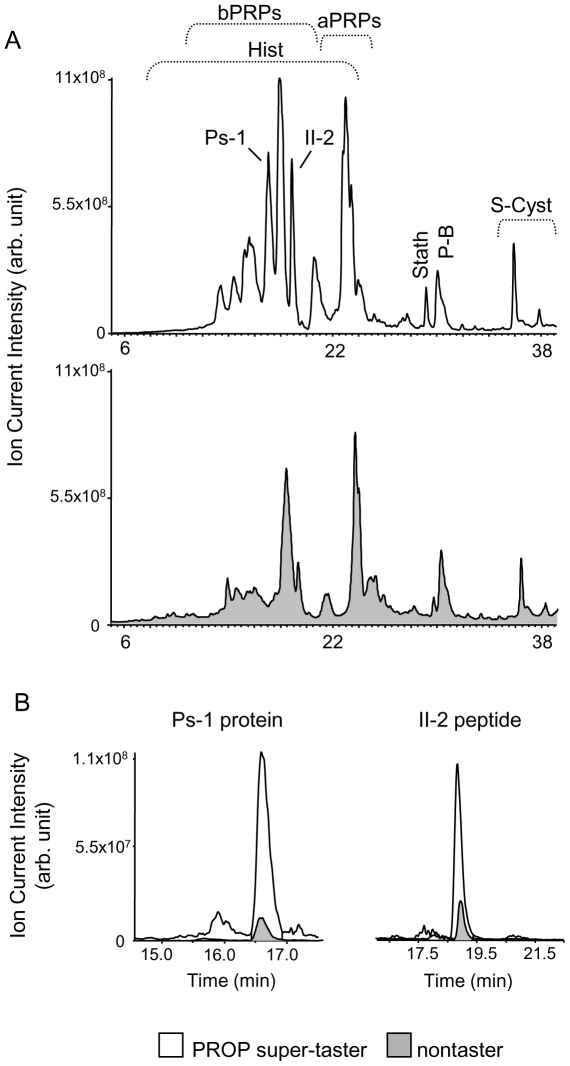
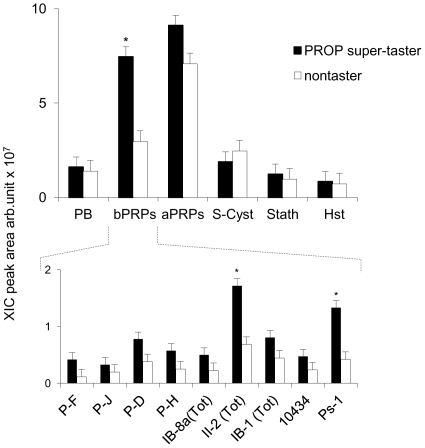
Thiourea tasting can be predictive of individual differences in bitter taste responses, general food preferences and eating behavior, and could be correlated with saliva chemical composition. We investigated the possible relationship between PROP bitter taste responsiveness and the salivary proteome in subjects genotyped for TAS2R38 and gustin gene polymorphisms. Taste perception intensity evoked by PROP and NaCl solutions was measured in sixty-three volunteers (21 males, 42 females, age 25±3 y) to establish their PROP taster status, and 24 PROP super-tasters and 21 nontasters were selected to participate in the study. TAS2R38 and gustin gene molecular analysis were performed using PCR techniques. Qualitative and quantitative determination of salivary proteins was performed by HPLC-ESI-MS before and after PROP taste stimulation. PROP super-tastings was strongly associated with the 'taster' variant (PAV haplotype) of TAS2R38 and the A allele of rs2274333 polymorphism in the gustin gene and nontasting was associated with the minor alleles at both loci. ANOVA revealed that basal levels of II-2 and Ps-1 proteins, belonging to the basic proline-rich protein (bPRPs) family, were significantly higher in PROP super-taster than in nontaster un-stimulated saliva, and that PROP stimulation elicited a rapid increase in the levels of these same proteins only in PROP super-taster saliva. These data show for the first time that responsiveness to PROP is associated with salivary levels of II-2 peptide and Ps-1 protein, which are products of the PRB1 gene. These findings suggest that PRB1, in addition to TAS2R38 and gustin, could contribute to individual differences in thiourea sensitivity, and the expression of the PROP phenotype as a complex genetic trait.
硫脲味觉可以预测苦味反应、一般食物偏好和饮食行为的个体差异,并且可能与唾液化学成分相关。我们研究了 PROP 苦味反应与 TAS2R38 和 gustin 基因多态性个体的唾液蛋白质组之间的可能关系。在 63 名志愿者(21 名男性,42 名女性,年龄 25±3 岁)中测量了 PROP 和 NaCl 溶液引起的味觉感知强度,以确定他们的 PROP 味觉状态,并选择 24 名 PROP 超味觉者和 21 名非味觉者参与研究。使用 PCR 技术对 TAS2R38 和 gustin 基因进行分子分析。在 PROP 味觉刺激前后,通过 HPLC-ESI-MS 进行唾液蛋白质的定性和定量测定。PROP 超味觉者与 TAS2R38 的“味觉者”变体(PAV 单倍型)和 gustin 基因 rs2274333 多态性的 A 等位基因强烈相关,非味觉者与两个基因座的次要等位基因相关。方差分析显示,在 PROP 超味觉者的非刺激唾液中,属于碱性富含脯氨酸蛋白(bPRPs)家族的 II-2 和 Ps-1 蛋白的基础水平明显高于非味觉者,而 PROP 刺激仅在 PROP 超味觉者的唾液中快速增加这些相同蛋白质的水平。这些数据首次表明,对 PROP 的反应与 II-2 肽和 Ps-1 蛋白的唾液水平相关,这两种蛋白是 PRB1 基因的产物。这些发现表明,除了 TAS2R38 和 gustin 之外,PRB1 可能有助于硫脲敏感性的个体差异,以及作为复杂遗传特征的 PROP 表型的表达。