Davydok Anton, Breuer Steffen, Biermanns Andreas, Geelhaar Lutz, Pietsch Ullrich
Festkörperphysik, Universität Siegen, Walter-Flex-Str, 3, Siegen, 57072, Germany.
Nanoscale Res Lett. 2012 Feb 8;7(1):109. doi: 10.1186/1556-276X-7-109.
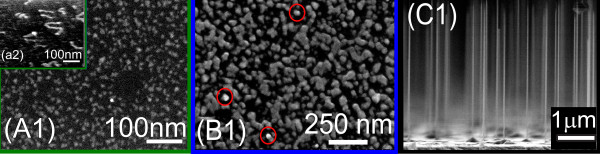
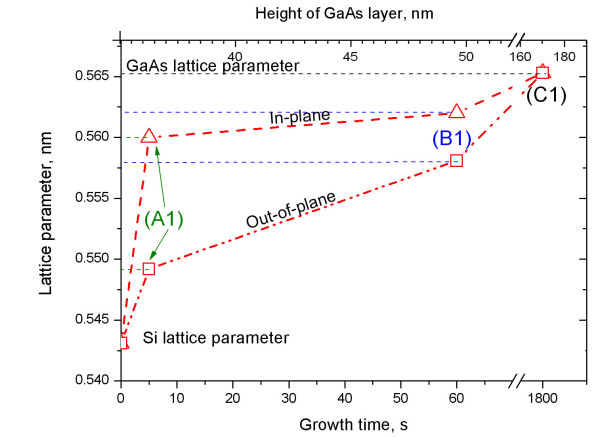
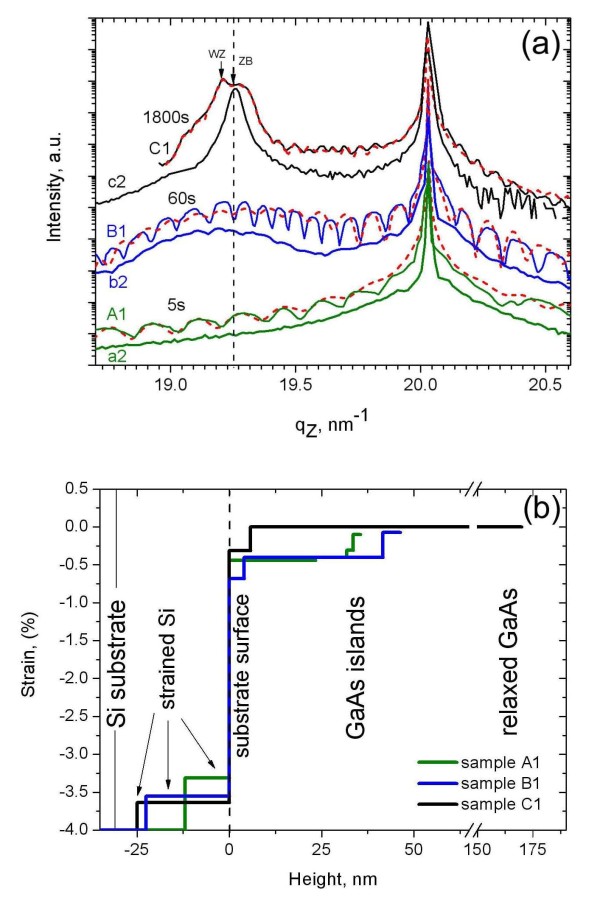
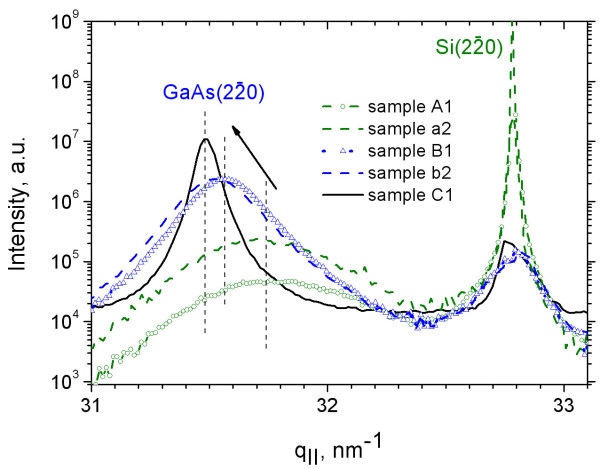
Using out-of-plane and in-plane X-ray diffraction techniques, we have investigated the structure at the interface between GaAs nanowires [NWs] grown by Au-assisted molecular beam epitaxy and the underlying Si(111) substrate. Comparing the diffraction pattern measured at samples grown for 5, 60, and 1,800 s, we find a plastic strain release of about 75% close to the NW-to-substrate interface even at the initial state of growth, probably caused by the formation of a dislocation network at the Si-to-GaAs interface. In detail, we deduce that during the initial stage, zinc-blende structure GaAs islands grow with a gradually increasing lattice parameter over a transition region of several 10 nm in the growth direction. In contrast, accommodation of the in-plane lattice parameter takes place within a thickness of about 10 nm. As a consequence, the ratio between out-of-plane and in-plane lattice parameters is smaller than the unity in the initial state of growth. Finally the wurtzite-type NWs grow on top of the islands and are free of strain.
利用面外和面内X射线衍射技术,我们研究了通过金辅助分子束外延生长的砷化镓纳米线(NWs)与下层硅(111)衬底之间界面处的结构。通过比较在生长5秒、60秒和1800秒的样品上测得的衍射图案,我们发现即使在生长的初始状态,靠近纳米线与衬底界面处也有大约75%的塑性应变释放,这可能是由于在硅与砷化镓界面处形成了位错网络所致。具体而言,我们推断在初始阶段,闪锌矿结构的砷化镓岛在生长方向上几个10纳米的过渡区域内,随着晶格参数逐渐增加而生长。相比之下,面内晶格参数的调整发生在大约10纳米的厚度范围内。因此,在生长的初始状态,面外和面内晶格参数的比值小于1。最后,纤锌矿型纳米线生长在这些岛的顶部且无应变。