Laboratory of Host Defenses, Graduate School of Medical Science and Engineering, Korea Advanced Institute of Science and Technology, Daejeon, Korea.
Yonsei Med J. 2012 Mar;53(2):241-7. doi: 10.3349/ymj.2012.53.2.241.
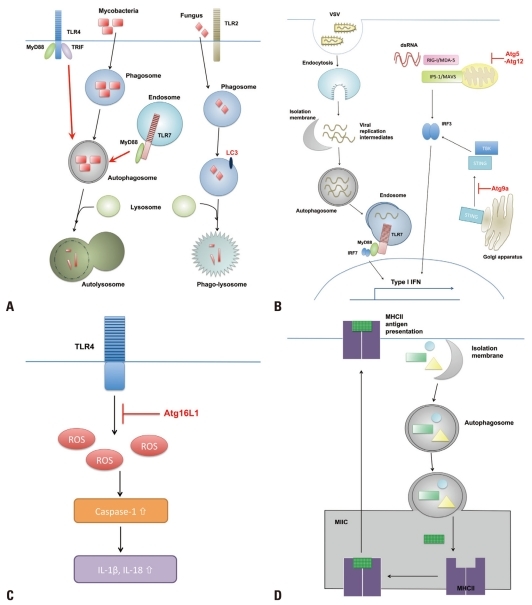
Autophagy is a specialized cellular pathway involved in maintaining homeostasis by degrading long-lived cellular proteins and organelles. Recent studies have demonstrated that autophagy is utilized by immune systems to protect host cells from invading pathogens and regulate uncontrolled immune responses. During pathogen recognition, induction of autophagy by pattern recognition receptors leads to the promotion or inhibition of consequent signaling pathways. Furthermore, autophagy plays a role in the delivery of pathogen signatures in order to promote the recognition thereof by pattern recognition receptors. In addition to innate recognition, autophagy has been shown to facilitate MHC class II presentation of intracellular antigens to activate CD4 T cells. In this review, we describe the roles of autophagy in innate recognition of pathogens and adaptive immunity, such as antigen presentation, as well as the clinical relevance of autophagy in the treatment of human diseases.
自噬是一种专门的细胞途径,通过降解寿命长的细胞蛋白质和细胞器来维持细胞内的平衡。最近的研究表明,自噬被免疫系统用来保护宿主细胞免受入侵病原体的侵害,并调节不受控制的免疫反应。在病原体识别过程中,模式识别受体诱导的自噬会促进或抑制随后的信号通路。此外,自噬在递呈病原体特征方面发挥作用,以促进模式识别受体对其的识别。除了先天识别之外,自噬还被证明有助于 MHC Ⅱ类分子呈递细胞内抗原以激活 CD4 T 细胞。在这篇综述中,我们描述了自噬在病原体的先天识别和适应性免疫中的作用,如抗原呈递,以及自噬在人类疾病治疗中的临床相关性。