Cai Dongsheng, Liu Tiewen
Department of Molecular Pharmacology and Diabetes Research Center, Albert Einstein College of Medicine, Bronx, NY 10461, USA.
Aging (Albany NY). 2012 Feb;4(2):98-115. doi: 10.18632/aging.100431.
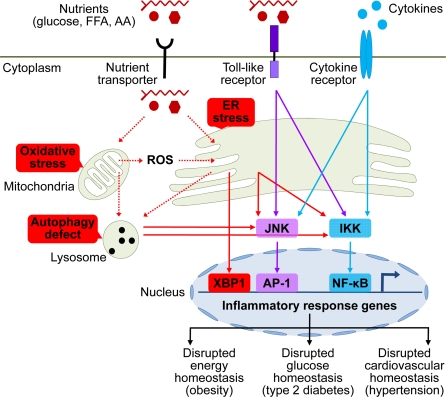
Metabolic syndrome, a network of medical disorders that greatly increase the risk for developing metabolic and cardiovascular diseases, has reached epidemic levels in many areas of today's world. Despite this alarming medicare situation, scientific understandings on the root mechanisms of metabolic syndrome are still limited, and such insufficient knowledge contributes to the relative lack of effective treatments or preventions for related diseases. Recent interdisciplinary studies from neuroendocrinology and neuroimmunology fields have revealed that overnutrition can trigger intracellular stresses to cause inflammatory changes mediated by molecules that control innate immunity. This type of nutrition-related molecular inflammation in the central nervous system, particularly in the hypothalamus, can form a common pathogenic basis for the induction of various metabolic syndrome components such as obesity, insulin resistance, and hypertension. Proinflammatory NF-κB pathway has been revealed as a key molecular system for pathologic induction of brain inflammation, which translates overnutrition and resulting intracellular stresses into central neuroendocrine and neural dysregulations of energy, glucose, and cardiovascular homeostasis, collectively leading to metabolic syndrome. This article reviews recent research advances in the neural mechanisms of metabolic syndrome and related diseases from the perspective of pathogenic induction by intracellular stresses and NF-κB pathway of the brain.
代谢综合征是一组医学病症,会大幅增加患代谢性疾病和心血管疾病的风险,在当今世界许多地区已达到流行程度。尽管这种医保状况令人担忧,但对代谢综合征根本机制的科学认识仍然有限,而这种知识不足导致了相关疾病的有效治疗或预防手段相对匮乏。神经内分泌学和神经免疫学领域最近的跨学科研究表明,营养过剩会引发细胞内应激,导致由控制先天免疫的分子介导的炎症变化。这种在中枢神经系统,尤其是下丘脑发生的与营养相关的分子炎症,可能构成诱发肥胖、胰岛素抵抗和高血压等各种代谢综合征成分的共同致病基础。促炎的核因子κB(NF-κB)信号通路已被揭示为病理性诱导脑部炎症的关键分子系统,它将营养过剩及由此产生的细胞内应激转化为能量、葡萄糖和心血管稳态的中枢神经内分泌和神经调节紊乱,共同导致代谢综合征。本文从细胞内应激和大脑NF-κB信号通路致病诱导的角度,综述了代谢综合征及相关疾病神经机制的最新研究进展。