• 文献检索
  • 文档翻译
  • 深度研究
  • 学术资讯
  • Suppr Zotero 插件Zotero 插件
  • 邀请有礼
  • 套餐&价格
  • 历史记录
应用&插件
Suppr Zotero 插件Zotero 插件浏览器插件Mac 客户端Windows 客户端微信小程序
定价
高级版会员购买积分包购买API积分包
服务
文献检索文档翻译深度研究API 文档MCP 服务
关于我们
关于 Suppr公司介绍联系我们用户协议隐私条款
关注我们

Suppr 超能文献

核心技术专利:CN118964589B侵权必究
粤ICP备2023148730 号-1Suppr @ 2026

文献检索

告别复杂PubMed语法,用中文像聊天一样搜索,搜遍4000万医学文献。AI智能推荐,让科研检索更轻松。

立即免费搜索

文件翻译

保留排版,准确专业,支持PDF/Word/PPT等文件格式,支持 12+语言互译。

免费翻译文档

深度研究

AI帮你快速写综述,25分钟生成高质量综述,智能提取关键信息,辅助科研写作。

立即免费体验

使用认知、意愿和采用差距对电子健康服务中的数字鸿沟进行矩阵分析。

Matrix analysis of the digital divide in eHealth services using awareness, want, and adoption gap.

作者信息

Liang Te-Hsin

机构信息

Department of Statistics and Information Sciences, College of Management, Fu Jen Catholic University, New Taipei County, Taiwan.

出版信息

J Med Internet Res. 2012 Feb 13;14(1):e11. doi: 10.2196/jmir.1670.

DOI:10.2196/jmir.1670
PMID:22329958
原文链接:https://pmc.ncbi.nlm.nih.gov/articles/PMC3374548/
Abstract

BACKGROUND

The digital divide usually refers to access or usage, but some studies have identified two other divides: awareness and demand (want). Given that the hierarchical stages of the innovation adoption process of a customer are interrelated, it is necessary and meaningful to analyze the digital divide in eHealth services through three main stages, namely, awareness, want, and adoption.

OBJECTIVE

By following the three main integrated stages of the innovation diffusion theory, from the customer segment viewpoint, this study aimed to propose a new matrix analysis of the digital divide using the awareness, want, and adoption gap ratio (AWAG). I compared the digital divide among different groups. Furthermore, I conducted an empirical study on eHealth services to present the practicability of the proposed methodology.

METHODS

Through a review and discussion of the literature, I proposed hypotheses and a new matrix analysis. To test the proposed method, 3074 Taiwanese respondents, aged 15 years and older, were surveyed by telephone. I used the stratified simple random sampling method, with sample size allocation proportioned by the population distribution of 23 cities and counties (strata).

RESULTS

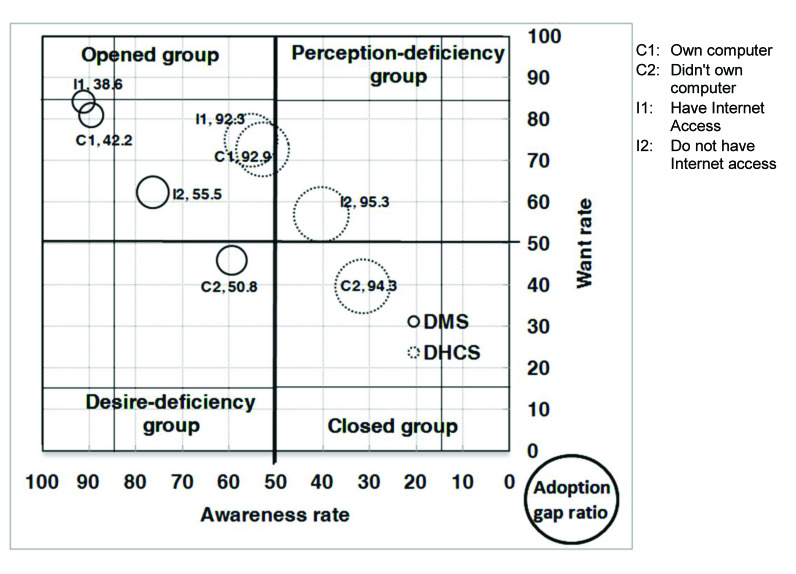
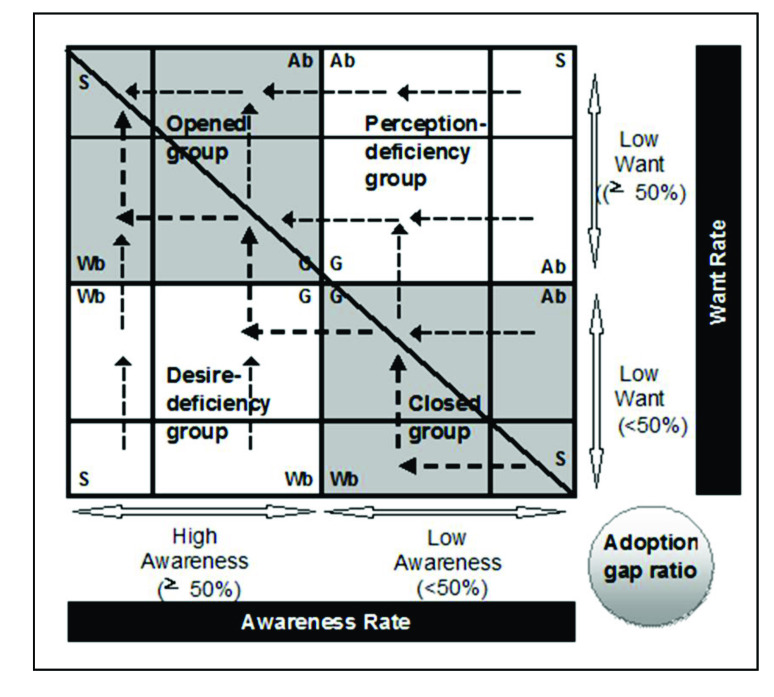
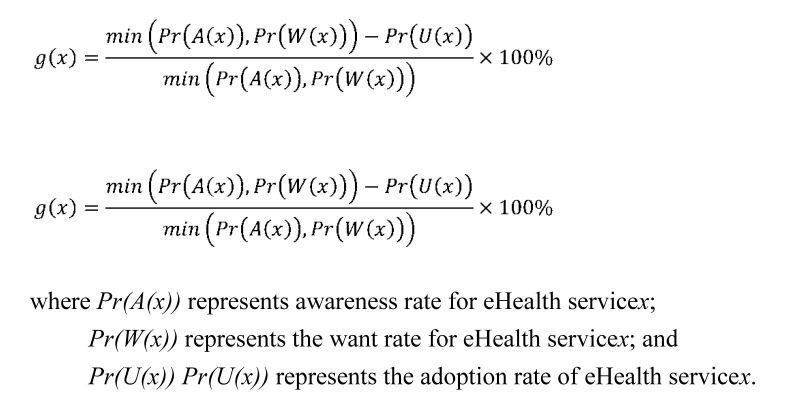
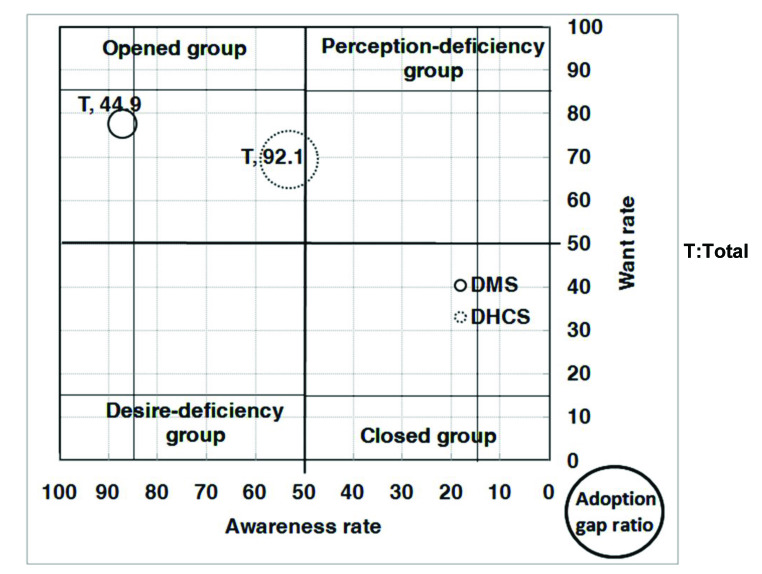
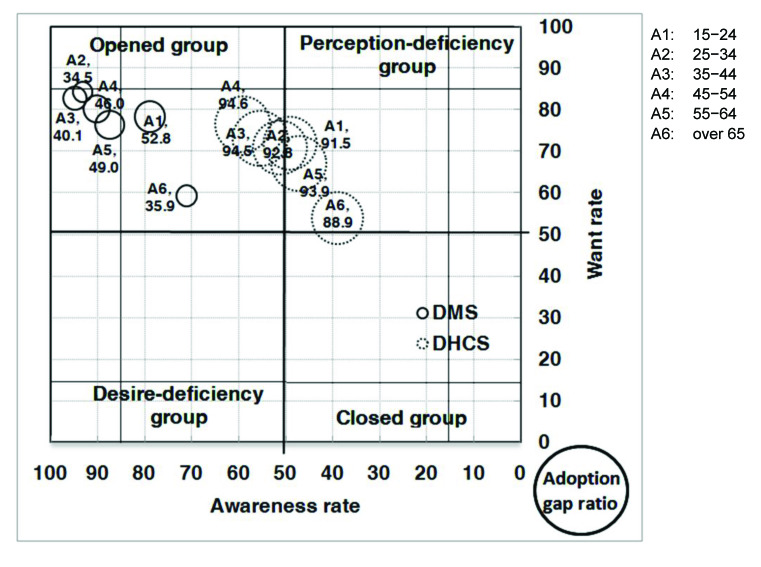
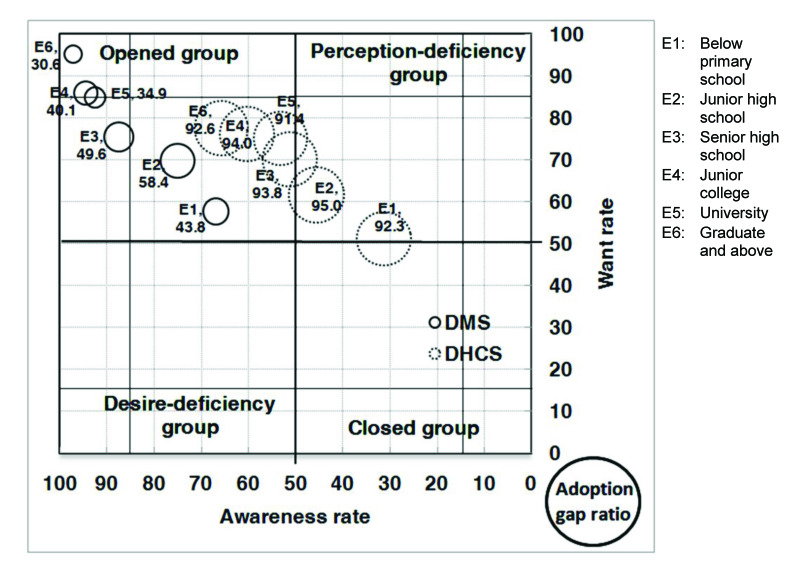
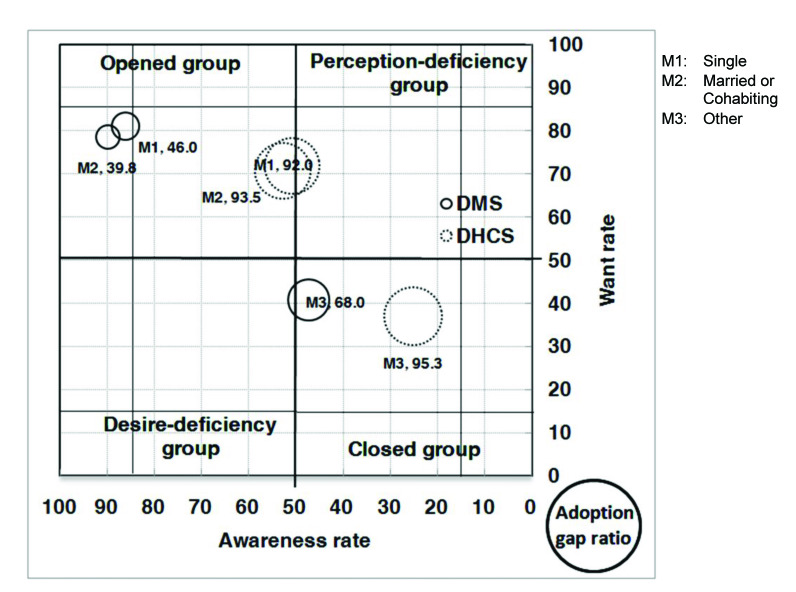
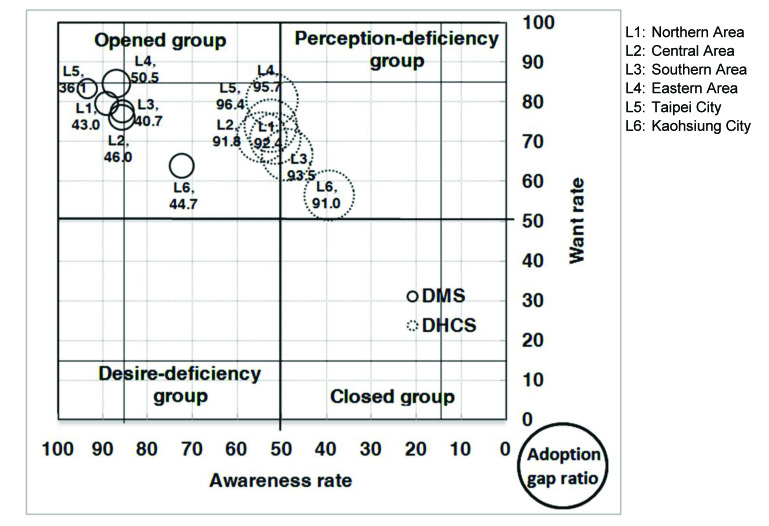
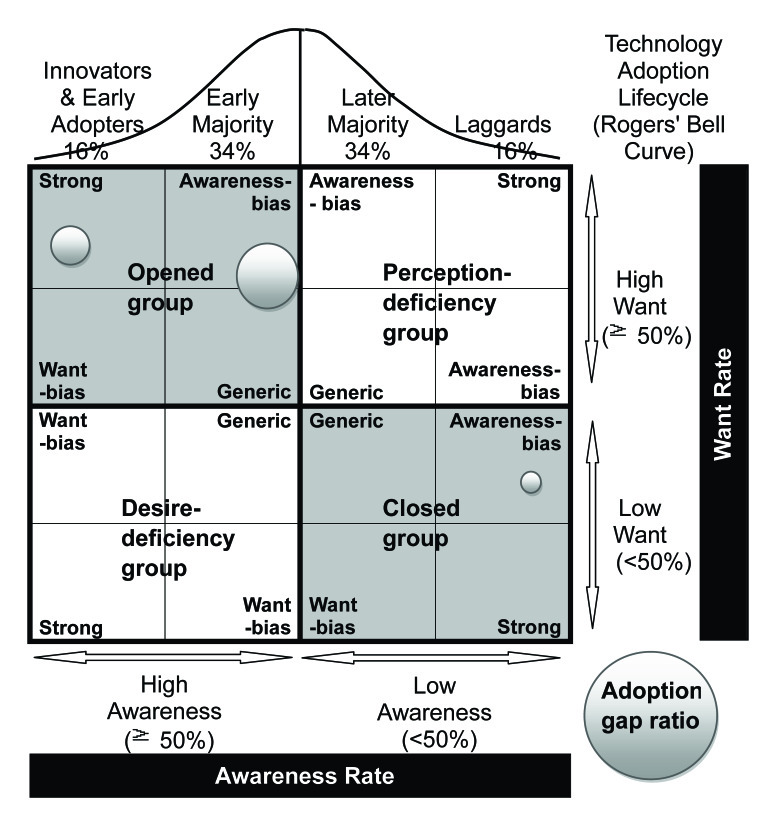
This study proposed the AWAG segment matrix to analyze the digital divide in eHealth services. First, awareness and want rates were divided into two levels at the middle point of 50%, and then the 2-dimensional cross of the awareness and want segment matrix was divided into four categories: opened group, desire-deficiency group, perception-deficiency group, and closed group. Second, according to the degrees of awareness and want, each category was further divided into four subcategories. I also defined four possible strategies, namely, hold, improve, evaluate, and leave, for different regions in the proposed matrix. An empirical test on two recently promoted eHealth services, the digital medical service (DMS) and the digital home care service (DHCS), was conducted. Results showed that for both eHealth services, the digital divides of awareness, want, and adoption existed across demographic variables, as well as between computer owners and nonowners, and between Internet users and nonusers. With respect to the analysis of the AWAG segment matrix for DMS, most of the segments, except for people with marriage status of Other or without computers, were positioned in the opened group. With respect to DHCS, segments were separately positioned in the opened, perception-deficiency, and closed groups.

CONCLUSIONS

Adoption does not closely follow people's awareness or want, and a huge digital divide in adoption exists in DHS and DHCS. Thus, a strategy to promote adoption should be used for most demographic segments.
摘要
https://cdn.ncbi.nlm.nih.gov/pmc/blobs/4291/3374548/8d56257b43e6/jmir_v14i1e11_fig11.jpg
https://cdn.ncbi.nlm.nih.gov/pmc/blobs/4291/3374548/9e5c6ee68925/jmir_v14i1e11_fig1.jpg
https://cdn.ncbi.nlm.nih.gov/pmc/blobs/4291/3374548/75f4dda829a7/jmir_v14i1e11_fig2.jpg
https://cdn.ncbi.nlm.nih.gov/pmc/blobs/4291/3374548/34974865bfaf/jmir_v14i1e11_fig3.jpg
https://cdn.ncbi.nlm.nih.gov/pmc/blobs/4291/3374548/e2e5ad01812f/jmir_v14i1e11_fig4.jpg
https://cdn.ncbi.nlm.nih.gov/pmc/blobs/4291/3374548/57c4d96f522b/jmir_v14i1e11_fig5.jpg
https://cdn.ncbi.nlm.nih.gov/pmc/blobs/4291/3374548/d77370e88d36/jmir_v14i1e11_fig6.jpg
https://cdn.ncbi.nlm.nih.gov/pmc/blobs/4291/3374548/3c4740616001/jmir_v14i1e11_fig7.jpg
https://cdn.ncbi.nlm.nih.gov/pmc/blobs/4291/3374548/b0cddabc9a4d/jmir_v14i1e11_fig8.jpg
https://cdn.ncbi.nlm.nih.gov/pmc/blobs/4291/3374548/8fa4e117fc0e/jmir_v14i1e11_fig9.jpg
https://cdn.ncbi.nlm.nih.gov/pmc/blobs/4291/3374548/e62ce10e84c0/jmir_v14i1e11_fig10.jpg
https://cdn.ncbi.nlm.nih.gov/pmc/blobs/4291/3374548/8d56257b43e6/jmir_v14i1e11_fig11.jpg
https://cdn.ncbi.nlm.nih.gov/pmc/blobs/4291/3374548/9e5c6ee68925/jmir_v14i1e11_fig1.jpg
https://cdn.ncbi.nlm.nih.gov/pmc/blobs/4291/3374548/75f4dda829a7/jmir_v14i1e11_fig2.jpg
https://cdn.ncbi.nlm.nih.gov/pmc/blobs/4291/3374548/34974865bfaf/jmir_v14i1e11_fig3.jpg
https://cdn.ncbi.nlm.nih.gov/pmc/blobs/4291/3374548/e2e5ad01812f/jmir_v14i1e11_fig4.jpg
https://cdn.ncbi.nlm.nih.gov/pmc/blobs/4291/3374548/57c4d96f522b/jmir_v14i1e11_fig5.jpg
https://cdn.ncbi.nlm.nih.gov/pmc/blobs/4291/3374548/d77370e88d36/jmir_v14i1e11_fig6.jpg
https://cdn.ncbi.nlm.nih.gov/pmc/blobs/4291/3374548/3c4740616001/jmir_v14i1e11_fig7.jpg
https://cdn.ncbi.nlm.nih.gov/pmc/blobs/4291/3374548/b0cddabc9a4d/jmir_v14i1e11_fig8.jpg
https://cdn.ncbi.nlm.nih.gov/pmc/blobs/4291/3374548/8fa4e117fc0e/jmir_v14i1e11_fig9.jpg
https://cdn.ncbi.nlm.nih.gov/pmc/blobs/4291/3374548/e62ce10e84c0/jmir_v14i1e11_fig10.jpg
https://cdn.ncbi.nlm.nih.gov/pmc/blobs/4291/3374548/8d56257b43e6/jmir_v14i1e11_fig11.jpg

背景

数字鸿沟通常指的是接入或使用情况,但一些研究还发现了另外两种鸿沟:认知和需求(意愿)。鉴于客户创新采用过程的各个层次阶段相互关联,通过认知、意愿和采用这三个主要阶段来分析电子健康服务中的数字鸿沟是必要且有意义的。

目的

本研究从客户群体的角度出发,遵循创新扩散理论的三个主要综合阶段,旨在提出一种使用认知、意愿和采用差距比(AWAG)对数字鸿沟进行新的矩阵分析方法。我比较了不同群体之间的数字鸿沟。此外,我对电子健康服务进行了实证研究,以展示所提出方法的实用性。

方法

通过对文献的回顾和讨论,我提出了假设和一种新的矩阵分析方法。为了检验所提出的方法,通过电话对3074名15岁及以上的台湾受访者进行了调查。我采用分层简单随机抽样方法,样本量根据23个市县(层)的人口分布进行分配。

结果

本研究提出了AWAG群体矩阵来分析电子健康服务中的数字鸿沟。首先,将认知率和意愿率在50%的中点处分为两个水平,然后将认知和意愿群体矩阵的二维交叉分为四类:开放组、意愿不足组、认知不足组和封闭组。其次,根据认知和意愿的程度,每个类别进一步细分为四个子类别。我还为所提出矩阵中的不同区域定义了四种可能的策略,即保持、改进、评估和放弃。对最近推广的两项电子健康服务,即数字医疗服务(DMS)和数字家庭护理服务(DHCS)进行了实证检验。结果表明,对于这两项电子健康服务,在人口统计学变量之间,以及在有电脑者和无电脑者之间、互联网用户和非用户之间,都存在认知、意愿和采用方面的数字鸿沟。关于DMS的AWAG群体矩阵分析,除婚姻状况为“其他”或没有电脑的人群外,大多数群体都处于开放组。关于DHCS,各群体分别处于开放组、认知不足组和封闭组。

结论

采用情况并不紧密跟随人们的认知或意愿,在数字医疗服务和数字家庭护理服务中存在巨大的采用方面的数字鸿沟。因此,对于大多数人口群体应采用促进采用的策略。

相似文献

1
Matrix analysis of the digital divide in eHealth services using awareness, want, and adoption gap.使用认知、意愿和采用差距对电子健康服务中的数字鸿沟进行矩阵分析。
J Med Internet Res. 2012 Feb 13;14(1):e11. doi: 10.2196/jmir.1670.
2
The awareness and want matrix with adoption gap ratio analysis for e-service diffusion effect.电子服务扩散效果的意识与需求矩阵及采用差距比分析。
Cyberpsychol Behav Soc Netw. 2011 Mar;14(3):131-40. doi: 10.1089/cyber.2009.0349. Epub 2010 Nov 30.
3
eHealth literacy: extending the digital divide to the realm of health information.电子健康素养:将数字鸿沟扩展至健康信息领域。
J Med Internet Res. 2012 Jan 27;14(1):e19. doi: 10.2196/jmir.1619.
4
Why does the NHS struggle to adopt eHealth innovations? A review of macro, meso and micro factors.英国国家医疗服务体系为何难以采用电子健康创新?宏观、中观和微观因素的回顾。
BMC Health Serv Res. 2019 Dec 21;19(1):984. doi: 10.1186/s12913-019-4790-x.
5
Electronic Health Use in the European Union and the Effect of Multimorbidity: Cross-Sectional Survey.欧盟电子健康的使用及多重疾病的影响:横断面调查
J Med Internet Res. 2018 May 3;20(5):e165. doi: 10.2196/jmir.7299.
6
Refined Analysis of Older eHealth Users From an Agency Perspective: Quantitative Telephone Interview Study.从机构视角对老年电子健康用户的精细化分析:定量电话访谈研究
JMIR Aging. 2023 Apr 26;6:e40004. doi: 10.2196/40004.
7
Characterizing the Digital Health Citizen: Mixed-Methods Study Deriving a New Typology.刻画数字健康公民:一项衍生新类型学的混合方法研究
J Med Internet Res. 2019 Mar 5;21(3):e11279. doi: 10.2196/11279.
8
A Profile of eHealth Behaviors in China: Results From a National Survey Show a Low of Usage and Significant Digital Divide.中国电子健康行为概况:一项全国性调查结果显示使用率较低且存在显著数字鸿沟。
Front Public Health. 2018 Sep 26;6:274. doi: 10.3389/fpubh.2018.00274. eCollection 2018.
9
Offerings and User Demands of eHealth Services in Spain: National Survey.西班牙电子健康服务的提供与用户需求:全国性调查。
J Med Internet Res. 2023 May 18;25:e42304. doi: 10.2196/42304.
10
Consumer Adoption of Future MyData-Based Preventive eHealth Services: An Acceptance Model and Survey Study.消费者对未来基于个人数据的预防性电子健康服务的采用:一种接受模型及调查研究。
J Med Internet Res. 2017 Dec 22;19(12):e429. doi: 10.2196/jmir.7821.

引用本文的文献

1
Multiple Perspectives on the Adoption of SMART Technologies for Improving Care of Older People: Mixed Methods Study.采用 SMART 技术改善老年人护理的多重视角:混合方法研究。
J Med Internet Res. 2024 Feb 7;26:e45492. doi: 10.2196/45492.
2
Adoption Processes of Innovations in Health Systems: The Example of Telemedicine in Germany.卫生系统创新的采用过程:以德国的远程医疗为例。
Healthcare (Basel). 2024 Jan 6;12(2):129. doi: 10.3390/healthcare12020129.
3
A Technology Acceptance Model for Deploying Masks to Combat the COVID-19 Pandemic in Taiwan (My Health Bank): Web-Based Cross-sectional Survey Study.

本文引用的文献

1
Cultural differences in use of an electronic discussion group.文化差异对电子讨论组使用的影响。
J Health Psychol. 2003 Jan;8(1):105-17. doi: 10.1177/1359105303008001447.
2
The awareness and want matrix with adoption gap ratio analysis for e-service diffusion effect.电子服务扩散效果的意识与需求矩阵及采用差距比分析。
Cyberpsychol Behav Soc Netw. 2011 Mar;14(3):131-40. doi: 10.1089/cyber.2009.0349. Epub 2010 Nov 30.
3
Digital divide: variation in internet and cellular phone use among women attending an urban sexually transmitted infections clinic.
用于在台湾(我的健康银行)部署口罩以对抗 COVID-19 大流行的技术接受模型:基于网络的横断面调查研究。
J Med Internet Res. 2021 Apr 21;23(4):e27069. doi: 10.2196/27069.
4
Gender and the Digital Divide Across Urban Slums of New Delhi, India: Cross-Sectional Study.性别与印度新德里城市贫民窟的数字鸿沟:横断面研究
J Med Internet Res. 2020 Jun 22;22(6):e14714. doi: 10.2196/14714.
5
A Mobile Patient-Reported Outcome Measure App With Talking Touchscreen: Usability Assessment.一款带有语音触摸屏的移动患者报告结局测量应用程序:可用性评估。
JMIR Form Res. 2019 Sep 27;3(3):e11617. doi: 10.2196/11617.
6
Importance-Performance Analysis of Personal Health Records in Taiwan: A Web-Based Survey.台湾个人健康记录的重要性-绩效分析:一项基于网络的调查。
J Med Internet Res. 2017 Apr 27;19(4):e131. doi: 10.2196/jmir.7065.
7
Smartphones and health promotion: a review of the evidence.智能手机与健康促进:证据综述
J Med Syst. 2014 Jan;38(1):9995. doi: 10.1007/s10916-013-9995-7. Epub 2013 Nov 16.
数字鸿沟:城市性传播感染诊所就诊女性在互联网和手机使用方面的差异。
J Urban Health. 2010 Jan;87(1):122-8. doi: 10.1007/s11524-009-9415-y.
4
The technology acceptance model: its past and its future in health care.技术接受模型:在医疗保健领域的过去和未来。
J Biomed Inform. 2010 Feb;43(1):159-72. doi: 10.1016/j.jbi.2009.07.002. Epub 2009 Jul 15.
5
Use of computers and the Internet for health information by patients with epilepsy.癫痫患者使用计算机和互联网获取健康信息的情况。
Epilepsy Behav. 2008 Jan;12(1):109-14. doi: 10.1016/j.yebeh.2007.07.013. Epub 2007 Oct 23.
6
Factors predictive for incidence and remission of internet addiction in young adolescents: a prospective study.青少年网络成瘾发生率及缓解的预测因素:一项前瞻性研究。
Cyberpsychol Behav. 2007 Aug;10(4):545-51. doi: 10.1089/cpb.2007.9992.
7
The role of e-Health in the changng health care environment.电子健康在不断变化的医疗保健环境中的作用。
Nurs Econ. 2006 Nov-Dec;24(6):283-8, 279; quiz 289.
8
Perceptions and behaviour of access of the Internet: a study of women attending a breast screening service in Sydney, Australia.互联网使用认知与行为:对澳大利亚悉尼参加乳房筛查服务的女性的一项研究。
Int J Med Inform. 2008 Jan;77(1):24-32. doi: 10.1016/j.ijmedinf.2006.12.002. Epub 2007 Jan 9.
9
Early experiences with e-health services (1999-2002): promise, reality, and implications.电子健康服务的早期经历(1999 - 2002年):前景、现实与启示
Med Care. 2006 May;44(5):491-6. doi: 10.1097/01.mlr.0000207917.28988.dd.
10
Models of telepsychiatric consultation--liaison service to rural primary care.远程精神科会诊模式——为农村基层医疗提供联络服务。
Psychosomatics. 2006 Mar-Apr;47(2):152-7. doi: 10.1176/appi.psy.47.2.152.