Koivumäki Timo, Pekkarinen Saara, Lappi Minna, Väisänen Jere, Juntunen Jouni, Pikkarainen Minna
Martti Ahtisaari Institute, Oulu Business School, University of Oulu, Oulu, Finland.
VTT Technical Research Centre of Finland, Oulu, Finland.
J Med Internet Res. 2017 Dec 22;19(12):e429. doi: 10.2196/jmir.7821.
Constantly increasing health care costs have led countries and health care providers to the point where health care systems must be reinvented. Consequently, electronic health (eHealth) has recently received a great deal of attention in social sciences in the domain of Internet studies. However, only a fraction of these studies focuses on the acceptability of eHealth, making consumers' subjective evaluation an understudied field. This study will address this gap by focusing on the acceptance of MyData-based preventive eHealth services from the consumer point of view. We are adopting the term "MyData", which according to a White Paper of the Finnish Ministry of Transport and Communication refers to "1) a new approach, a paradigm shift in personal data management and processing that seeks to transform the current organization centric system to a human centric system, 2) to personal data as a resource that the individual can access and control."
The aim of this study was to investigate what factors influence consumers' intentions to use a MyData-based preventive eHealth service before use.
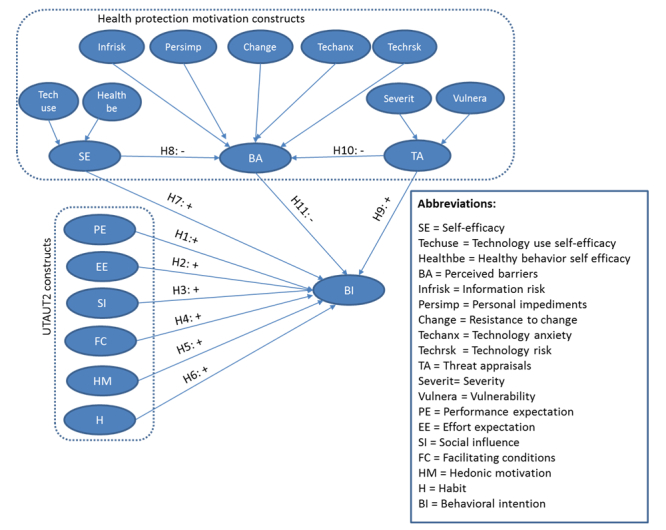
We applied a new adoption model combining Venkatesh's unified theory of acceptance and use of technology 2 (UTAUT2) in a consumer context and three constructs from health behavior theories, namely threat appraisals, self-efficacy, and perceived barriers. To test the research model, we applied structural equation modeling (SEM) with Mplus software, version 7.4. A Web-based survey was administered. We collected 855 responses.
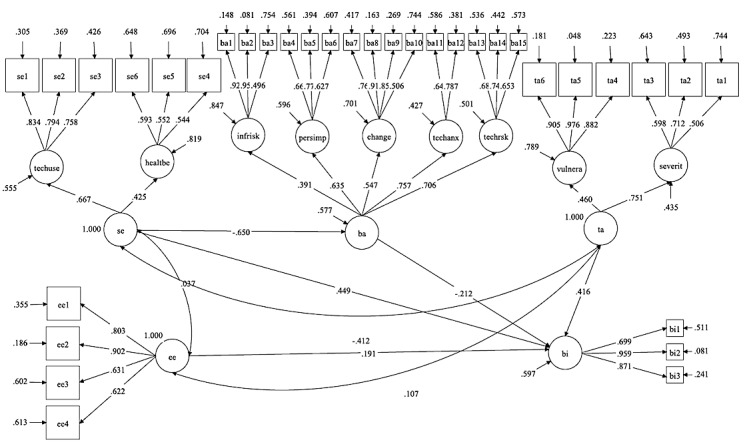
We first applied traditional SEM for the research model, which was not statistically significant. We then tested for possible heterogeneity in the data by running a mixture analysis. We found that heterogeneity was not the cause for the poor performance of the research model. Thus, we moved on to model-generating SEM and ended up with a statistically significant empirical model (root mean square error of approximation [RMSEA] 0.051, Tucker-Lewis index [TLI] 0.906, comparative fit index [CFI] 0.915, and standardized root mean square residual 0.062). According to our empirical model, the statistically significant drivers for behavioral intention were effort expectancy (beta=.191, P<.001), self-efficacy (beta=.449, P<.001), threat appraisals (beta=.416, P<.001), and perceived barriers (beta=-.212, P=.009).
Our research highlighted the importance of health-related factors when it comes to eHealth technology adoption in the consumer context. Emphasis should especially be placed on efforts to increase consumers' self-efficacy in eHealth technology use and in supporting healthy behavior.
不断上涨的医疗保健成本已使各国和医疗保健服务提供者面临必须对医疗保健系统进行重塑的局面。因此,电子健康(eHealth)最近在互联网研究领域的社会科学中受到了广泛关注。然而,这些研究中只有一小部分关注电子健康的可接受性,使得消费者的主观评价成为一个研究不足的领域。本研究将从消费者角度关注基于个人数据(MyData)的预防性电子健康服务的接受情况,以填补这一空白。我们采用“个人数据”这一术语,根据芬兰交通与通信部的一份白皮书,它指的是“1)一种新方法,个人数据管理和处理的范式转变,旨在将当前以组织为中心的系统转变为以用户为中心的系统;2)个人数据作为个人可以访问和控制的一种资源”。
本研究的目的是调查在使用之前,哪些因素会影响消费者使用基于个人数据的预防性电子健康服务的意愿。
我们应用了一种新的采用模型,该模型将Venkatesh的技术接受与使用统一理论2(UTAUT2)应用于消费者情境,并结合了健康行为理论中的三个构念,即威胁评估、自我效能感和感知障碍。为了检验研究模型,我们使用Mplus软件7.4版进行结构方程建模(SEM)。进行了一项基于网络的调查。我们收集了855份回复。
我们首先对研究模型应用传统的SEM,结果无统计学意义。然后我们通过进行混合分析来测试数据中可能存在的异质性。我们发现异质性不是研究模型表现不佳的原因。因此,我们转向生成模型的SEM,最终得到了一个具有统计学意义的实证模型(近似均方根误差[RMSEA]为0.051,塔克 - 刘易斯指数[TLI]为0.906,比较拟合指数[CFI]为0.915,标准化均方根残差为0.062)。根据我们的实证模型,对行为意愿具有统计学意义的驱动因素是努力期望(β = 0.191,P < 0.001)、自我效能感(β = 0.449,P < 0.001)、威胁评估(β = 0.416,P < 0.001)和感知障碍(β = -0.212,P = 0.009)。
我们的研究强调了在消费者情境中采用电子健康技术时与健康相关因素的重要性。尤其应着重努力提高消费者在使用电子健康技术方面的自我效能感,并支持健康行为。