State Key Laboratory of Food Science and Technology, Jiangnan University, Wuxi 214122, China.
Microb Cell Fact. 2012 Feb 15;11:24. doi: 10.1186/1475-2859-11-24.
Fumaric acid is a commercially important component of foodstuffs, pharmaceuticals and industrial materials, yet the current methods of production are unsustainable and ecologically destructive.
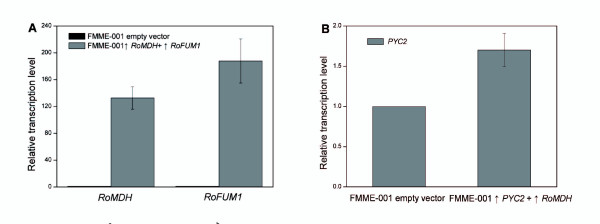
In this study, the fumarate biosynthetic pathway involving reductive reactions of the tricarboxylic acid cycle was exogenously introduced in S. cerevisiae by a series of simple genetic modifications. First, the Rhizopus oryzae genes for malate dehydrogenase (RoMDH) and fumarase (RoFUM1) were heterologously expressed. Then, expression of the endogenous pyruvate carboxylase (PYC2) was up-regulated. The resultant yeast strain, FMME-001 ↑PYC2 + ↑RoMDH, was capable of producing significantly higher yields of fumarate in the glucose medium (3.18 ± 0.15 g liter-1) than the control strain FMME-001 empty vector.
The results presented here provide a novel strategy for fumarate biosynthesis, which represents an important advancement in producing high yields of fumarate in a sustainable and ecologically-friendly manner.
富马酸是食品、药品和工业材料中一种重要的商业成分,但目前的生产方法是不可持续且具有生态破坏性的。
在这项研究中,通过一系列简单的遗传修饰,将涉及三羧酸循环还原反应的富马酸生物合成途径在酿酒酵母中进行了外源导入。首先,异源表达了米根霉的苹果酸脱氢酶(RoMDH)和延胡索酸酶(RoFUM1)基因。然后,上调了内源性丙酮酸羧化酶(PYC2)的表达。结果,酵母菌株 FMME-001↑PYC2↑RoMDH 在葡萄糖培养基中能够产生显著更高产量的富马酸(3.18±0.15 g/L),比对照菌株 FMME-001 空载体产量更高。
本研究提出了一种富马酸生物合成的新策略,为以可持续和环保的方式生产高富马酸产量提供了重要进展。